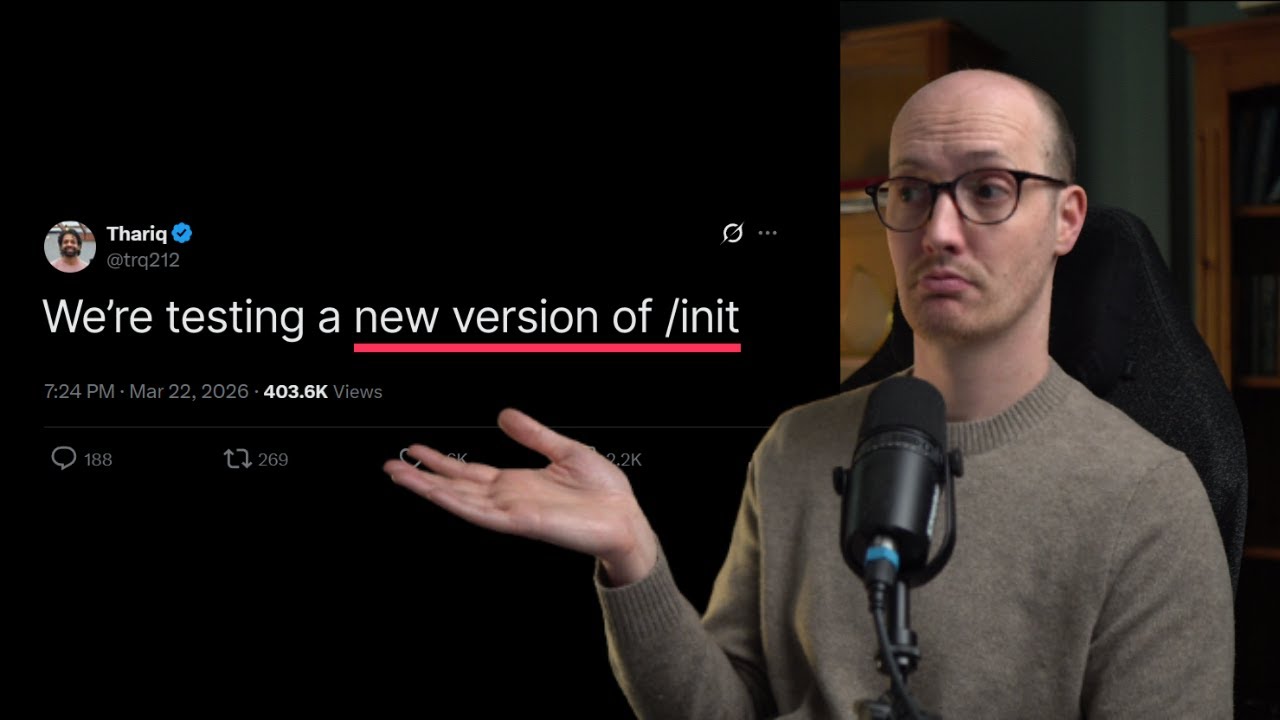
Three weeks ago, the creator made a video titled “Never Run Claude in It,” criticizing the generation of large, bloated claude.md files by Claude Code’s init command, which he felt were not very useful. Interestingly, another YouTuber had a similar idea around the same time. Shortly after, Tariq from the Claude Code team reached out, expressing interest in making the init command more useful and asking for suggestions. The creator recommended using progressive disclosure aggressively and keeping the claude.md file minimal, mainly containing environment information. Several community members also contributed ideas, and recently, a new version of the init command was released for testing, incorporating some of this feedback.
The creator tested the new init command in his React router-based course video manager repo. The init process starts by asking setup questions, such as which claude.md files to create and whether to include skills and hooks. The creator found the question about skills and hooks odd, preferring the tool to automatically explore the codebase and recommend relevant skills and hooks without user input. The exploration took nearly two minutes and concluded that skills and hooks were appropriate for the project, suggesting a format-on-edit hook to run prettier and a verify skill for type checking and tests. However, the creator felt the init command should not ask these questions but instead proactively suggest options.
During the review, the creator criticized the “ask user question” UI used by the init command, finding it clunky and difficult to interact with, especially when trying to add notes or understand proposals. After dismissing the UI, the tool generated a claude.md file and a skill file. The claude.md was minimal, mainly recommending the use of the “use-effect-reducer” library instead of React’s built-in useReducer hook. The creator questioned the value of this recommendation since the codebase already clearly uses use-effect-reducer, making it somewhat redundant. However, the tool justified this as cheap insurance to prevent mistakes when writing new reducer code, which the creator tentatively accepted.
The init command also suggested documenting testing patterns and npm install commands for effect packages. The creator argued that these patterns are discoverable through code exploration and that including them in claude.md could create unnecessary maintenance overhead. He preferred placing rare or complex instructions, like effect package installation, inside dedicated skills invoked only when needed, preserving the LLM’s instruction budget. Overall, the creator appreciated the minimalism of the new claude.md file compared to previous bloated versions but remained critical of some redundant or questionable inclusions.
In conclusion, the creator acknowledged that the new init command is an improvement over the previous version, which generated large claude.md files without user interaction. He liked the new skill file and the more minimal claude.md but urged the Claude Code team to make the init command more proactive, less sycophantic, and better at defending its recommendations. He invited viewers to try the new init script and share feedback, while also promoting his upcoming cohort course on Claude Code for engineers interested in advanced AI coding techniques. The video ends with thanks and encouragement for further improvements.