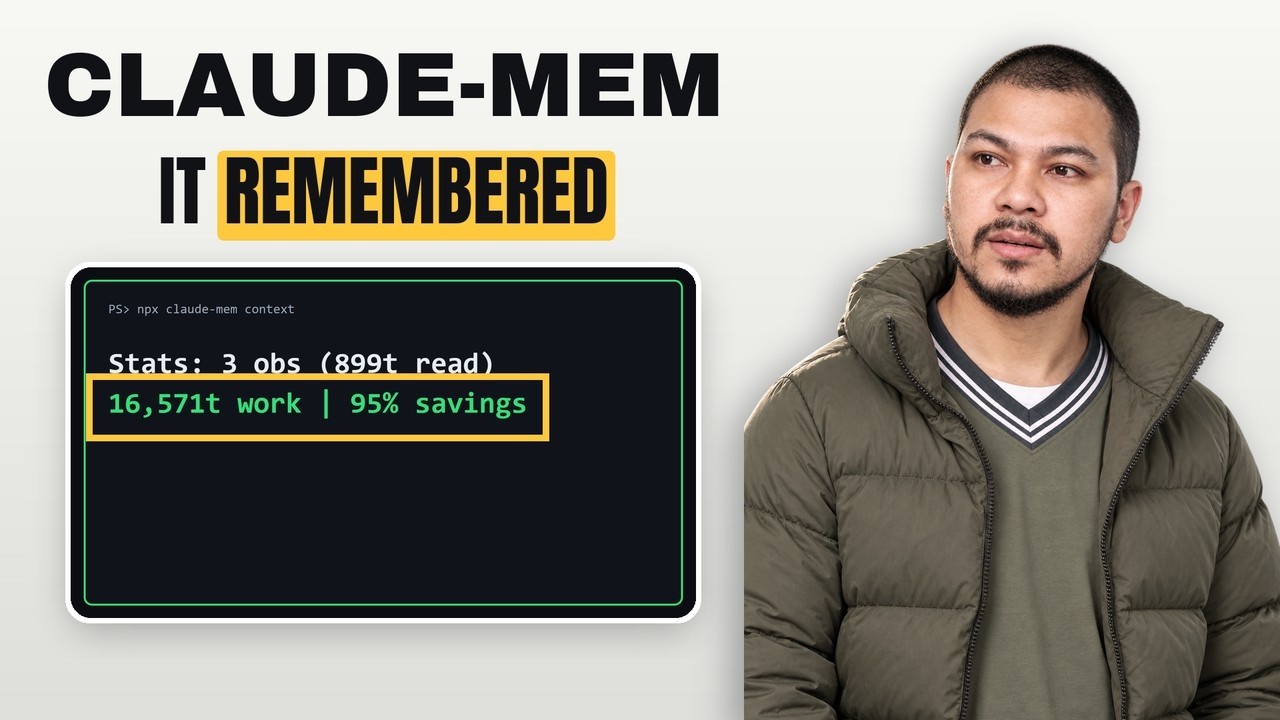
The video reviews Cloud Mem, a popular memory plugin for coding agents like Claude Code, boasting over 114,000 GitHub stars and rapid development with frequent releases. Cloud Mem aims to solve the problem of agents starting fresh each coding session by taking notes during work and providing a compact index of relevant observations to subsequent sessions. The architecture involves hooks, a worker, an observer, a database, and a context builder, all designed to capture and summarize session data efficiently. The plugin stores data locally in a SQLite database, with optional cloud sync, and runs entirely on CPU without requiring a GPU.
The installation process on Windows initially failed due to issues with the Bun runtime and the hook launcher not being on the system path. After troubleshooting by placing the real Bun executable first in the path and adding the launcher folder to the path, the plugin began recording observations properly. The reviewer also encountered an authentication error with the observer, which was resolved by restarting the worker to pick up the correct login credentials. These setup challenges highlight the importance of running the diagnostic “doctor” command and ensuring environment variables are correctly configured.
Once properly installed, the plugin successfully recorded session data, capturing key development steps such as adding a command-line interface and storing tasks in a JSON file. The observer generated concise, readable observation cards with timestamps and IDs, allowing easy auditing and deletion of incorrect notes. The plugin’s viewer interface provides both brief facts and detailed narratives for each observation, enabling users to quickly scan or deep dive into their coding history. This structured memory was then injected into a fresh session, allowing the agent to recall previous work accurately without re-reading files.
The memory system uses a three-step search workflow: a compact index for quick scanning, a timeline for context, and full observation retrieval only when necessary. This approach significantly reduces token usage compared to loading entire histories, making it efficient for ongoing projects. However, the reviewer noted that overlapping memory systems (native Claude Code memory and Cloud Mem) can cause some confusion, and some initial session data may be missed if hooks are not working from the start. The plugin supports multiple providers and agents, but the review focused on Claude Code with the cloud provider.
In conclusion, the reviewer found that Cloud Mem’s core promise works well: it records, summarizes, and injects memory across sessions, improving continuity in coding projects. Despite initial installation hurdles and some rough edges in error messaging, the plugin is valuable for developers who frequently return to the same codebase and want to avoid repeating explanations. It is less useful for one-off scripts where native memory might suffice. The reviewer plans to test it on larger projects and recommends others try it, especially those working on ongoing development, while noting the easy uninstall process if needed.
Useful Links