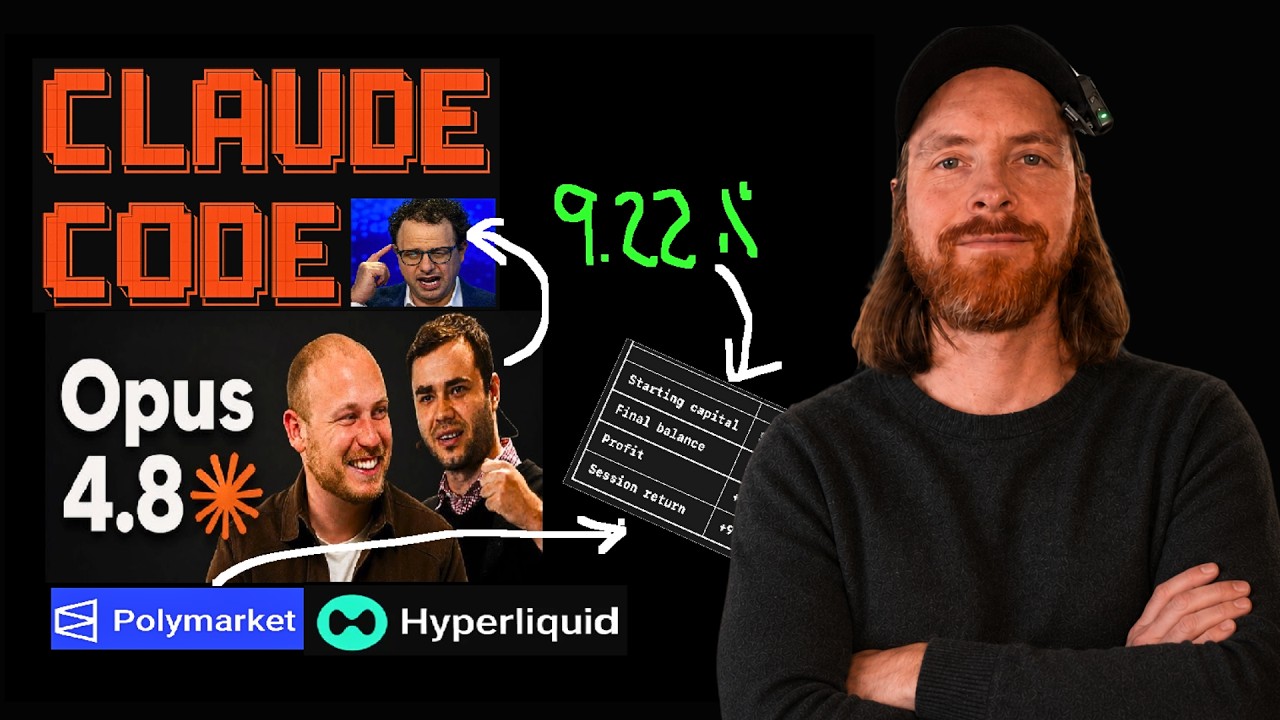
The presenter tests Anthropic’s Opus 4.8 AI model in agentic trading on Hyperliquid and Polymarket, finding that while it can develop profitable strategies, its performance and user experience are less reliable compared to Codex 5.5. The video emphasizes that this is a preliminary, non-scientific test and invites viewers to join a Discord community for further AI trading experimentation.
In this video, the presenter tests Anthropic’s newly released AI model, Opus 4.8, in agentic trading scenarios on two platforms: Hyperliquid and Polymarket. The goal is to compare its performance against previous models like Hyperliquid and Polymarket using consistent rules and prompts to maintain comparability. The test involves running the AI for one hour on each platform, trading 5-minute BTC contracts on Polymarket and various trades on Hyperliquid, with set investment amounts of $50 and $200 respectively. The presenter emphasizes that this is a quick, non-scientific snapshot test rather than a comprehensive evaluation.
The setup includes using Claude Code with Opus 4.8 at a high effort setting, and the AI is tasked with creating profitable trading strategies while actively managing trades through a heartbeat monitor that checks and adjusts positions every 60 seconds. The AI develops distinct strategies for each platform: on Hyperliquid, it focuses on a long position in the memory chip super cycle and silver, while on Polymarket, it aims to buy the favored side only after significant price movement from the window open. The presenter initiates the trades and monitors the progress through custom dashboards.
During the one-hour session, the Hyperliquid agent quickly enters a long position on MU, but the Polymarket agent takes longer to start due to waiting for the correct trading window. After the session, results show that Polymarket performed well with a profit of $9.22, whereas Hyperliquid ended with a loss of $5.60. The Hyperliquid losses were mainly due to poor trades on Samsung, despite some positive results on ARM. The presenter notes that the AI frequently stopped and restarted despite instructions to run continuously, which caused frustration.
The presenter concludes that while Opus 4.8 does work and understands the trading tasks, the user experience was less smooth compared to using Codex 5.5, which handled heartbeat monitoring and continuous operation more reliably. Although Opus 4.8 showed some promising trades and strategies, the presenter prefers Codex 5.5 for agentic trading due to its flexibility and stability. The video ends with a reminder that this test is just a market snapshot and not a definitive scientific evaluation, with plans to continue testing Opus 4.8 further.
Finally, the presenter invites viewers interested in AI automation and agentic trading to join their growing Discord community, where many are experimenting with similar AI trading setups. They also mention upcoming personal commitments but promise to return with more content soon. The video closes with well wishes for safe trading and a reminder to check the description for the Discord link.