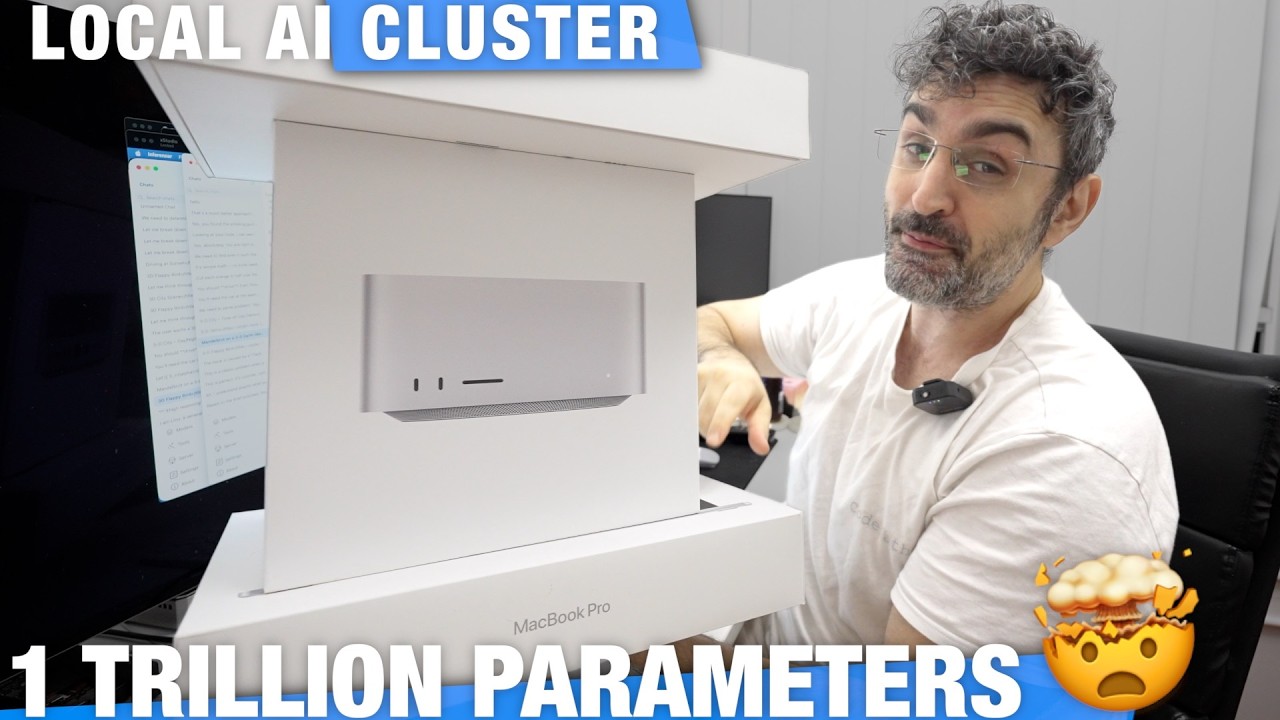
In this video, the host explores the capabilities of Ring 2.6, a one trillion parameter reasoning model developed by Ant Group, a fintech giant spun off from Alibaba. Ring 2.6 features an “extra high thinking” mode designed to enhance its reasoning abilities, reportedly outperforming models like Shhatzipped, Gemini, and Claude in benchmarks. The model is licensed under MIT, allowing commercial use and fine-tuning, but it is primarily focused on reasoning rather than coding. Due to its massive size—around a terabyte—the host runs it on a Mac Studio with quantization and also experiments with a distributed cluster setup combining multiple MacBooks to handle the computational demands.
The host tests Ring 2.6 on various tasks, including coding challenges like generating Flappy Birds games and 3D city scenes. While the model can produce runnable code, its coding quality is inconsistent and often results in runtime errors. Increasing the quantization bits or clustering multiple devices does not significantly improve the coding output. However, the model excels in reasoning tasks, successfully solving math Olympiad problems and logical questions with high accuracy. The “extra high thinking” mode enables extremely long reasoning chains, sometimes generating up to 70,000 tokens over nearly two hours, showcasing its deep reasoning potential despite occasional incomplete outputs.
To address the coding limitations, the host experiments with combining Ring’s reasoning strengths with the coding capabilities of Quen, another model from Alibaba. By feeding Ring’s reasoning output into Quen 3.6 and 27B versions, the combined approach produces more polished and error-free code, such as improved Flappy Birds games and city visualizations with functional sliders. This “brothers in arms” strategy leverages the best of both models, with Ring providing complex reasoning and Quen handling the coding execution, resulting in more reliable and visually appealing outputs.
The video also highlights Ring’s performance in generating large-scale HTML canvas animations, producing up to 80,000 tokens over two hours with consistent speed despite not using all available optimizations like speculative decoding. Although the final outputs are less refined compared to Quen’s, Ring’s ability to maintain long, non-looping reasoning chains without crashing is impressive. The host notes that the model’s sliding window mechanism keeps memory usage low even with extensive token generation, suggesting efficient handling of large context windows and potential for future improvements.
Overall, the video presents Ring 2.6 as a powerful reasoning-focused AI model with promising capabilities but some practical limitations in coding tasks. Its open MIT license encourages community-driven enhancements, and the combination with Quen demonstrates a viable path to harnessing its reasoning power effectively. The host invites viewers to consider further challenges and applications for Ring, including creative storytelling and literacy tasks, emphasizing the model’s potential as it continues to evolve.