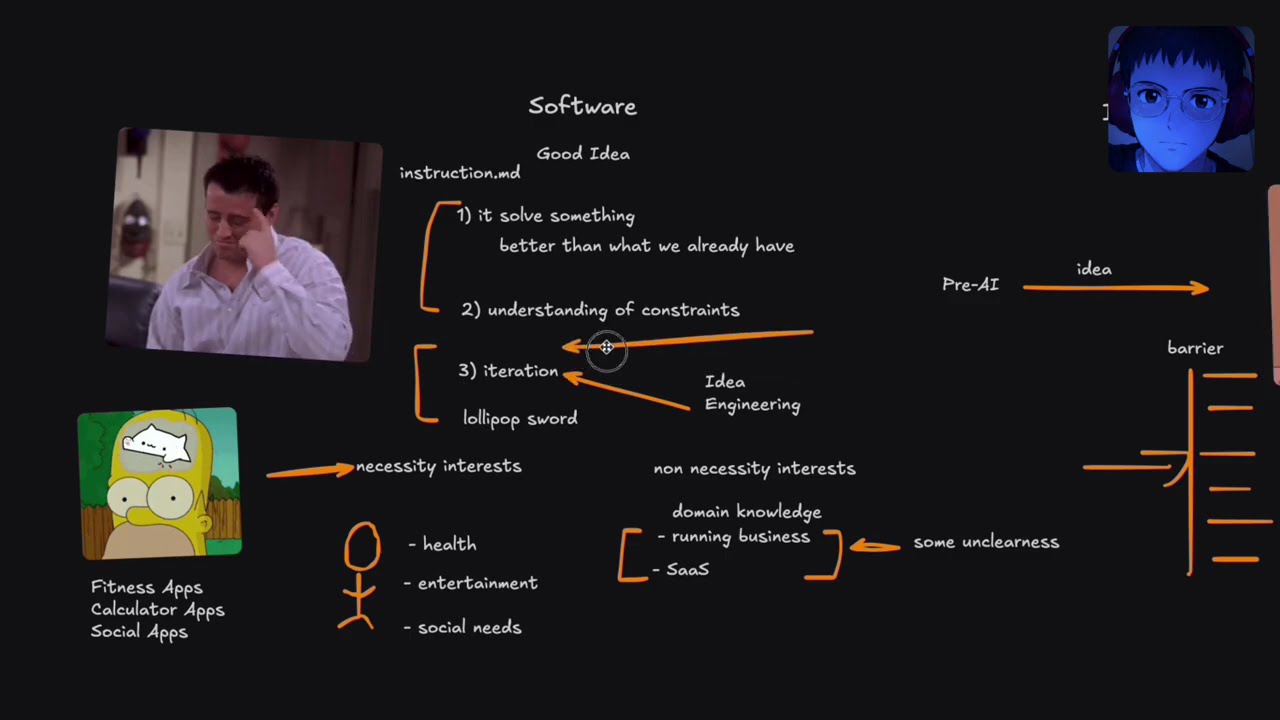
The video emphasizes the increasing value of ideas in the age of AI, highlighting that while code has become cheap and easy to produce, the quality and depth of ideas remain crucial. Before AI, the barrier to execution was high, forcing deeper contemplation and refinement of ideas. Drawing on philosophical concepts like Descartes’ theory of ideas, the speaker reflects on how ideas must have sufficient “reality” or substance to be meaningful, especially in software development where understanding constraints and iterative refinement are key to transforming a raw concept into a viable product.
A good idea, according to the video, must solve a problem—preferably better than existing solutions—and this “better” aspect can be subjective, involving factors like user experience or efficiency. The speaker stresses the importance of understanding constraints, such as technical feasibility and domain knowledge, which shape whether an idea is practical or not. Without this understanding, ideas can be unrealistic or unworkable. Iteration is presented as a critical phase where ideas are tested, refined, or even pivoted, often requiring significant time and effort before they mature into something valuable.
The video also discusses how AI has drastically shortened the time from idea to execution, reducing the inertia that once forced more thorough vetting and iteration. This ease of execution can lead to premature development of underdeveloped ideas, bypassing the essential process of “idea engineering.” The speaker argues that despite AI’s capabilities, the foundational work of deeply understanding the problem, market, and constraints remains indispensable. This process, which can take months or years, is necessary to ensure that ideas are robust and truly innovative.
Another key point is the role of firsthand experience and domain immersion in generating and validating ideas. The speaker suggests that ideas born from direct involvement with a problem or market tend to be more grounded and relevant. Simply asking others for ideas or relying on surface-level research often leads to weaker concepts. The analogy of playing basketball versus just watching it illustrates how direct experience provides insights that are difficult to gain otherwise. This hands-on approach accelerates the iterative process and improves the quality of ideas.
Finally, the video warns against dismissing ideas prematurely due to external skepticism or negative feedback, citing examples where initial criticism could have derailed potentially good concepts. The speaker encourages maintaining a healthy ego and resilience to navigate the iterative process, balancing customer feedback with personal conviction. Ultimately, the message is that idea development is a dynamic, ongoing process that requires patience, critical thinking, and persistence—especially in an era where AI makes execution easier but does not replace the need for thoughtful, well-engineered ideas.