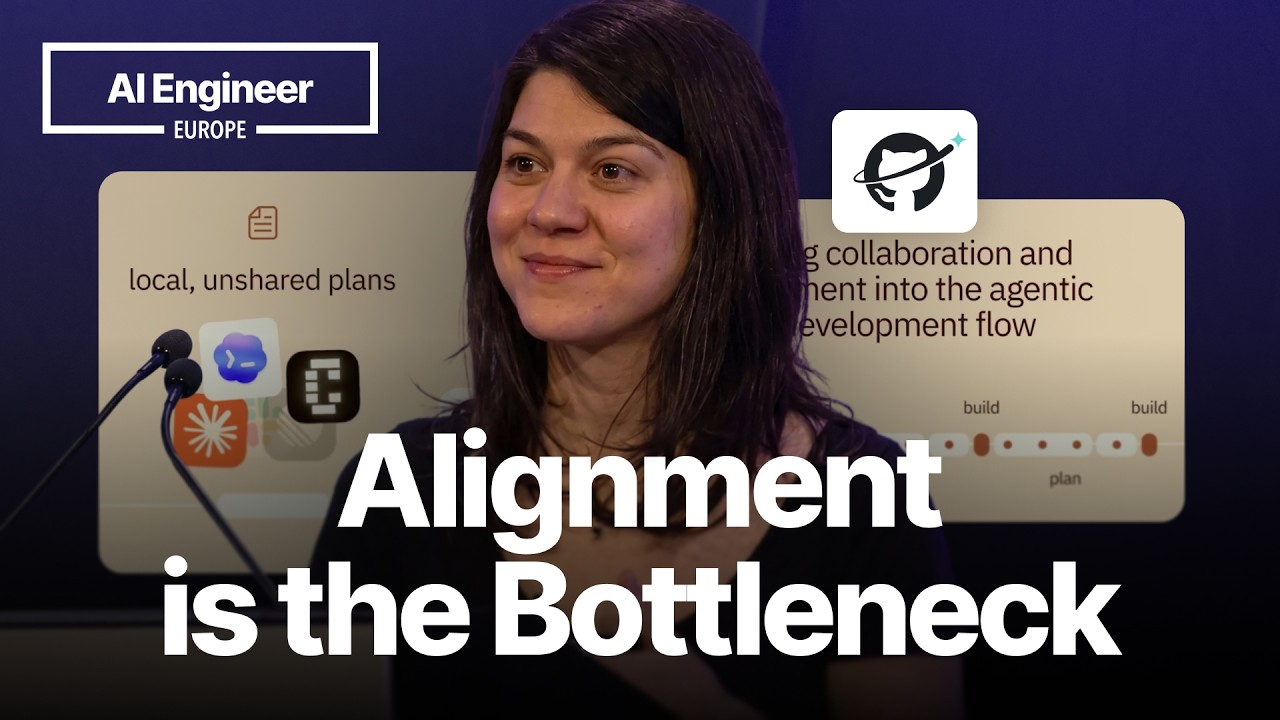
In her talk, Maggie Appleton from GitHub Next discusses the limitations of current AI coding agents and the need for collaborative AI engineering to improve software development. She highlights that while many envision a future where a single developer manages dozens of AI agents to boost productivity, this approach overlooks the inherently collaborative nature of software development. Software is built by teams who must align on what and why they are building, and simply scaling individual output does not address the critical challenges of communication and coordination.
Appleton explains that the traditional software development process involved distinct phases of planning, building, and review, with multiple alignment checkpoints that allowed teams to stay coordinated. However, with AI agents drastically speeding up implementation, these early alignment phases are often skipped, pushing all coordination to the pull request stage, which is too late and inefficient. Current tools like GitHub, Slack, and Jira were not designed for this new agent-driven workflow, leading to wasted work, duplicated efforts, and overwhelming volumes of uncontextualized pull requests.
To address these challenges, Appleton introduces ACE (Agent Collaboration Environment), a research prototype developed by GitHub Next. ACE is designed as a multiplayer, cloud-based coding environment that integrates chat, coding agents, and shared workspaces. It allows team members and agents to collaborate in real-time on isolated branches within microVMs, providing shared context, live previews, and seamless switching between tasks. This environment supports not only developers but also designers, product managers, and other stakeholders, fostering better alignment and communication throughout the development process.
ACE also features collaborative planning tools where teams can co-create and refine plans before coding begins, ensuring alignment on goals and requirements. The platform includes a dashboard that summarizes ongoing work and team activity, helping developers stay oriented amid the rapid pace of agent-driven development. By embedding social context and proactive notifications, ACE aims to transform software development from isolated, individual efforts into a connected, intelligent workspace that supports continuous alignment and higher-quality outcomes.
Ultimately, Appleton emphasizes that the goal of collaborative AI engineering is to reclaim time and energy for critical thinking, research, and craftsmanship in software development. With AI agents handling much of the implementation work, teams have the opportunity to focus on building fewer, better products through rigorous alignment and thoughtful planning. She envisions tools like ACE enabling teams to work smarter together, producing exceptional software rather than a flood of low-quality features, and invites interested developers to join the early access program to help shape the future of AI-assisted collaboration.