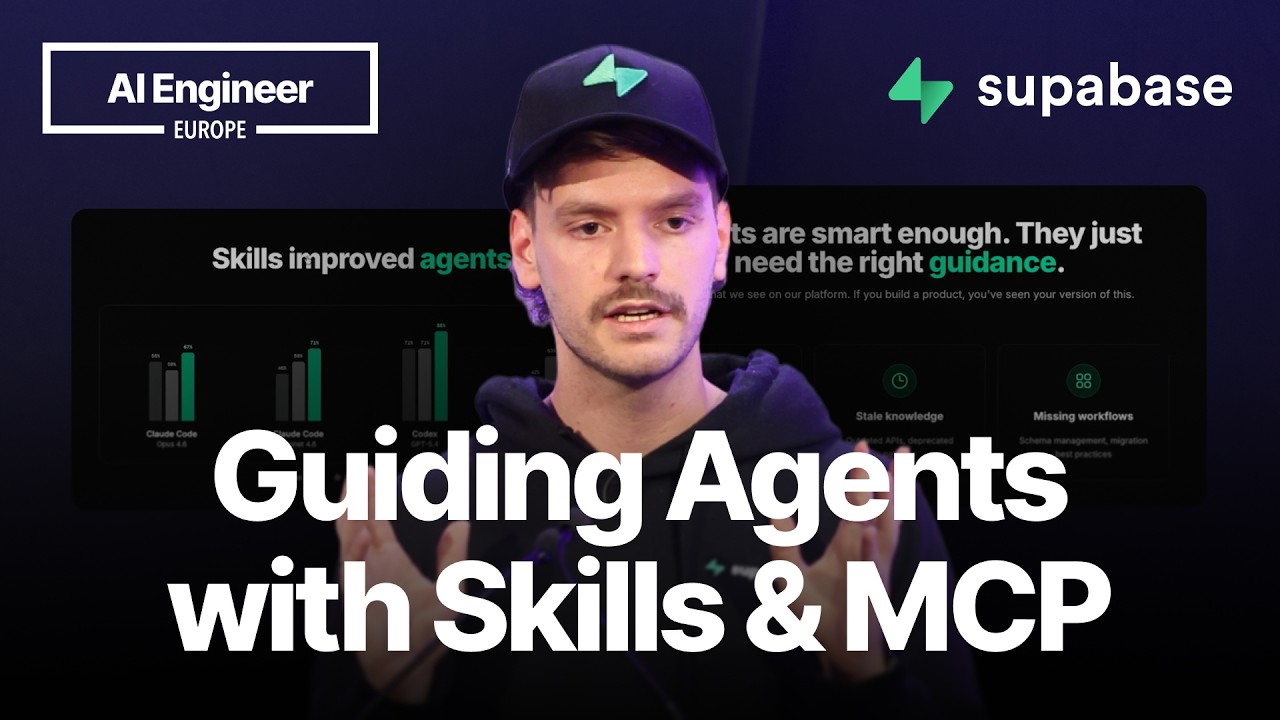
Pedro Rodrigues from Supabase highlighted the complementary roles of Skills and Model-Callable Plugins (MCP) in AI agents, demonstrating that combining both closes the context gap by providing essential, up-to-date guidance that MCP alone lacks, especially for complex tasks like secure database management. He emphasized best practices for building effective Skills, showcased their superior performance through testing, and encouraged developers to adopt a minimal, iterative approach linked to official documentation while discussing future directions and collaboration opportunities.
Pedro Rodrigues, an AI tooling engineer at Supabase and MCP enthusiast, presented on combining Skills and MCP (Model-Callable Plugins) to close the context gap in AI agents. He began by explaining the evolving debate around MCPs and Skills, emphasizing that both have distinct roles and that the current focus is on MCP versus CLI. Pedro shared his experience developing the Supabase agent skill, highlighting the complexity involved in writing a comprehensive skill document for a complex product like Supabase. He introduced Skills as folders containing instructions, scripts, and resources that agents progressively discover, with a main skill.md file containing essential guidance and optional reference files.
Pedro illustrated the importance of combining MCP with Skills through an example involving a collaborative app with row-level security (RLS) in Postgres. Agents equipped only with MCP often missed critical security configurations, potentially exposing sensitive data, whereas agents with both MCP and Skills correctly implemented secure SQL views. This demonstrated that Skills provide crucial, up-to-date guidance that MCP alone cannot offer. Consequently, Supabase developed and announced their official agent skill to help agents interact safely and effectively with their platform.
He outlined three key principles for building effective product skills: avoid duplicating information by linking to existing documentation, recognize that agents tend to skip optional or reference files so critical information should be included directly in the main skill file, and be opinionated by guiding agents toward the most efficient workflows tailored to the product. For Supabase, this meant instructing agents to manage database schema changes on development or staging environments first, use an advisor tool to check for security or performance issues, and only then create migration files, optimizing the schema management process.
Pedro also discussed how Supabase tested their skill using evals—automated tests for evaluating agent behavior—across multiple agents and conditions. The results showed that agents using both MCP and Skills outperformed those using MCP alone or no tools, confirming that Skills significantly improve agent performance by providing the right operational guidance. He emphasized that Skills are agent-agnostic and encouraged developers to start minimal, iterate, and expand their skills while maintaining a single source of truth by pointing to official documentation.
In the Q&A, Pedro addressed questions about the demand for vector databases at Supabase, noting growing interest particularly for semantic search and embedding use cases. He also discussed the current challenges in distributing Skills, explaining that while there is no standardized distribution system yet, Supabase packages skills within repositories and leverages existing tools like skills packages for discovery. He welcomed collaboration on self-improving skills and concluded by inviting attendees to try out the Supabase agent skill and participate in a giveaway.