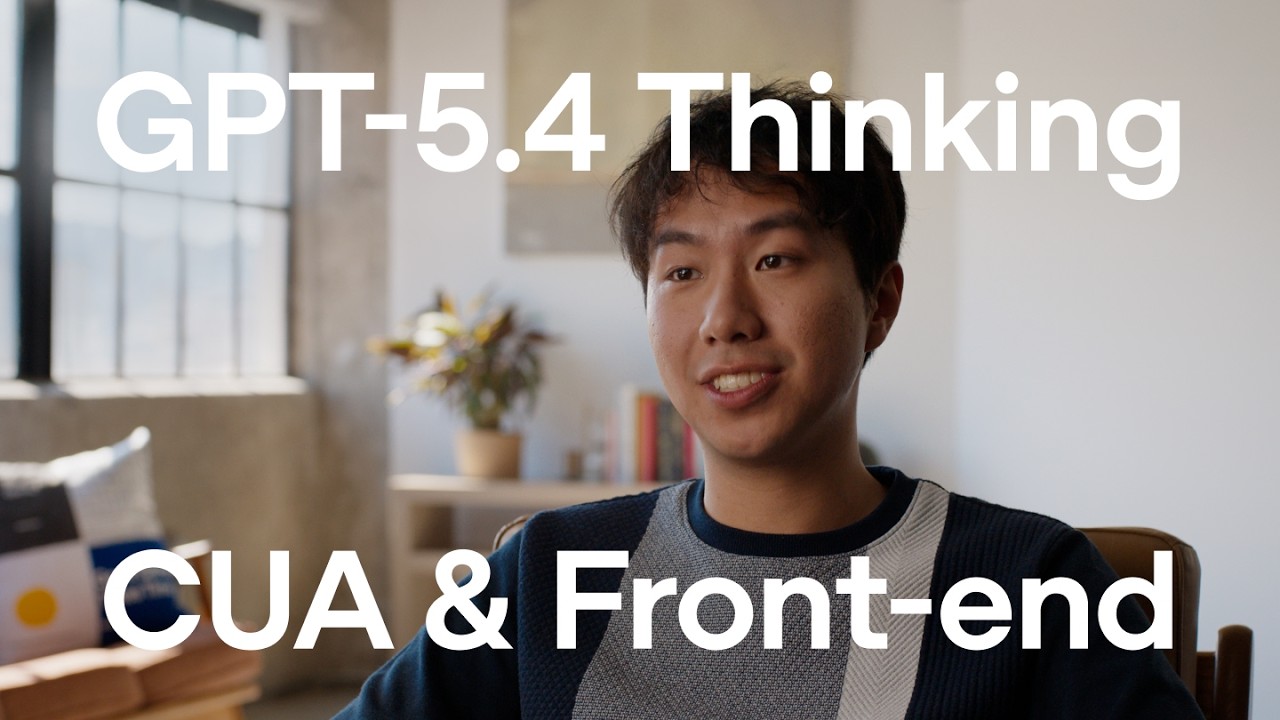
The video introduces GPT-5.4 Thinking, an advanced AI model for web and app development that features improved computer use automation (KUA) and enhanced website creation from image inputs, enabling more efficient, accurate, and self-validated results. Demonstrations include building a 3D chess game and replicating a website design, showcasing the model’s ability to interact with interfaces, check its own work, and produce user-friendly outputs.
The video features SQ, a developer focused on improving AI models for web and app development, particularly in enhancing user experience. SQ introduces the launch of the new GPT-5.4 Thinking model, highlighting its advanced capabilities in app development. The main focus is on two features: the model’s ability to use KUA (computer use automation) and its improved skill in creating websites from image inputs. These advancements are designed to help the model better check its own work, which becomes increasingly important as the complexity of tasks grows.
One of the key improvements in GPT-5.4 Thinking is its integration with KUA. Unlike previous versions, such as 5.3 Codecs, the new model does not need to spin up a separate environment to interact with a computer. Instead, it operates more like a human user, persistently interacting with the interface. This change has led to a significant reduction in token usage—by as much as two-thirds in some cases—making the process more efficient and cost-effective.
To demonstrate these capabilities, SQ provides an example where GPT-5.4 Thinking is tasked with building and testing a 3D chess game as an Electron app. The challenge is increased by asking the model to implement two visual effects: glass and marble. The model must not only generate the code but also interact with the game, clicking the correct pieces and ensuring that complex rules, such as castling, are properly implemented and tested. This showcases the model’s ability to reason through intricate user interactions and validate its own output.
The second major feature discussed is website replication using image input. SQ shares a personal example involving a coffee shop website design provided by his partner, Nancy, who is not a coder. Using Codecs and GPT-5.4 Thinking, the model interprets the design and generates a website that closely matches the provided image. The model demonstrates improved contextual understanding, selecting and generating images that are stylistically appropriate and cohesive with the overall design.
Finally, the video highlights how GPT-5.4 Thinking leverages KUA to verify its work. The model opens both the generated images and the website, compares them side by side, and ensures that the final product aligns with the original design. This self-checking ability not only improves the quality and accuracy of the output but also makes the development process more efficient and affordable. Overall, these updates represent a significant step forward in AI-assisted software development, enabling more reliable and user-friendly results.