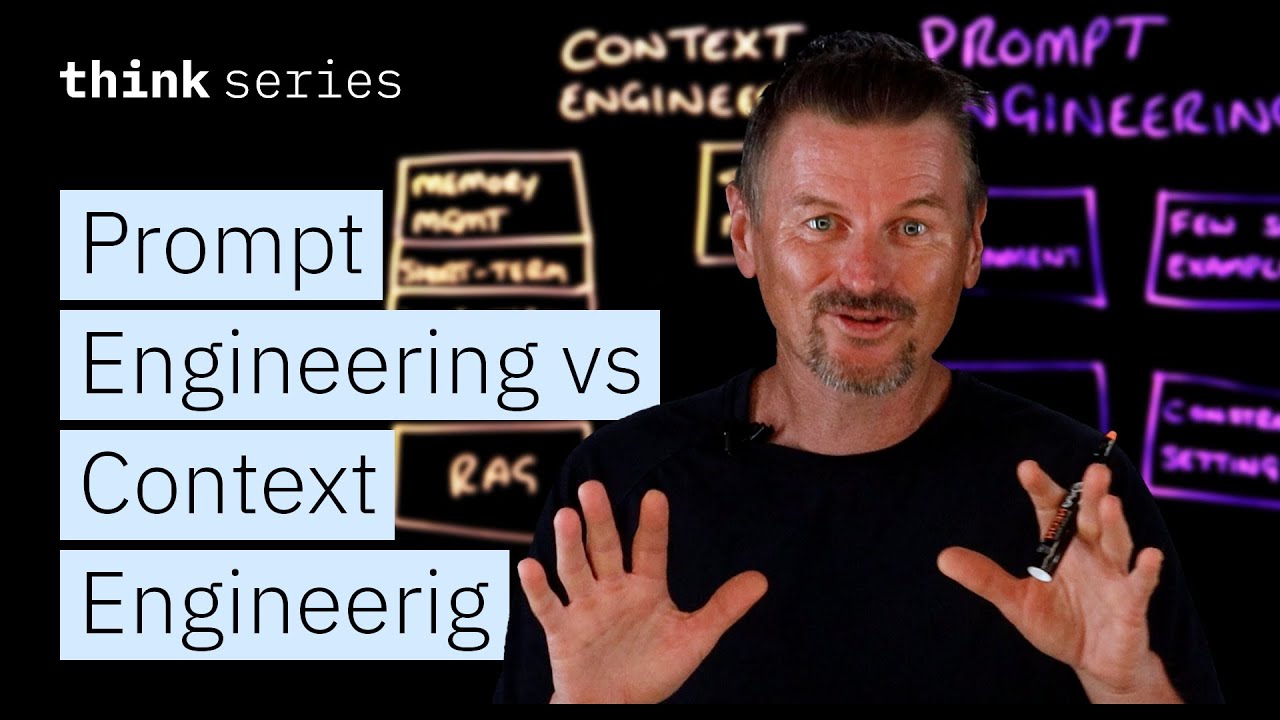
The video begins by distinguishing between prompt engineering and context engineering in the realm of large language models (LLMs). Prompt engineering involves crafting the input text—such as instructions, examples, and formatting cues—that guides the LLM’s behavior and output. In contrast, context engineering is a broader discipline that programmatically assembles everything the LLM sees during inference, including prompts, retrieved documents, memory, and tools, to ensure accurate and relevant responses.
To illustrate the difference, the video introduces an agentic AI model named Agent Graeme, specialized in travel booking. When given a vague prompt to book a hotel in Paris for a conference, Graeme mistakenly books a hotel in Paris, Kentucky, instead of Paris, France. This error highlights the limitations of prompt engineering alone and underscores the importance of context engineering—such as integrating tools to check calendars or look up conference locations—to provide the necessary context for accurate task completion.
The video then explores key prompt engineering techniques that enhance LLM performance. These include role assignment, which sets the model’s persona to tailor its responses; few-shot examples, which demonstrate the desired input-output format; chain of thought prompting, encouraging the model to reason step-by-step; and constraint setting, which limits the model’s responses to specific boundaries. These techniques help refine the instructions given to the model to produce more precise and relevant outputs.
Context engineering, on the other hand, focuses on building dynamic, agentic systems that manage memory, state, retrieval, and tool integration. Memory management involves both short-term summarization of conversations and long-term storage using vector databases. State management tracks progress in multi-step tasks, ensuring continuity. Retrieval Augmented Generation (RAG) connects the agent to relevant knowledge sources by selectively retrieving contextually pertinent information. Tools enable the agent to interact with external systems, such as databases or APIs, bridging the gap between LLM capabilities and real-world actions.
Finally, the video emphasizes that prompt engineering and context engineering are complementary. Prompt engineering crafts better questions and instructions, while context engineering builds the systems that provide the necessary environment and resources for the LLM to perform effectively. When combined, they enable smarter AI agents like Graeme to deliver accurate, context-aware results—such as booking the right hotel within budget and near the venue—though organizational processes like approvals may still introduce delays. The video closes with a humorous note on the challenges of navigating human systems alongside AI advancements.