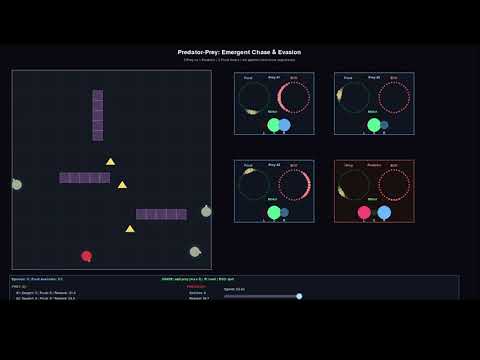
The video presents a project focused on building biologically inspired predator-prey simulations without relying on traditional neural networks. The core idea involves a predator and prey dynamic where agents, starting from random positions, learn over time to exhibit complex behaviors such as prey avoiding predators while seeking food (cheese). This learning is driven by a continuous attractor network, specifically a ring network of 36 neurons that encode directional information about food location. The network connects to motor neurons that control movement, and additional mechanisms like boundary vector cells and hardcoded instinctive rules help with obstacle and predator avoidance.
The continuous attractor network functions as a sensory apparatus, encoding the direction of food in a population coding manner, where neurons represent angles in 10-degree increments. The motor neurons use a softmax activation to produce smooth, probabilistic movement outputs rather than deterministic actions. Boundary vector cells detect nearby walls and obstacles, producing inhibitory signals that modulate motor outputs to prevent collisions. This combination of learned and instinctive behaviors results in emergent complex actions such as obstacle avoidance, predator evasion, and food seeking, despite the simplicity of the network.
Learning in this system is based on reward-modulated Hebbian plasticity with eligibility traces, a biologically plausible mechanism. The network tracks which neurons fired during actions and updates synaptic weights based on whether the agent’s actions brought it closer to the food. This three-factor learning rule involves synaptic tagging when neurons fire together, sequential firing rules that strengthen connections if neuron A fires shortly before neuron B, and reward signals that modulate synaptic changes. This approach mimics dopamine-driven reinforcement learning observed in biological brains, allowing the agents to improve their behavior over time.
The video also discusses additional biologically inspired features such as boundary vector cells that simulate rodent wall-hugging behavior (tigmotaxis), which decays as the agent becomes familiar with the environment. The system includes reflexive layers for instant wall avoidance and corner escape, mimicking brainstem reflex loops. The motor output’s softmax action selection introduces stochasticity, promoting exploratory behavior rather than rigid, deterministic responses. The presenter highlights the potential for further experiments and improvements, including homeostatic motivation systems that could simulate internal drives like hunger.
Finally, the presenter invites viewers to access the project’s source code and related materials through their Patreon, which offers over 500 projects and exclusive content. They emphasize the surprising complexity and naturalistic behaviors that emerge from these simple, biologically inspired networks. The video concludes with a demonstration of the system running at different speeds, showing prey successfully avoiding predators and seeking food, and hints at future experiments exploring more sophisticated behaviors.