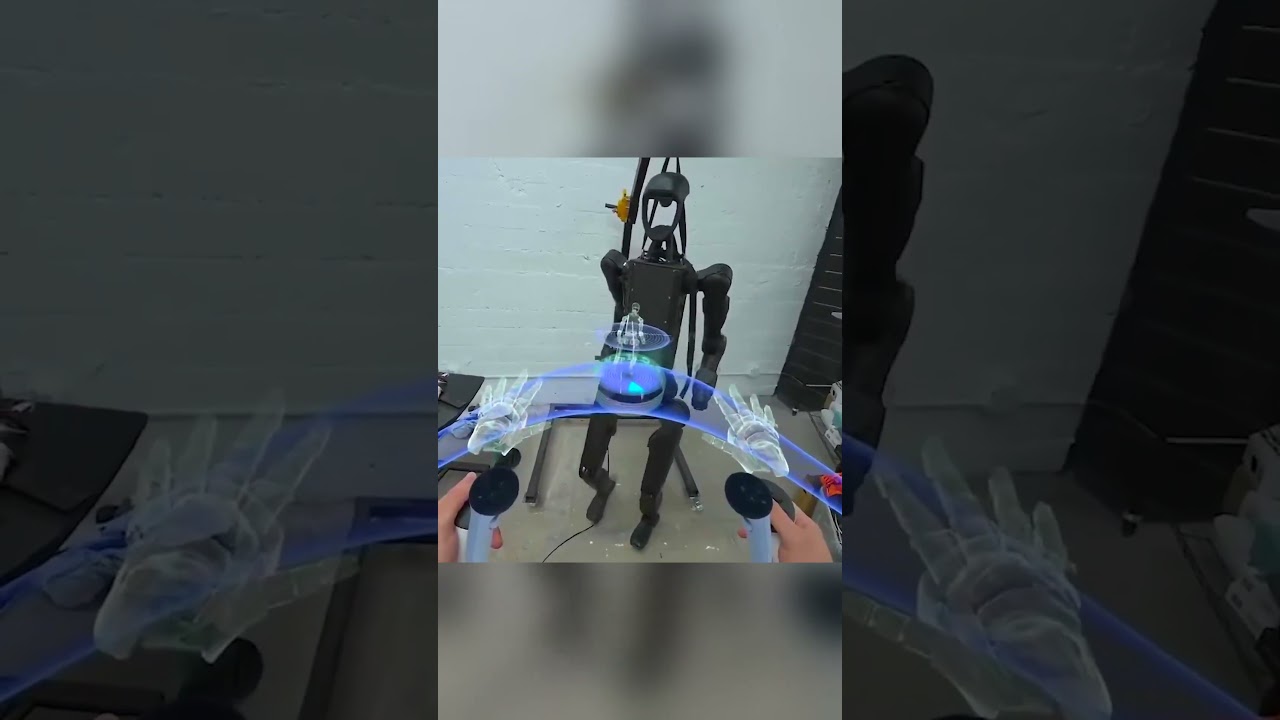
The video demonstrates how VR technology can be used to intuitively control AI-powered robots in real-time, allowing for precise manipulation and interaction within virtual environments. It highlights the potential applications of this integration, such as remote assistance and training, and discusses future advancements to enhance human-robot collaboration.
The video titled “Controlling AI Robot in VR! #ai” showcases an innovative demonstration of how virtual reality (VR) technology can be used to control an AI-powered robot. The presenter begins by introducing the concept of integrating VR with robotics, emphasizing the potential for immersive control and interaction. They highlight the importance of precise and intuitive interfaces to manage complex robotic movements, which VR can facilitate effectively.
Throughout the video, viewers see the presenter don a VR headset and controllers, which serve as the primary interface for commanding the robot. The VR environment is designed to mimic real-world settings, allowing the user to see the robot’s perspective and manipulate its actions in real-time. The presenter demonstrates various commands, such as moving the robot’s limbs, grasping objects, and navigating through different virtual scenarios, illustrating the system’s responsiveness and accuracy.
The AI component of the robot plays a crucial role in interpreting the commands received via VR. The robot’s AI algorithms process the user’s gestures and inputs, translating them into precise physical movements. This integration enables smooth and natural control, reducing latency and increasing the realism of interactions. The video emphasizes how AI enhances the robot’s ability to adapt to complex commands and perform tasks autonomously when needed.
In the latter part of the video, the presenter explores potential applications of this technology, including remote assistance, training simulations, and advanced robotics research. They discuss how VR-controlled AI robots could revolutionize industries by providing safer, more efficient ways to perform dangerous or intricate tasks. The demonstration concludes with a glimpse into future developments, such as improved AI capabilities and more immersive VR interfaces, promising even more seamless human-robot collaboration.
Overall, the video offers an exciting look at the convergence of VR, AI, and robotics, showcasing a cutting-edge method for controlling robots in a virtual environment. It highlights the technological advancements that make such interactions possible and hints at the transformative impact this could have across various fields. The presentation underscores the potential for more intuitive, immersive, and intelligent robotic control systems in the near future.