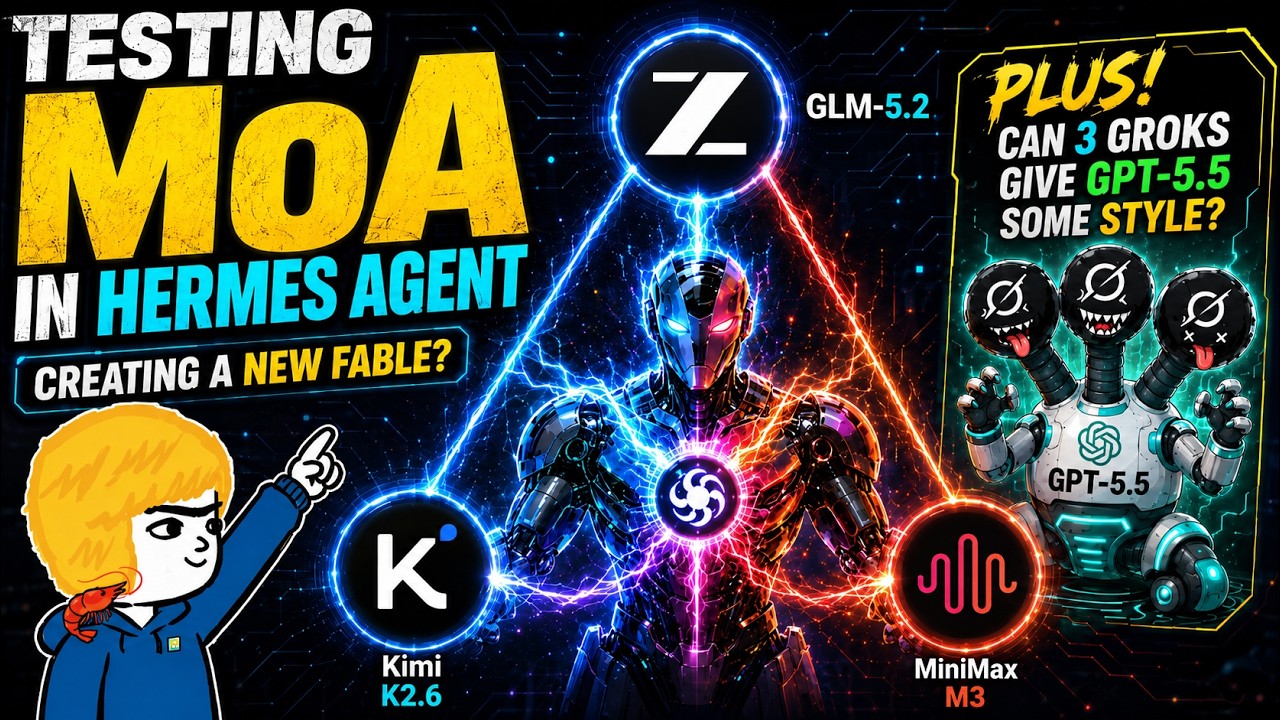
The video demonstrates the new Mixture of Agents (MOA) feature in Hermes agents, which combines multiple AI models to improve task performance and output quality, showing that while MOA may increase processing time and cost, it delivers more polished and creative results compared to single-model approaches. Through practical tests on coding and creative tasks, the presenter highlights MOA’s potential to blend diverse model strengths, encouraging viewers to experiment with different combinations as the feature continues to evolve.
The video explores the newly announced MOA (Mixture of Agents) feature by News Research, which enables combining multiple AI models to potentially surpass the capabilities of individual frontier models. The presenter explains that MOA uses several reference models to provide private advice and an aggregator model that makes final decisions and tool calls, enhancing overall performance. This concept is similar to other multi-model approaches like Open Router’s Fusion and Sakana AI’s Gugu. The video covers how to set up and configure MOA within the Hermes agent desktop app and dashboard, highlighting the flexibility to create custom presets with different model combinations.
To evaluate MOA’s effectiveness, the presenter conducts a practical test by assigning a complex coding task: building a self-contained HTML mini-game with various graphical and interactive elements. First, a baseline is established using a single GLM 5.2 model, which completes the task in about 13 minutes at a cost of 38 cents. The resulting game is functional but somewhat laggy and less polished. Next, a MOA preset combining GLM 5.2 as the aggregator with Kimi K 2.6 and Minimax M3 as reference models is tested. This approach takes significantly longer—around 35 minutes—but only slightly increases the cost to 47 cents. The output is noticeably better, with smoother animations, improved visuals, and a more enjoyable gameplay experience.
The presenter summarizes the initial findings, noting that while the MOA pipeline is slower, it produces higher-quality results that could justify the extra time and cost, especially if it reduces the need for multiple iterations. The video then shifts to a second comparison using GPT 5.5 as the baseline for a more creative task involving an anime multiverse tactical dashboard. GPT 5.5 completes this task in about seven minutes, delivering a solid and visually appealing product. The MOA setup here uses GPT 5.5 as the aggregator with three Grok models as references, which surprisingly finishes faster than the baseline by about a minute and adds more stylistic flair and creativity to the output.
The presenter highlights the advantages of MOA in blending the strengths of different models, such as combining GPT 5.5’s coding prowess with Grok’s creative style, resulting in a richer and more dynamic final product. Despite being a new feature with some performance trade-offs, MOA shows promise for improving AI-generated content quality by leveraging diverse model perspectives. The video encourages viewers to experiment with different model combinations and share their experiences, emphasizing that MOA is still evolving and likely to improve over time.
In conclusion, the video provides a detailed overview and hands-on testing of the MOA feature in Hermes agents, demonstrating its potential to enhance AI task performance through multi-model collaboration. While MOA may increase processing time and slightly raise costs, the quality improvements and creative enhancements can offer significant value, particularly for complex or nuanced projects. The presenter invites feedback and discussion from the community, signaling ongoing development and interest in this innovative approach to AI model orchestration.