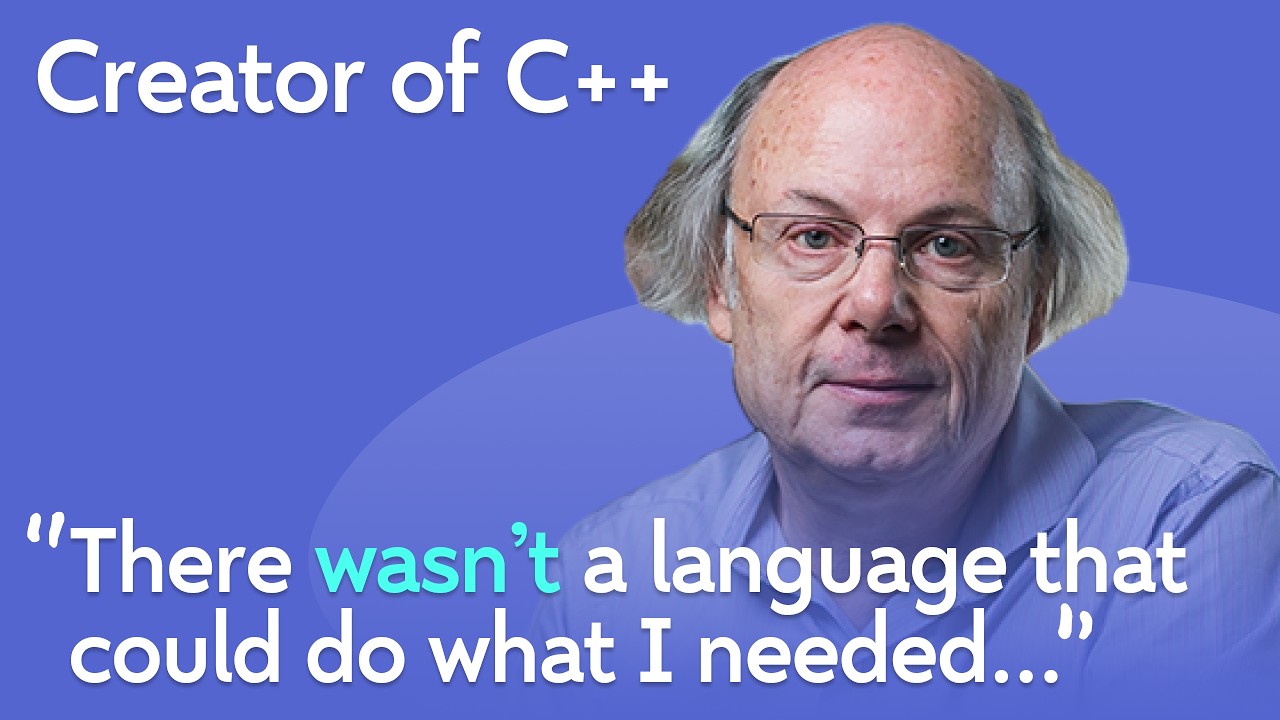
Bjarne Stroustrup, the creator of C++, began his career at Bell Labs, a renowned research institution known for pioneering Unix and the C language. Stroustrup identified a gap in programming languages: none combined low-level hardware access with high-level abstractions. Inspired by Simula’s object-oriented features and C’s efficiency, he merged these concepts to create C++, aiming for a language suitable for systems programming that could handle both hardware manipulation and complex software design. His early work involved rewriting simulators in BCPL to achieve better performance, which reinforced his conviction to develop a more capable language.
Bell Labs fostered an environment that valued hiring talented individuals and giving them freedom rather than imposing rigid project structures. Stroustrup described the culture as anarchic but highly productive, with interdisciplinary collaboration leading to innovations beyond computing, such as fiber optics and wireless technology. His interactions with legendary figures like Dennis Ritchie influenced C++ development, including features like the const keyword. Despite occasional disagreements, the relationship between C and C++ communities was collaborative rather than adversarial.
Regarding language design, Stroustrup emphasized that building a new language should start with a clear problem to solve rather than the desire to create a better language for its own sake. C++ evolved over time, balancing the need for backward compatibility with the introduction of powerful features like templates and overloading. He highlighted the importance of static typing for performance, reliability, and suitability in embedded systems, contrasting it with dynamically typed languages that trade off speed and safety for ease of use. He also addressed misconceptions about C++’s complexity and safety, noting that modern C++ practices and libraries mitigate many traditional pitfalls.
Stroustrup discussed the challenges and politics of standardizing C++, explaining how the language’s governance by a large committee ensures stability and broad consensus but can slow innovation. He recounted anecdotes from the standards process, including intense negotiations between major industry players and resistance to features like the auto keyword. Despite these hurdles, standardization helped C++ gain widespread adoption and prevented it from becoming a niche academic language. He also touched on the evolution of features like garbage collection and compile-time computation, illustrating C++’s adaptability.
Looking forward, Stroustrup expressed cautious skepticism about AI-generated code replacing human programmers, especially in safety-critical and performance-sensitive domains where validation and predictability are paramount. He remains motivated by the ongoing challenge of evolving C++ to meet real-world needs and by seeing its application in cutting-edge projects like Mars rovers and high-energy physics. Reflecting on his journey, he acknowledged mistakes such as not delaying C++’s release to include templates and the difficulty of overcoming legacy design decisions, but he remains committed to guiding the language’s future through education, coding guidelines, and community engagement.