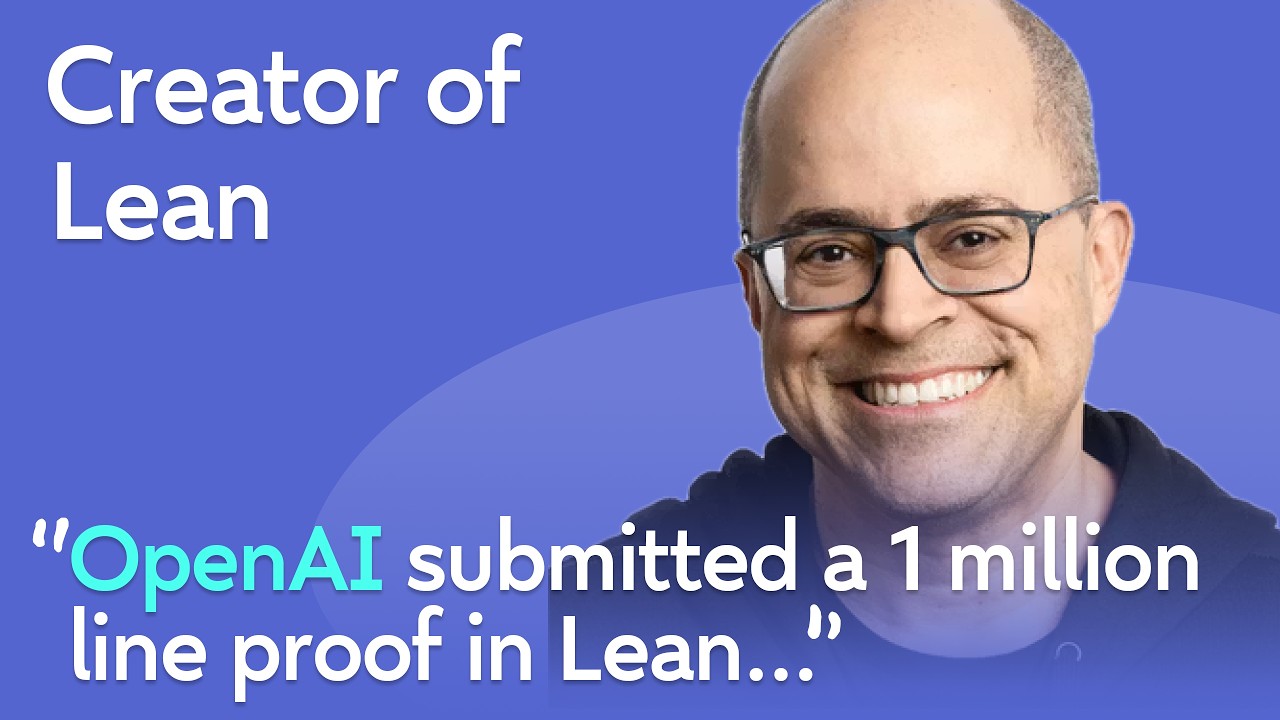
The video discusses Leonardo de Moura’s Lean, a proof assistant that formalizes and verifies mathematical proofs and software correctness, enhanced by integration with large language models to automate proof generation and validation. This innovation promises to transform mathematics and software development by ensuring error-free, machine-checked proofs, potentially making handwritten mathematics obsolete and significantly improving the reliability of complex proofs and critical software systems.
The video features a conversation with Leonardo de Moura, the creator of Lean, a proof assistant and programming language designed to formalize mathematical proofs and verify software correctness. Lean has recently gained prominence due to its integration with large language models (LLMs), which generate candidate proofs that Lean can then validate. This collaboration has led to significant breakthroughs in competition mathematics and the verification of cutting-edge mathematical results, showcasing Lean’s critical role in ensuring the accuracy and reliability of these proofs.
Lean serves as both a programming language and a platform for writing and verifying proofs. Users can write code, state properties about that code, and then formally prove those properties within Lean. The system produces machine-checkable proofs, providing absolute assurance of correctness. This capability addresses a fundamental limitation in traditional software testing, as highlighted by the Dijkstra quote referenced in the conversation: while testing can reveal the presence of bugs, it cannot guarantee their absence. Lean’s formal verification approach, however, can demonstrate that certain bugs cannot exist in the verified code.
The conversation emphasizes Lean’s role in bridging the gap between human mathematical reasoning and machine verification. By formalizing proofs, Lean helps mathematicians and software developers ensure that their work is free from logical errors. This is particularly important in frontier mathematics, where proofs can be highly complex and difficult to verify by hand. Lean’s rigorous checking provides a new level of confidence in these results, potentially transforming how mathematical knowledge is validated and shared.
Looking to the future, the discussion explores the possibility that handwritten mathematics might become obsolete as tools like Lean and LLMs become more sophisticated. The automation of proof generation and verification could dramatically change the practice of mathematics, making it more accessible and reliable. This shift could also impact software verification, where formal methods are increasingly important for ensuring the safety and security of critical systems.
Overall, the video highlights Lean as a powerful tool that combines programming, formal logic, and machine verification to revolutionize both mathematics and software development. By enabling the formalization and automatic checking of proofs, Lean helps eliminate errors that traditional methods cannot catch, paving the way for more robust and trustworthy mathematical and computational work.