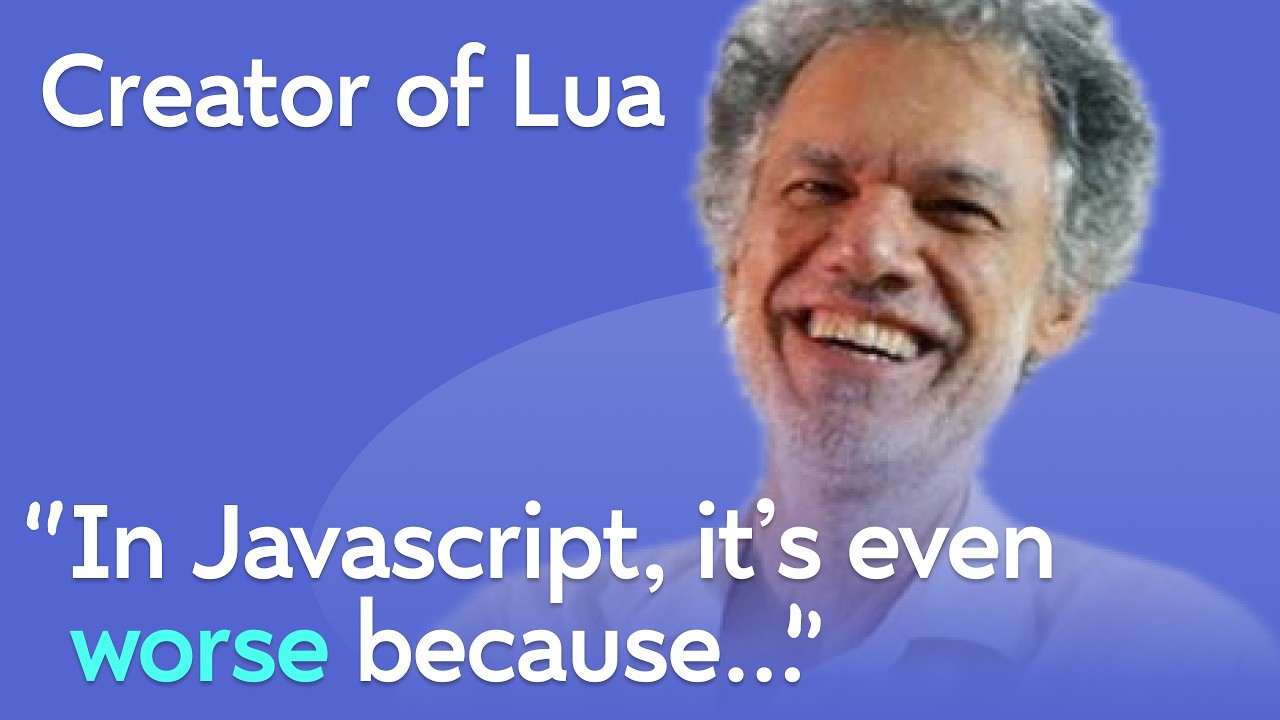
Roberto Ierusalimschy, the creator of the Lua programming language, discusses the design philosophy and unique features of Lua, emphasizing its role as a lightweight scripting language typically embedded within C or C++ programs. Lua excels in scenarios where a main program written in C calls Lua for dynamic tasks, such as in game development where Lua updates game states each frame while C handles resource-intensive rendering. Unlike many scripting languages, Lua was designed from the start as a library, enabling seamless embedding and extending, which contributes to its flexibility and efficiency.
Ierusalimschy contrasts Lua with Python, noting that Python is a larger, more feature-rich language with extensive libraries, making it suitable for standalone applications. Lua, by contrast, is minimalistic, relying on the host program to provide most libraries, which keeps it lightweight and fast. This minimalism, combined with Lua’s design choices—such as its handling of exceptions, lack of a global state, and a unique load function for compiling code—contributes to its superior performance compared to Python in many benchmarks.
The conversation also touches on LuaJIT, a just-in-time compiler for Lua developed independently, which leverages Lua’s simplicity to achieve high performance through trace compilation. Ierusalimschy explains the challenges of JIT compilation, including machine dependency and the complexity of managing execution states when assumptions made during compilation are invalidated. He further explains how Lua’s interpreter works as a virtual machine implemented in C, highlighting the portability of Lua through C’s portability.
On language design, Ierusalimschy advocates for simplicity and conceptual integrity, warning against the complexity that arises from committee-designed languages, using C++ as an example of a complex language. He discusses Lua’s one-based indexing, chosen to align with natural human conventions rather than the zero-based indexing popularized by C. He also reflects on Lua’s initial lack of a boolean type, explaining the design decisions behind adding booleans later to distinguish between false and nil in tables.
Finally, Ierusalimschy addresses the impact of AI on programming, expressing uncertainty about the future but emphasizing the continued importance of clear, simple languages that humans can understand, especially as AI-generated code becomes more prevalent. He recommends studying diverse languages like Haskell, Scheme, and assembly to deepen programming knowledge and advises aspiring programmers to be patient and thorough in their learning. Reflecting on Lua’s development, he values the freedom from client pressures, which allowed for thoughtful design and evolution over time.