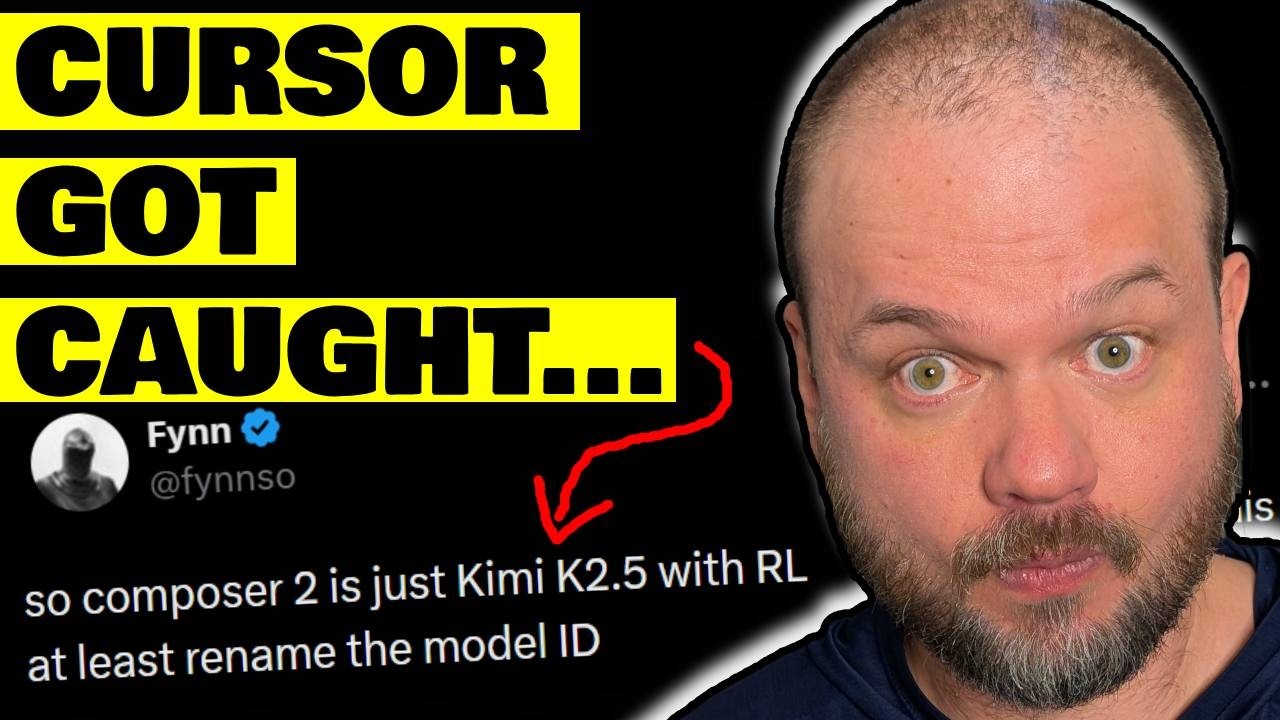
Cursor, a rapidly growing AI coding company valued at nearly $30 billion, recently released its own AI model called Composer 2, which impressed many with its frontier-level coding capabilities at a low cost. However, controversy arose when it was discovered that Composer 2 was largely based on an open-source Chinese model named Kimmy K2.5, developed by Kimmy AI. Despite the open-source nature of Kimmy K2.5, its license requires companies with significant revenue or user bases to disclose their use of the model prominently, something Cursor initially failed to do. This omission sparked backlash from the open-source community and Kimmy AI employees, who accused Cursor of not respecting licensing terms or paying fees.
Cursor responded by acknowledging that Composer 2 started from an open-source base and that about a quarter of the compute used was from the original Kimmy model, with the rest spent on additional training and reinforcement learning using Cursor’s own data. They also clarified that they accessed Kimmy K2.5 through an authorized inference partner, Fireworks AI, which they argued fulfilled their licensing obligations. Cursor further published a technical blog post explaining innovations like self-summarization, a method allowing the model to handle tasks exceeding its context window by summarizing its progress mid-task, which contributed significantly to Composer 2’s performance.
The controversy largely stemmed from Cursor’s initial lack of transparency and attribution rather than outright theft or deception. Many believe Cursor’s reluctance to credit Kimmy K2.5 was influenced by geopolitical sensitivities surrounding US-China relations and the potential negative perception of relying on a Chinese AI model. Despite the backlash, Cursor’s work involved substantial additional training and research, positioning Composer 2 as a significant advancement built on top of an open-source foundation rather than a simple rebranding of another company’s model.
This incident highlights broader issues in the AI community regarding open-source licensing, attribution, and the complex interplay of innovation and collaboration. Experts like Clement Delang of Hugging Face emphasize that open-source models are crucial for competition and innovation, and the real frontier lies in who can best adapt, fine-tune, and productize these models. Cursor’s case may not be unique, raising questions about how many other companies might be building on open-source models without full disclosure.
In conclusion, while Cursor should have been more transparent about its use of Kimmy K2.5, the situation is not a clear-cut case of wrongdoing. Cursor contributed meaningful research and improvements, and the controversy underscores the importance of proper attribution and the geopolitical challenges in AI development. The community hopes Cursor will continue its research and eventually develop fully independent models, while also respecting open-source licenses and fostering a collaborative ecosystem.