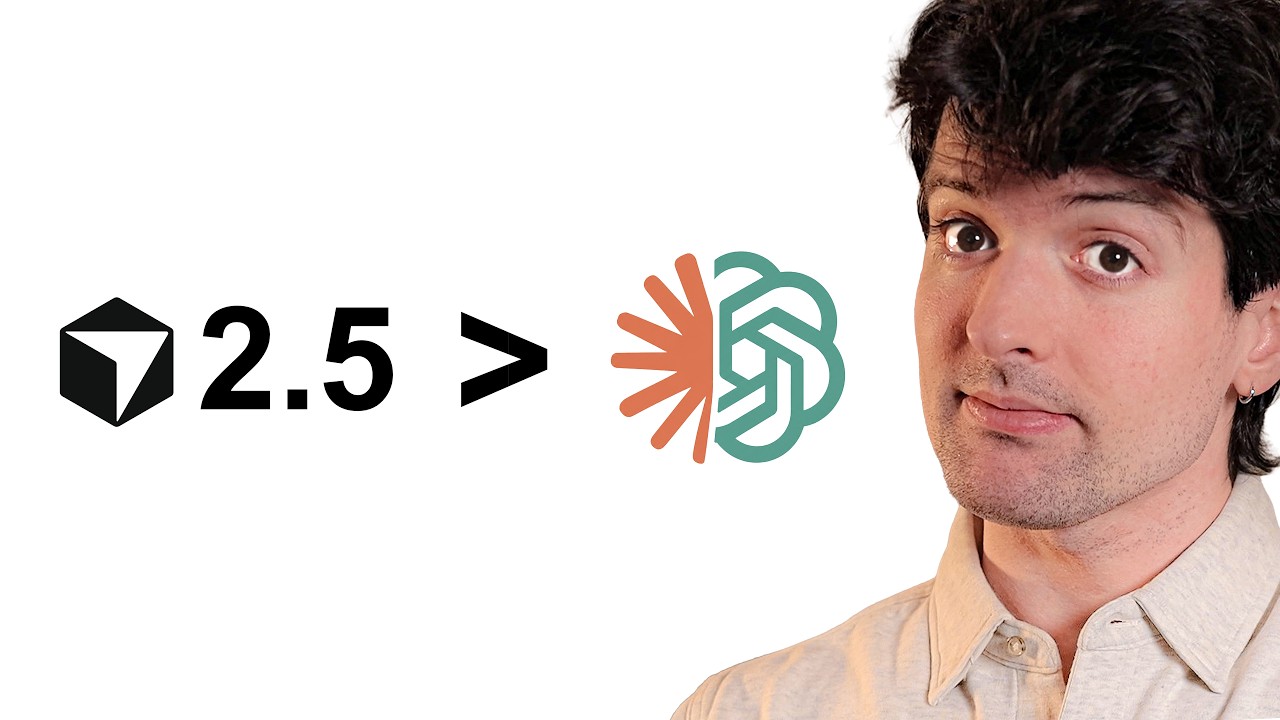
Cursor’s release of Composer 2.5 marks a significant advancement in specialized AI coding models, demonstrating strong performance within its platform and challenging larger competitors despite some limitations. The video also discusses the trade-offs in continuous integration workflows, promoting Blacksmith as a faster, more cost-effective CI solution, while emphasizing the importance of evaluating AI tools based on merit rather than hype.
Last week, Cursor released Composer 2.5, a small yet highly effective coding model that has been somewhat overlooked despite its impressive capabilities. Unlike other models such as Gemini 3.5 Flash, Composer 2.5 focuses on delivering strong performance specifically for code-related tasks. Cursor has rapidly caught up to state-of-the-art standards with this release, although there are some limitations to consider. The model is primarily designed for use within Cursor’s own platform, making external benchmarking challenging and requiring users to rely on internal metrics and personal experience.
Composer 2.5 is part of Cursor’s ongoing effort to refine open-weight models into specialized tools for developers. The company has shared promising benchmark results through their proprietary Cursor bench, which, while not publicly accessible, indicate significant advancements. From firsthand use, the model proves to be genuinely effective, though it may not be the ultimate solution for every coding task. Its release is notable because it reflects a shift where smaller, more focused models can compete with offerings from major AI labs, suggesting that the dominance of large players might be facing new challenges.
The speaker clarifies their impartiality despite being an early investor in Cursor, emphasizing that their endorsement is based on the model’s merits rather than financial incentives. They also hint at forthcoming critiques of other Cursor products, indicating a balanced perspective. This transparency adds credibility to the discussion and highlights the importance of evaluating AI tools based on performance and utility rather than hype or investment interests.
In addition to discussing Composer 2.5, the video touches on the broader context of continuous integration (CI) and its inherent trade-offs between convenience, performance, and cost. The speaker introduces the “CI compromise triangle,” explaining that optimizing all three aspects simultaneously is typically impossible. This segues into a sponsored segment promoting Blacksmith, a CI solution that claims to be twice as fast and 60% cheaper than GitHub Actions, with enhanced reliability and superior workflow analytics. The endorsement underscores the value of efficient and cost-effective development tools in modern software engineering.
Overall, the video highlights Cursor’s significant progress with Composer 2.5 as a noteworthy development in AI-assisted coding, while also addressing practical considerations in software development workflows. It encourages viewers to pay attention to emerging models that challenge established players and to consider the broader ecosystem of tools that support developer productivity. The combination of technical insight and practical advice makes the content valuable for developers interested in the evolving landscape of AI and software engineering.