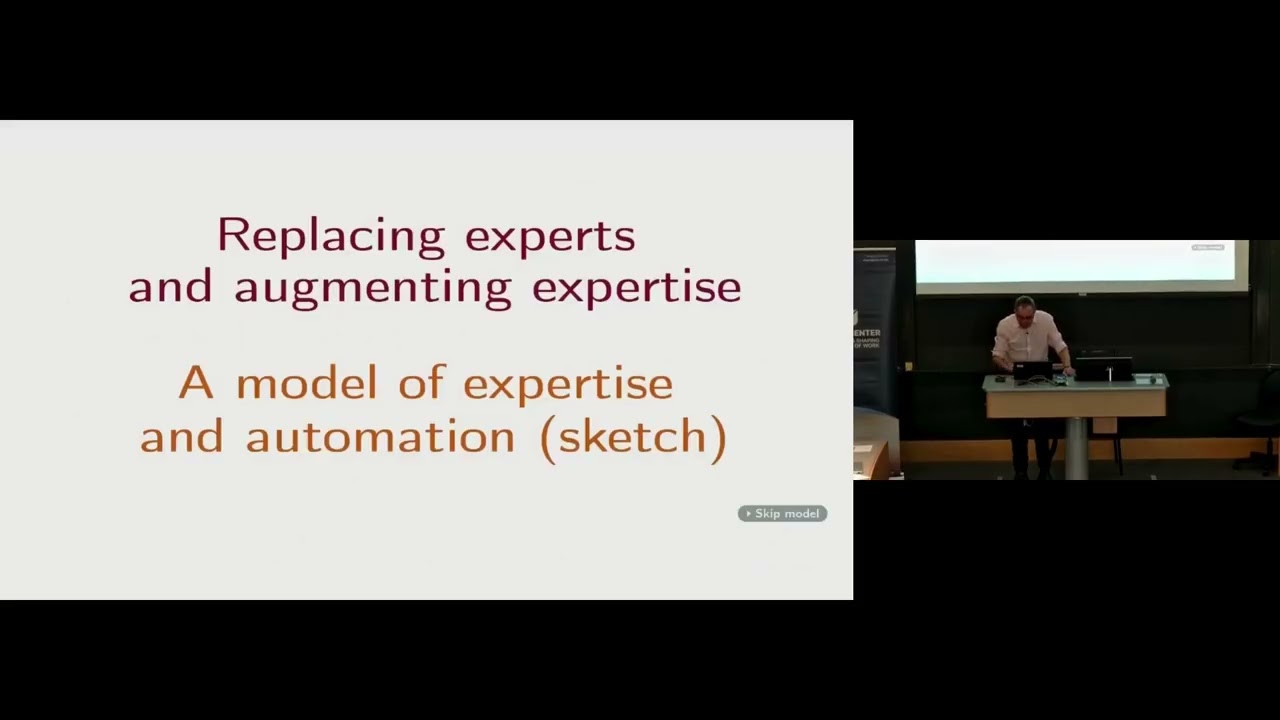
David Autor, the Daniel and Gail Rubenfeld Professor at MIT and co-director of the MIT Labor Studies Program, presented joint research on the concept of expertise in the labor market, particularly in the context of technological change and automation. He challenged the common narrative that AI exposure uniformly threatens jobs and wages, emphasizing that technology can both displace and augment labor. Autor introduced a nuanced model distinguishing between tasks within occupations based on their expertise level, arguing that automation affects occupations differently depending on whether it eliminates high-expertise or low-expertise tasks. For example, automating high-expertise tasks may raise wages but reduce employment, while automating low-expertise tasks may increase employment but suppress wages.
Autor illustrated his model with real-world examples such as taxi drivers and proofreaders. The rise of ride-sharing platforms like Uber reduced the expertise barrier for taxi driving, leading to increased employment but lower wages. Conversely, proofreading became more specialized and expert-focused as routine tasks were automated, resulting in higher wages but declining employment. He also discussed how automation can act as a force multiplier for experts, using the example of a writer whose productivity increases dramatically when assisted by AI, even as the most expert tasks of their assistants are automated away.
To measure expertise in job tasks, Autor leveraged the efficient coding hypothesis from neurobiology and linguistics, which explains how experts use specialized vocabularies to communicate efficiently within their domain. By analyzing task descriptions from the 1977 Dictionary of Occupational Titles and the 2018 O*NET database, and applying a word frequency and entropy measure, the research quantified the expertise level of tasks in a content-agnostic way. This approach revealed a strong correlation between task expertise and wages, even after controlling for education and occupation, demonstrating that expert tasks command higher pay.
Autor then examined changes in occupational expertise over time by comparing task embeddings from the two datasets, identifying tasks that were added, removed, or retained. He found that occupations becoming more expert tended to see wage increases but employment declines, while those becoming less expert experienced the opposite. Importantly, changes in expertise were distinct from changes in the quantity of tasks, with expertise shifts influencing labor supply and task quantity reflecting demand. This distinction helps explain complex labor market dynamics beyond simple automation exposure metrics.
In concluding, Autor emphasized that automation both replaces and augments expertise, and that understanding labor market impacts requires considering not just the number of tasks automated but their expertise content. He highlighted the importance of studying how occupational boundaries and task bundles evolve, noting that fights over task control reflect concerns about preserving scarce expert work. Finally, Autor expressed hope that this research framework could be extended from analyzing past trends to forecasting future labor market changes, providing deeper insights into the evolving nature of work in the age of AI and automation.