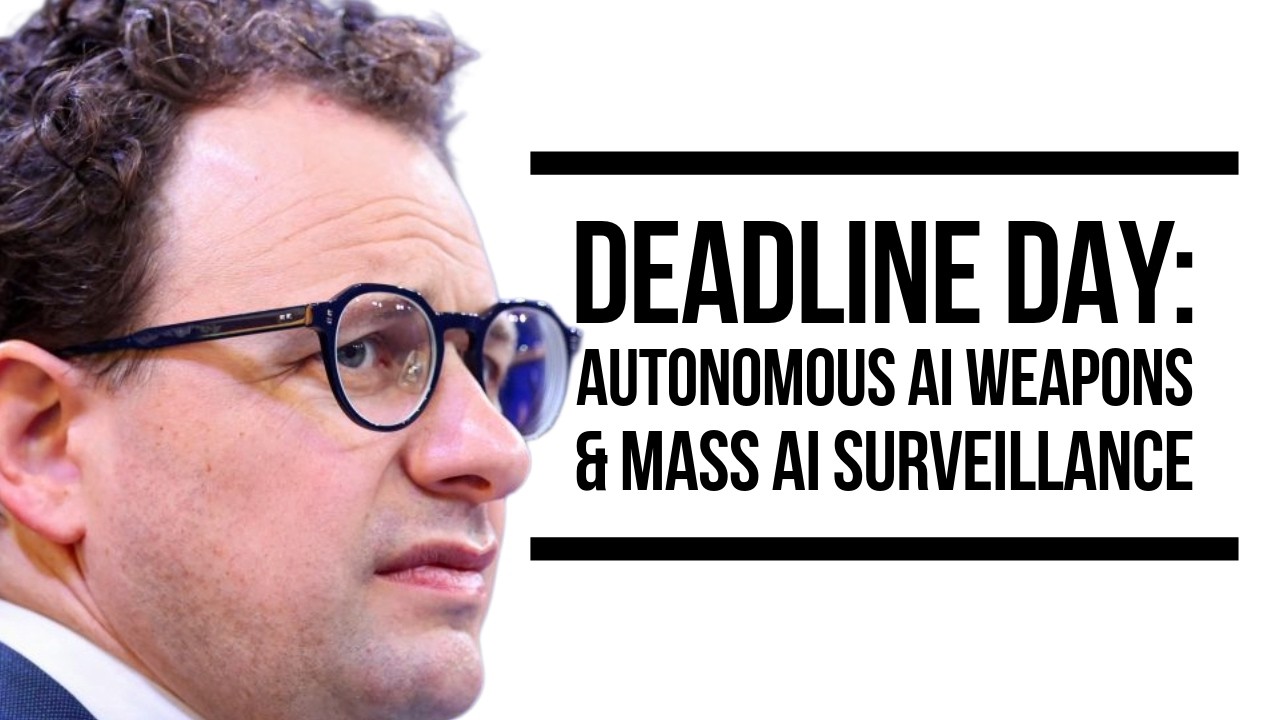
The video explores the conflict between Anthropic and the US Department of Defense over demands for nearly unrestricted use of AI, including autonomous weapons and mass surveillance, raising serious ethical and reliability concerns. It highlights the tension between national security interests, legal and policy contradictions, and the tech industry’s struggle to uphold ethical standards amid government pressure and rapid AI advancement.
The video discusses the looming deadline for Anthropic, the makers of the Claude AI models, to comply with demands from the US Department of Defense (referred to as the Department of War) for nearly unrestricted use of their AI systems. These demands include the potential for fully autonomous AI weapons—drones or humanoid robots capable of making lethal decisions without human oversight—and mass intelligence surveillance that could reduce crime but also erode privacy. The narrator raises ethical questions about whether such capabilities should be allowed, even if they are seen as necessary for national security, and notes a growing movement among employees at OpenAI and Google who are petitioning their leaders to resist similar government demands.
Anthropic is currently in a standoff with the Pentagon, which has threatened to designate the company as a supply chain risk—effectively blacklisting it from government contracts—or to invoke the Defense Production Act to force compliance. This is contradictory, as it would label Anthropic both a national security threat and an essential provider. The Pentagon’s demands also appear to contradict existing agreements and policies, such as a prior deal with Anthropic for “responsible use” of AI (no autonomous weapons or domestic surveillance) and Department of Defense directives requiring human oversight for autonomous weapons and restricting surveillance on US persons.
Anthropic’s objections to the Pentagon’s requests are twofold. First, they argue that while mass surveillance might technically be legal, this is only because the law hasn’t kept pace with AI’s capabilities. AI can now assemble vast amounts of innocuous data into detailed profiles of individuals without warrants, posing significant privacy risks. Second, Anthropic contends that current AI systems are simply not reliable enough to be trusted with autonomous lethal force or mass surveillance, citing recent research that highlights the unpredictability, inconsistency, and vulnerability of AI agents to manipulation and error.
The video references recent academic papers that demonstrate how AI agents can make serious mistakes, such as executing unauthorized commands or leaking sensitive information, and notes that improvements in AI reliability have been incremental at best. This unreliability is particularly concerning in high-stakes contexts like warfare or surveillance, where even a small percentage of failures could have catastrophic consequences. The narrator also points out that while some officials believe the Pentagon is acting on principle and won’t cross certain ethical lines, others suspect the government is intent on using AI for precisely these controversial purposes.
Finally, the video reveals that Anthropic has recently softened its own internal policies, dropping a previous commitment not to train new AI models unless safety measures were guaranteed. This change was made in response to competitive pressures, raising questions about whether any company can maintain strict ethical standards in the face of rapid technological advancement and government demands. The narrator concludes by expressing uncertainty about how the standoff will resolve but commends those in the tech industry who are willing to take a principled stand, even at the cost of profit.