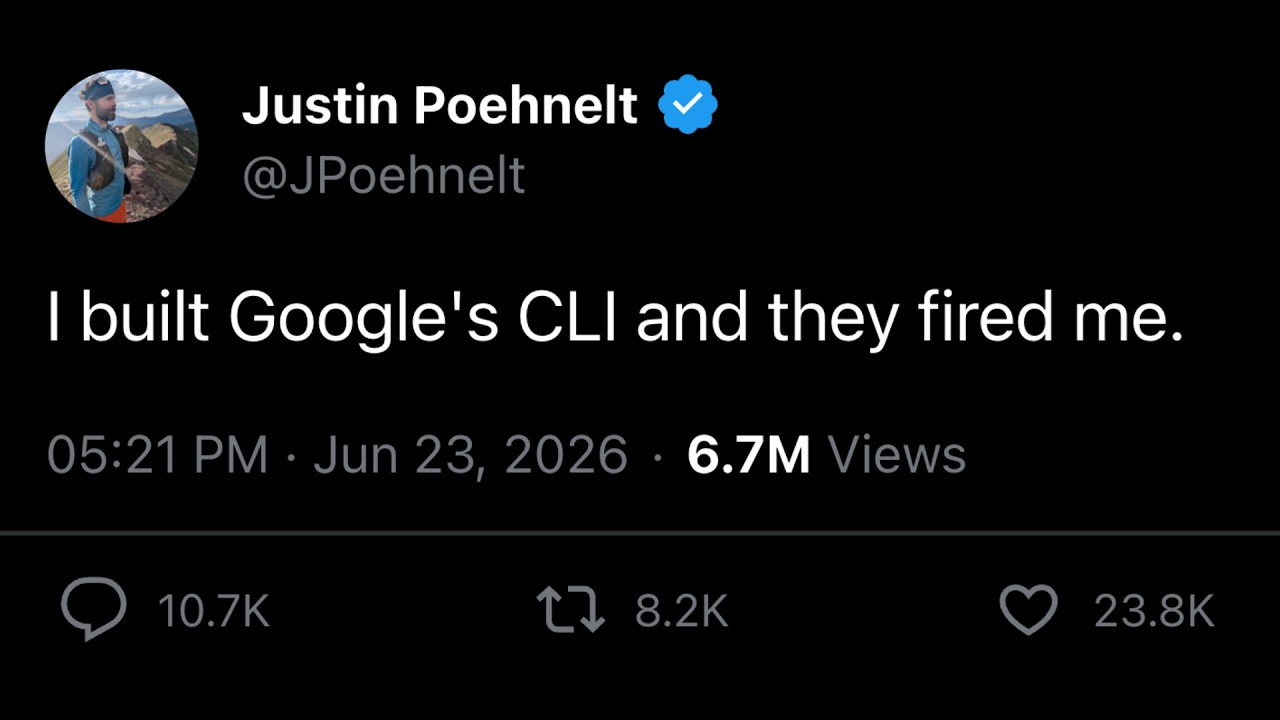
The video discusses significant recent departures of top AI researchers from Google DeepMind to Anthropic, highlighting a troubling internal environment at Google. Despite Google’s substantial resources, including a massive internal codebase and ownership stakes in Anthropic, the company appears to be struggling with cultural and strategic issues that are driving talent away. The creator of the popular Google Workspace CLI, Justin, was fired despite the tool’s success, illustrating a broader fear within Google of disruption and innovation, especially around AI agents and workspace tools.
The speaker contrasts Google’s approach with that of Anthropic and OpenAI, where experimental projects and internal hackathons are encouraged, fostering innovation and rapid product development. For example, OpenAI’s Codex began as a side project by a security engineer and was later embraced and open-sourced, while Anthropic supports experimental research like Claude code. Google, by contrast, seems to punish such initiatives, which stifles creativity and progress. This cultural rigidity is seen as a fundamental failure that hampers Google’s ability to compete effectively in the fast-evolving AI landscape.
Technically, Google’s AI models, particularly Gemini, are described as highly knowledgeable but poor at practical behavior and long-horizon tasks, such as coding with agents. The models often get stuck in reasoning loops and fail to complete tasks effectively, partly because Google’s training pipeline lacks the necessary data on real-world code changes and human-model interactions. This contrasts with smaller companies like Cursor, which have leveraged detailed usage histories to improve their models’ performance. Google’s focus on baking knowledge into models rather than improving their behavior is seen as a strategic misstep.
The video also critiques Google’s internal tools like anti-gravity, which are unpopular even among employees, and points out that despite having vast compute resources, Google is struggling with infrastructure and talent retention. The company’s delays in launching improved Gemini models and the departure of key personnel, including those recruited from competitors, signal deep-rooted problems. The speaker expresses skepticism about Google’s current trajectory, suggesting that without a fundamental cultural and strategic overhaul, the company will continue to lose ground to more agile competitors.
In conclusion, the speaker reflects on the broader implications of Google’s struggles, questioning whether the company was ever positioned to succeed in this new AI era. They invite viewers to share their thoughts on Google’s future and their experiences with Gemini. The overall tone is one of concern and disappointment, emphasizing that while Google has the potential to lead, it must first address its internal dysfunctions and embrace a more open, experimental culture to remain competitive in AI development.