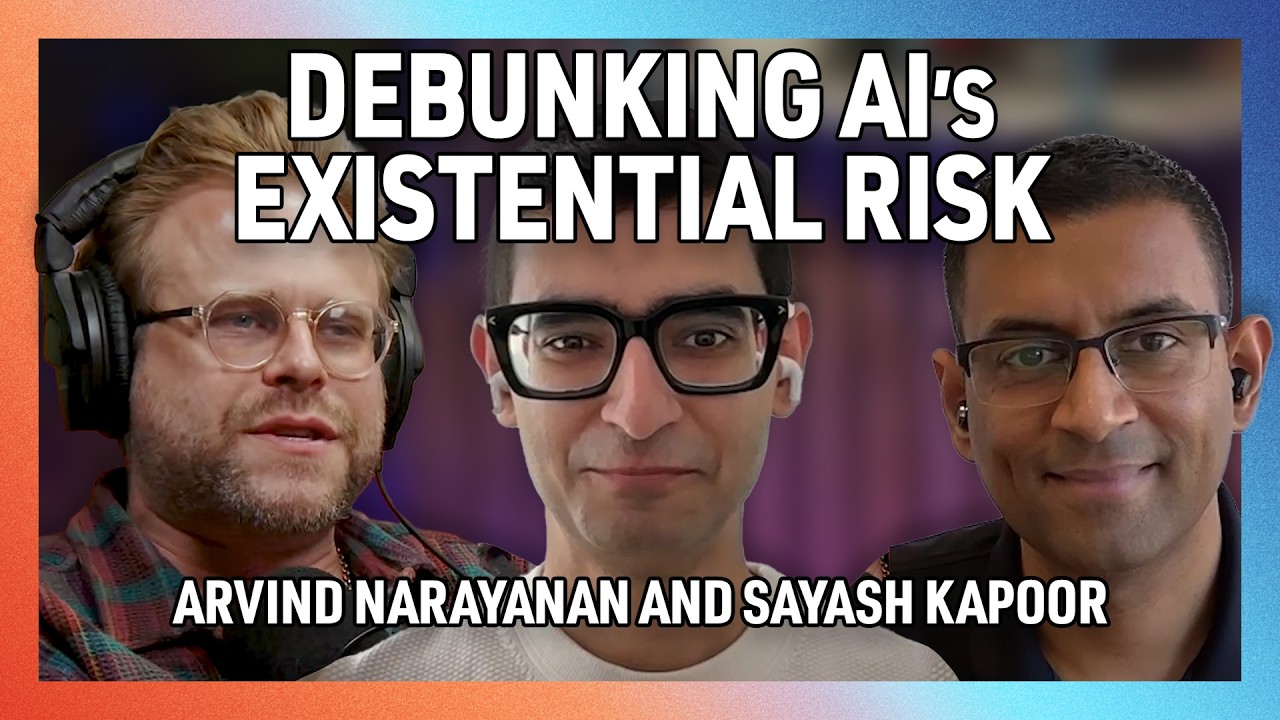
Certainly! Here’s a five-paragraph summary of the video transcript:
Adam Conover hosts AI researchers Arvind Narayanan and Sayash Kapoor to critically examine the popular claims about artificial intelligence (AI), particularly the idea that AI poses an existential risk to humanity. Adam opens by highlighting how extreme predictions—such as AI destroying all jobs or turning humans into paperclips—are often based on speculative thought experiments rather than real-world evidence. He stresses the importance of skepticism, especially since policymakers are increasingly influenced by these dramatic forecasts.
Narayanan and Kapoor discuss the actual progress of AI over the past 18 months, noting that while AI tools—especially for coding—have become more widely adopted and improved productivity, there has not been a corresponding loss of jobs in software engineering. They point out that many dire predictions about mass layoffs have not materialized, and that in many industries, especially regulated ones like healthcare and finance, AI adoption remains limited. They also note that some companies may use AI as a convenient excuse for layoffs that are actually due to other economic factors.
The conversation then turns to the existential risk narrative, where the guests argue that forecasts about AI wiping out humanity are not grounded in evidence or scientific reasoning. They explain that such predictions often rely on arbitrary numbers and speculative scenarios, lacking historical precedent or deductive logic. Instead, they emphasize that the real risks of AI come from how humans choose to deploy these systems—such as using AI irresponsibly in government or military contexts—rather than from AI itself becoming uncontrollable or superintelligent.
Narayanan and Kapoor advocate for viewing AI as a “normal technology,” akin to past transformative innovations like railroads or the industrial revolution. They argue that the integration of AI into society will be gradual, shaped by human choices, regulations, and market forces, rather than an abrupt, uncontrollable takeover. They highlight that while AI could bring significant changes—both positive and negative—society has agency in determining how these technologies are adopted and regulated, and that many of the challenges are political and economic rather than purely technical.
Finally, the guests urge a balanced perspective: while AI has the potential to bring substantial benefits, such as improving access to legal and medical services or increasing productivity, it also risks exacerbating existing societal inequalities if not managed properly. They stress that the focus should be on ensuring democratic oversight, robust regulation, and equitable distribution of AI’s benefits. Ultimately, they conclude that the real challenge is not the technology itself, but how society chooses to integrate and govern it—emphasizing human agency and the need for thoughtful, evidence-based policy rather than panic or fatalism.