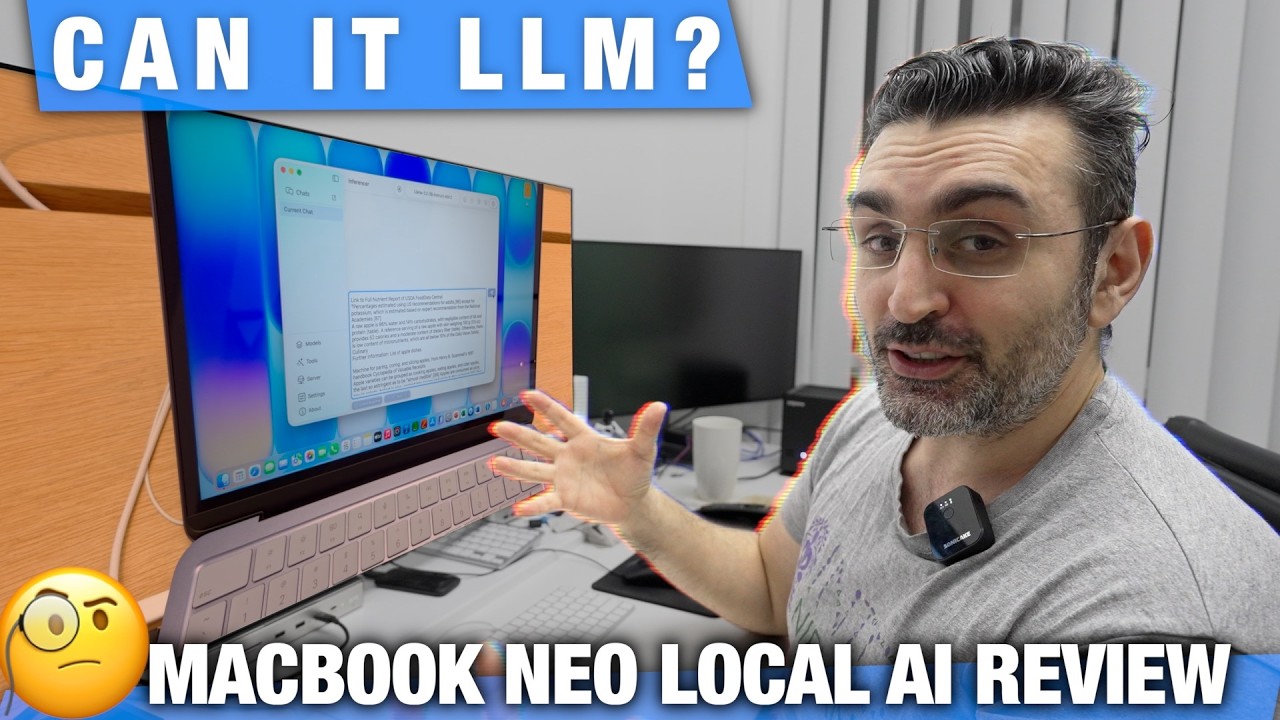
In this video, the host tests the capabilities of the MacBook Neo in handling large language models (LLMs), audio language models (ALMs), and vision language models (VLMs) by conducting undercover trials at an Apple Store. The main focus is on running extensive 10,000-token context window prompts using various models and quantization techniques to see if the MacBook Neo can manage such demanding tasks without running out of memory. The host begins with Llama 3.2, a 3-billion parameter model with 4-bit quantization, successfully processing the large prompt at a rate of 13 tokens per second, demonstrating the MacBook Neo’s potential despite its mobile phone-grade processor.
Memory usage is a critical factor throughout the tests, with the MacBook Neo’s system itself consuming a significant portion of RAM—around 6.7 to 7.4 GB—leaving limited headroom for inferencing applications. The host highlights the importance of choosing the right inferencing software, noting that some applications can use up to 17 GB of memory, which is impractical for the Neo’s 8 GB RAM. By contrast, more efficient applications like Infurancer use less memory, making them better suited for this hardware. This memory constraint is a recurring theme, especially when attempting to run larger models or longer context windows.
The host then experiments with newer and more complex models, including Google’s Gemma 4, which supports audio and image inferencing alongside language tasks. Despite the model’s advanced features, running a 10,000-token prompt proves challenging due to memory limitations, with the system maxing out around 7.7 GB of usage and the model struggling to complete the task. Smaller prompts work better, and the host demonstrates that even a simple story prompt runs smoothly at around 16 tokens per second, which is impressive given the MacBook Neo’s relatively modest hardware.
To push the limits further, the host employs a technique called turbo quantization, which reduces memory requirements by using 2-bit quantization with context precision. This approach allows the Gemma 4 model to start processing the 10,000-token prompt again, albeit at a slower speed of about 7 tokens per second and with memory usage still near the system’s limits. This shows that while the MacBook Neo can handle large context windows with optimization, it is still constrained by its hardware, and smaller prompts or reduced precision settings are more practical for everyday use.
In conclusion, the MacBook Neo is capable of running various LLMs, ALMs, and VLMs, but with significant limitations due to memory constraints imposed by the operating system and hardware. Efficient inferencing applications and quantization techniques like turbo quant help maximize performance, enabling the device to handle complex models and large context windows to some extent. The host encourages viewers to experiment with these models and share their experiences, highlighting that while the MacBook Neo may not be ideal for heavy-duty AI tasks, it still offers impressive capabilities for its class.