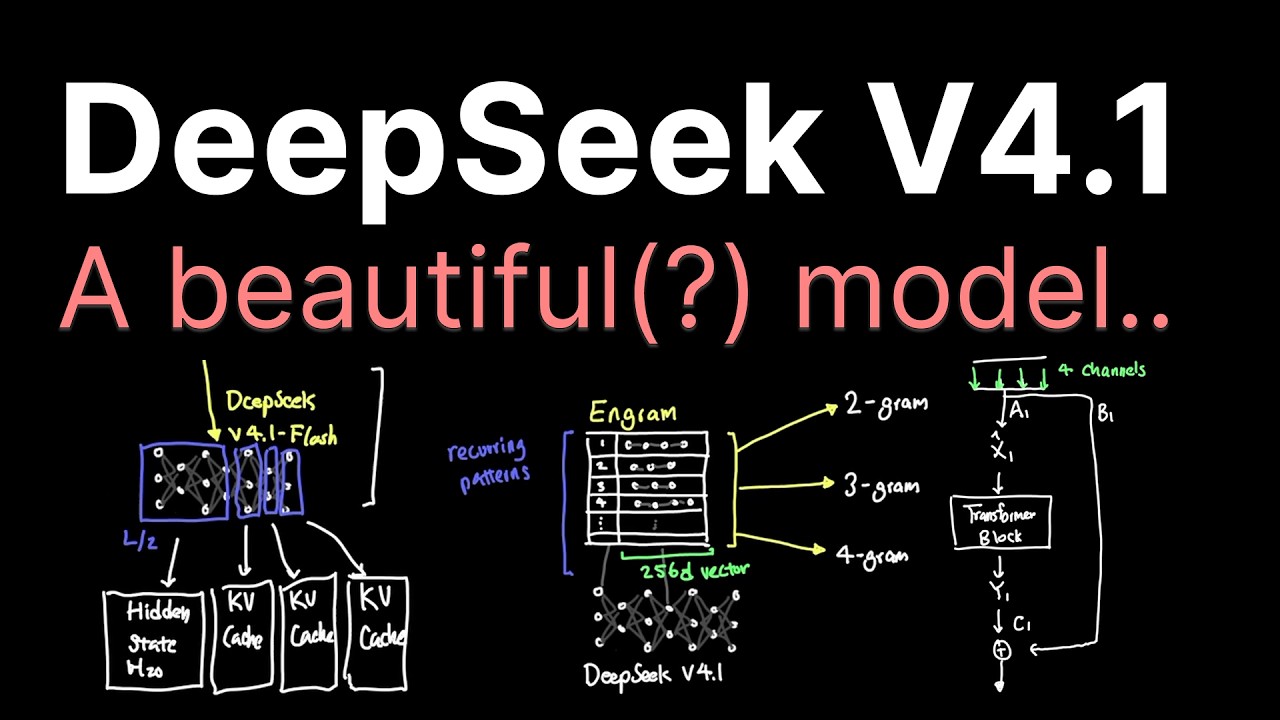
DeepSeek V4.1 Flash introduces a novel engram module designed to store recurring local language patterns separately from the main language model backbone. Instead of relying solely on internal parameters, this module creates a distinct memory storage where the model can look up frequently occurring token sequences during inference. The engram uses 2-gram, 3-gram, and 4-gram token patterns hashed into a fixed-size table with 384 million rows, each containing 256-dimensional vectors. This approach cleverly manages the otherwise astronomical number of possible token combinations by reducing vocabulary size and employing multiple hash heads, allowing the model to efficiently memorize and recall local patterns without overwhelming storage requirements.
Another key innovation in DeepSeek V4.1 Flash is the introduction of a causal encoder-decoder (CED) architecture, which revisits the transformer model’s original encoder-decoder design but adapts it for efficiency. Unlike the prevalent decoder-only models like GPT, CED splits the model into two parts: an encoder that processes input tokens during prefill and a decoder that handles output tokens during generation. This split significantly reduces the computational load and KV cache size during prefill, which dominates most real-world usage. By only using half the layers during prefill and the full model during decoding, DeepSeek achieves substantial efficiency gains without sacrificing model expressiveness.
To further optimize KV cache usage, DeepSeek employs CSA 2, an enhanced version of their previous Cross-layer Sparse Attention mechanism. CSA 2 introduces three modes—full, index, and reuse—that allow layers to selectively build or reuse KV cache entries, balancing computational cost and model performance. This selective reuse reduces redundant KV cache storage across layers, mitigating the overhead introduced by the CED architecture’s split while maintaining the benefits of layer-specific learned projections. Additionally, a hierarchical sparse indexer narrows down attention candidates to manageable blocks, improving efficiency in handling large context windows.
DeepSeek also optimizes the residual network’s memory handling through a single pass MHC (Multi-Headed Channel) mechanism. This innovation addresses inefficiencies in the original MHC design, which required multiple kernel operations and frequent data transfers between GPU memory hierarchies. By restructuring the algebraic dependencies, single pass MHC consolidates these operations into one kernel pass, reducing memory bandwidth usage and improving computational speed. This optimization leverages GPU memory architecture to minimize costly data movement, enhancing overall model throughput.
Overall, DeepSeek V4.1 Flash represents a sophisticated blend of architectural innovations aimed at improving memory efficiency, computational speed, and model scalability. The engram module enables effective local pattern memorization, the CED architecture reduces prefill compute and KV cache size, CSA 2 optimizes KV cache reuse, and single pass MHC streamlines GPU memory operations. While the model excels in cost and memory efficiency and achieves high token processing speeds, there remains room for improvement in token efficiency and model intelligence. Nonetheless, DeepSeek’s advancements mark a significant step forward in large language model design and deployment.