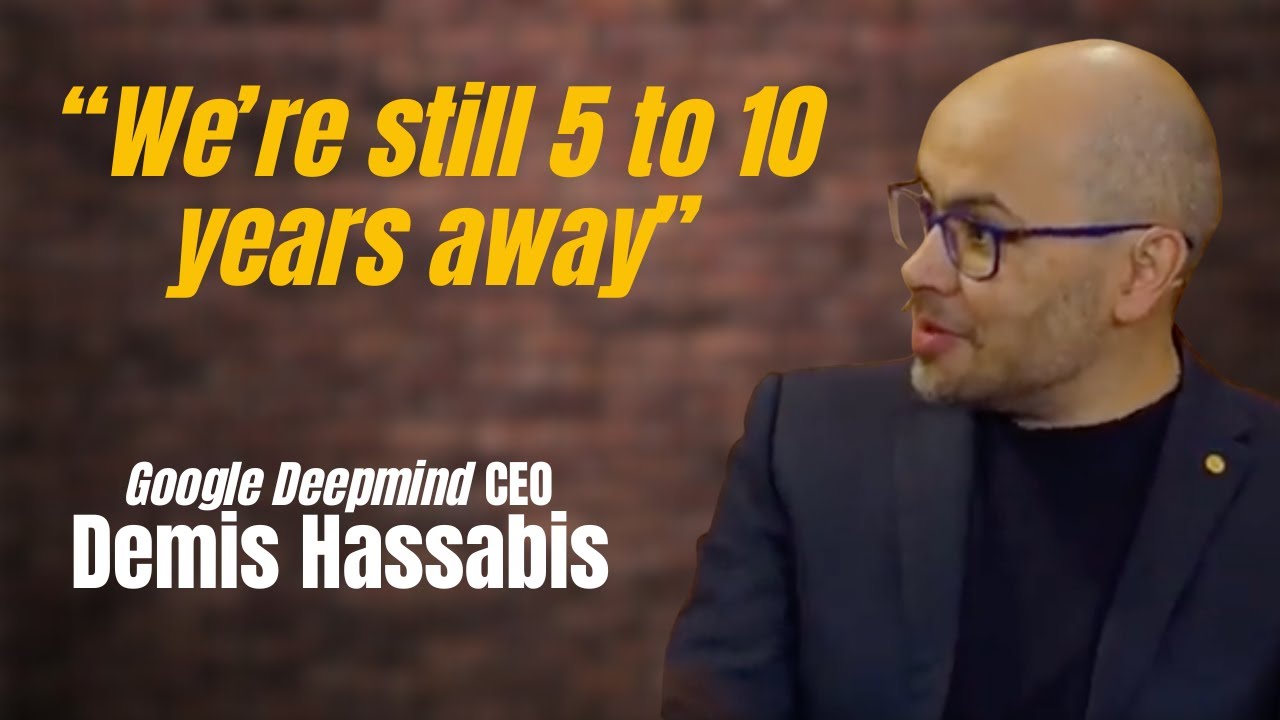
Demis Hassabis discusses the distinction between Artificial General Intelligence (AGI) and superintelligence, emphasizing that AGI should not be diluted into a marketing term. He defines AGI as a system capable of exhibiting all cognitive abilities that humans possess, including the highest levels of creativity and scientific innovation—such as formulating entirely new theories or artistic genres, not just solving existing problems. Hassabis argues that current AI systems, despite their impressive achievements, are still far from this level of capability, especially in terms of creativity and physical intelligence, such as elite sports performance or advanced robotics.
He addresses the argument that if a system could do all the things he describes, it would already be considered superintelligent. Hassabis disagrees, noting that while rare, individual humans have achieved such feats within the limits of human brain architecture. Superintelligence, in his view, refers to capabilities that go beyond human potential, such as thinking in many dimensions or directly integrating with vast external data sources. AGI, therefore, is about matching the full spectrum of human intelligence, while superintelligence would surpass it.
Hassabis also touches on the progress of AI models like image and video generators, such as DeepMind’s “Nano Banana” and “Veo.” He explains that these models are steps toward AGI because they demonstrate an emerging understanding of the physical world—what he calls “world models.” Such models are essential for long-term planning and reasoning, which are hallmarks of human intelligence. He envisions future AI systems that can integrate multiple modalities (text, image, video) into a single, unified model, which would be crucial for both robotics and universal digital assistants.
The conversation shifts to the impact of AI on human competition and work, using games like chess, Go, and StarCraft as examples. Hassabis notes that while AI has surpassed humans in these domains, human interest in the games remains strong, and top players have even improved by learning from AI. He draws a parallel to the Olympics, where human achievement is celebrated despite the existence of faster machines. Hassabis believes humans have an infinite capacity to adapt to new technologies because of our general intelligence and tool-making abilities.
Finally, Hassabis reflects on the broader societal implications of advanced AI, particularly regarding work, purpose, and meaning. He acknowledges that as AI automates more tasks, people may need to find new sources of fulfillment beyond traditional jobs. He suggests that humanity will adapt, as it has during previous technological revolutions, and may develop new forms of art, exploration, and philosophy. Hassabis concludes that while the transition will be significant—perhaps even more profound than the industrial revolution—it does not have to diminish human purpose or meaning.