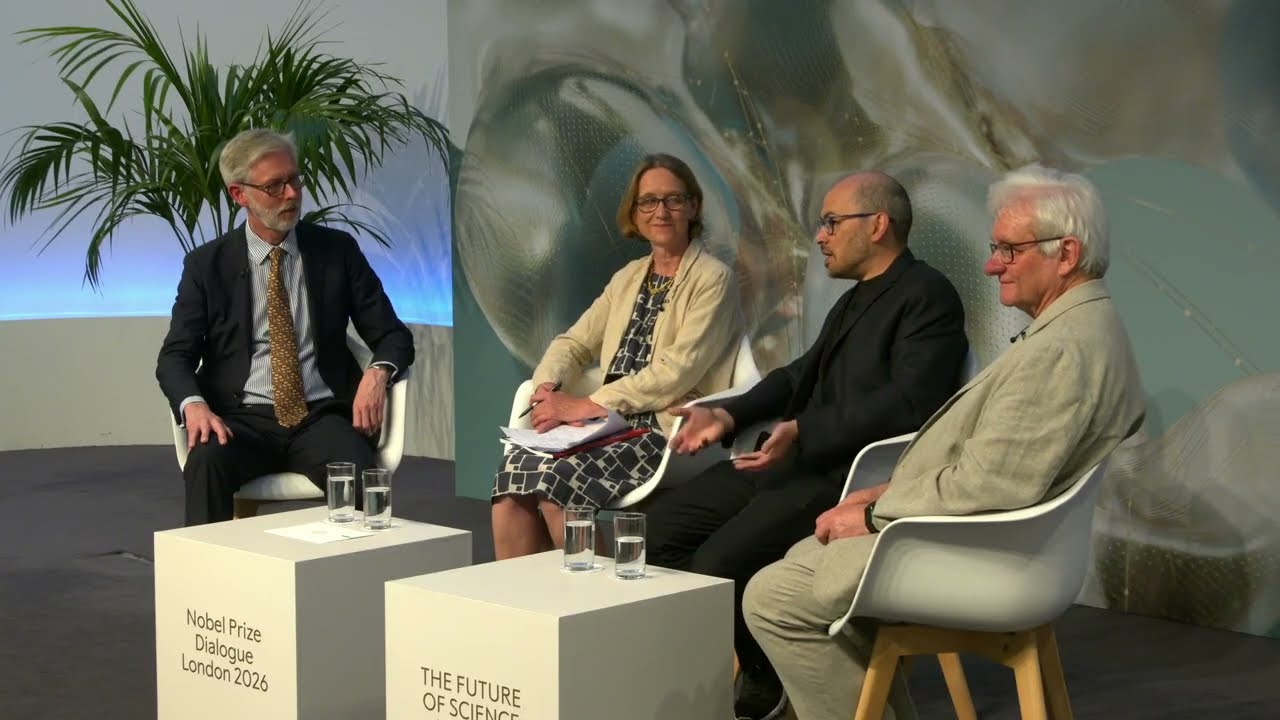
The discussion opens with reflections on the evolving understanding and perception of AI, particularly in science. Two years prior, many were unfamiliar with AI concepts like large language models, but widespread use of tools like ChatGPT has accelerated public and scientific comprehension. A report produced by the Royal Society explored AI’s disruptive impact on scientific methodology, emphasizing challenges such as access to data and compute resources, reproducibility, and the cultural shift towards team science. The report also highlighted the need for discipline-specific standards and international collaboration to responsibly harness AI’s potential in research.
Demis Hassabis, CEO of DeepMind, describes the transformative impact of AI on science, coining the phrase “science at digital speed.” He cites AlphaFold’s rapid and accurate protein folding predictions as a landmark achievement that accelerated scientific discovery and democratized access to complex data globally. Hassabis envisions an imminent “agentic era” where AI systems autonomously accelerate scientific breakthroughs, potentially ushering in a new renaissance in research. However, he cautions that while engineering advances rapidly, scientific understanding and rigorous evaluation of AI systems lag behind, underscoring the need for thoughtful deployment and governance.
Paul Nurse and Alison Noble contribute perspectives from biology and healthcare AI, respectively. Nurse emphasizes that AI has already streamlined routine tasks like image analysis, freeing scientists to focus on creative hypothesis generation. He discusses the ambitious goal of simulating a virtual cell, acknowledging the complexity and current limitations of modeling biological systems. Noble highlights the integration of AI with human expertise in medical imaging, noting progress from computational methods to co-designed solutions and the aspiration for fully autonomous robotic systems. Both stress the importance of interdisciplinary collaboration and adapting scientific workflows to incorporate AI effectively.
The panel addresses broader societal and ethical considerations, including equitable access to AI technologies, the challenges of managing vast data volumes, and the evolving nature of scientific inquiry. Hassabis advocates for focusing academic efforts on understanding and interpreting AI “black boxes” rather than competing to build ever-larger models, emphasizing creativity and imagination in applying AI to science. The conversation also touches on philosophical questions about consciousness, the scientific method, and the role of philosophy in shaping future science, with consensus that new frameworks are needed to accommodate AI-driven research paradigms.
Concluding the discussion, the panel reflects on AI’s impact on the culture and future of science. While acknowledging concerns about the pace of change and potential misuse, they remain optimistic about AI enabling a golden age of discovery by augmenting human creativity and accelerating experimentation. They stress that AI is a powerful tool that does not replace the fundamental scientific drive to understand the unknown. The dialogue underscores the importance of thoughtful integration, international collaboration, and continued reflection on ethical and societal implications as AI reshapes the scientific landscape.