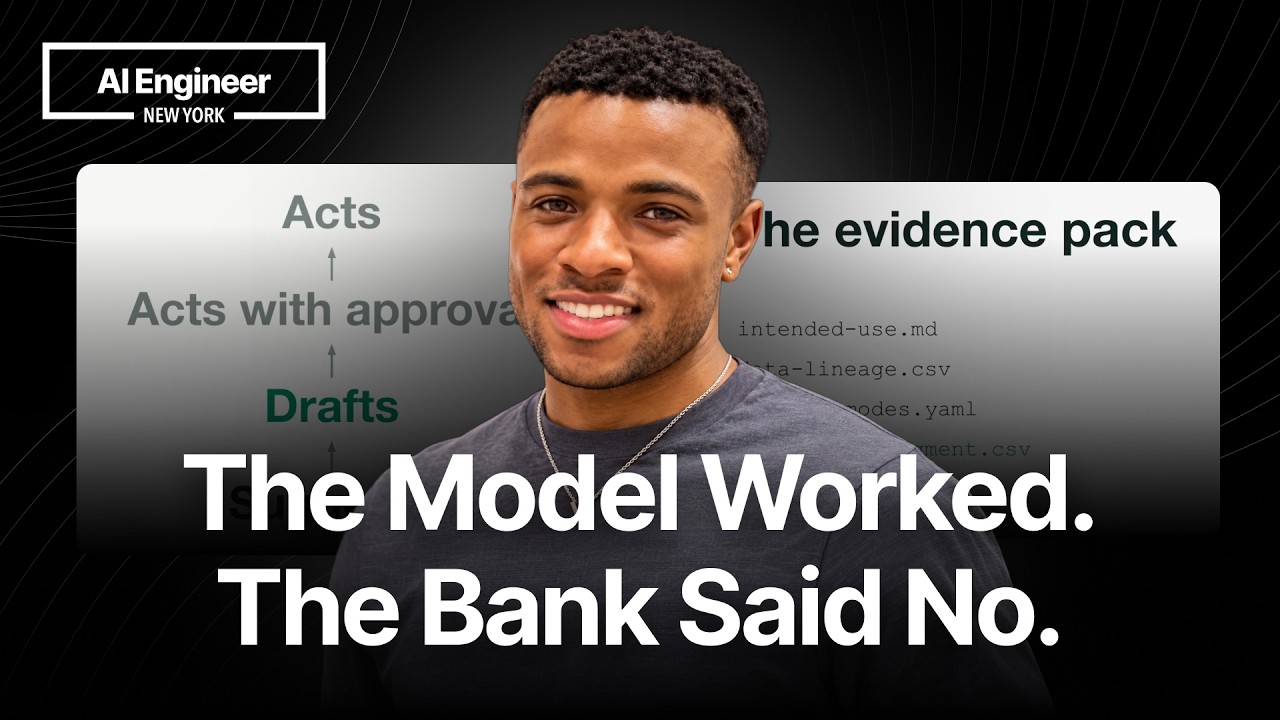
In this presentation, Paden Gayle discusses the challenges of deploying AI within a banking environment, emphasizing that it is not merely an engineering problem but one deeply intertwined with organizational, regulatory, and operational considerations. He begins by sharing his diverse background in consulting, software engineering, and security, highlighting his experience with complex systems at companies like Accenture, Bloomberg, and Google. Using a hypothetical example of a system that reviews customer documents and flags exceptions for analysts, he illustrates how technical success in a demonstration does not guarantee production deployment due to questions from security, data ownership, risk, and audit teams.
Gayle outlines four critical categories that influence AI deployment decisions: data ownership and access, model risk and verification, third-party dependencies, and audit requirements. He stresses the importance of identifying responsible individuals for each category early in the project to ensure clear accountability and evidence collection. This proactive engagement helps transform vague requirements and organizational uncertainties into a manageable implementation plan. He advises involving stakeholders from the start to define system boundaries, permissions, and risk controls, which are essential for creating a reliable path to production.
The speaker further explains the necessity of understanding the existing workflows and organizational structures before designing AI solutions. By mapping out who owns the data, who approves its use, and who manages risk and security, teams can avoid costly redesigns later. He recommends asking pointed questions about data storage, access permissions, risk reviews, and operational environments to clarify project scope and responsibilities. This approach enables the creation of a minimum viable product (MVP) that fits within current controls and can be iteratively improved based on real-world usage and evidence.
Gayle also discusses the concept of autonomy in AI systems, advocating for starting with minimal authority and gradually increasing it as confidence and evidence grow. He highlights the importance of defining failure modes, detection mechanisms, and backup plans, assigning clear responsibility for each potential issue. This disciplined approach ensures that automated actions are controlled and that human reviewers remain integral to decision-making, especially in high-stakes environments like banking. He emphasizes that risk assessment and operational readiness must be documented and continuously updated to maintain trust and compliance.
In conclusion, Paden Gayle summarizes his key takeaways: engineering AI deployment is fundamentally about research and discovery, involving specification, risk management, and stakeholder engagement. He encourages teams to focus on securing necessary permissions, defining clear workflows without over-relying on AI hype, and building evidence packages early in the development cycle. By doing so, organizations can navigate the complex regulatory and operational landscape of banking AI projects, moving from successful demonstrations to sustainable, approved production systems. Gayle invites further discussion on these topics and offers his contact information for those interested in learning more.
Useful Links