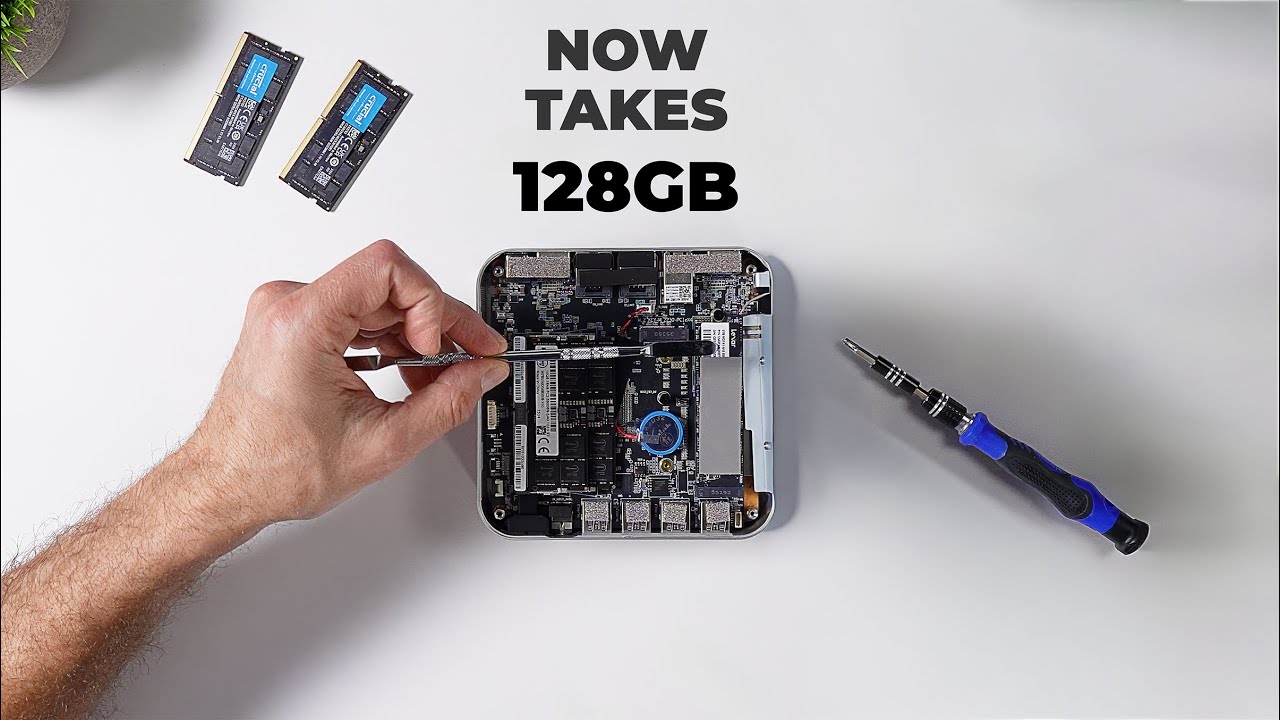
The video reviews the GeekCom A9 Max mini PC, which features the AMD Strix Point chip with a Ryzen AI 9 HX370 processor. This machine stands out because it offers upgradeable RAM up to 128 GB, unlike many competitors with soldered memory. The reviewed unit comes with 96 GB of DDR5 RAM and 2 TB of storage. The device has a variety of ports including multiple USB-A and USB4 ports, HDMI outputs, dual 2.5 gigabit Ethernet ports, an SD card reader, and a headphone jack. The system is built on a 4nm process, making it highly efficient, with an idle power consumption of just 3.7 watts.
Performance benchmarks show the A9 Max delivering solid results in both synthetic and real-world tests. In Geekbench, it scores moderately well, with single-core and multi-core scores of 2891 and 13,922 respectively, placing it around the middle of the pack among mini PCs. Web development benchmarks like Speedometer 3.1 show it performing better than most mini PCs except for the Mac Mini M4 series. However, some web tooling benchmarks reveal it lags behind the Mac Mini and the discontinued Snapdragon XLE dev kit, though memory type (soldered vs. upgradeable) does not seem to impact these results significantly.
The reviewer tests the A9 Max under realistic developer workloads, opening multiple IDEs, terminals, and browser tabs, and running large builds such as an NX monorepo and a .NET 9 application with 100,000 namespaces. Build times are competitive, with the NX monorepo building in about 14 seconds and the .NET project in around 95 seconds. A heavy multi-core Python fractal algorithm test also shows strong performance, with the CPU fully utilized and completing the task in about 33 seconds while consuming roughly 75-80 watts of power. These results position the A9 Max as a capable machine for demanding developer tasks at a price point under $1,000.
The video also explores the A9 Max’s capabilities with large language models (LLMs) using LM Studio, a cross-platform AI tool that leverages both CPU and GPU. Despite the integrated GPU having only 4.5 GB of dedicated memory, the machine can run smaller sparse models like OpenAI’s GPT OSS 20B and mixture of experts models with decent token generation speeds. Larger dense models like Llama 3 70B and 120B parameter models are more challenging but still partially load and run, albeit slowly. The reviewer experiments with offloading different numbers of model layers to the GPU, finding a balance between performance and stability, with token generation rates ranging from about 1.6 to 20 tokens per second depending on the model.
In conclusion, the GeekCom A9 Max offers a compelling balance of performance, flexibility, and price for developers and AI enthusiasts. It provides upgradeable high-capacity RAM, efficient power usage, and solid multi-core CPU performance suitable for large builds and multitasking. While it cannot match the top-tier Mac Mini M4 Pro in raw speed or GPU power, it delivers respectable AI model performance on a budget under $1,000. This makes it an attractive option for those seeking a versatile mini PC capable of handling both development workloads and local AI inference without breaking the bank.