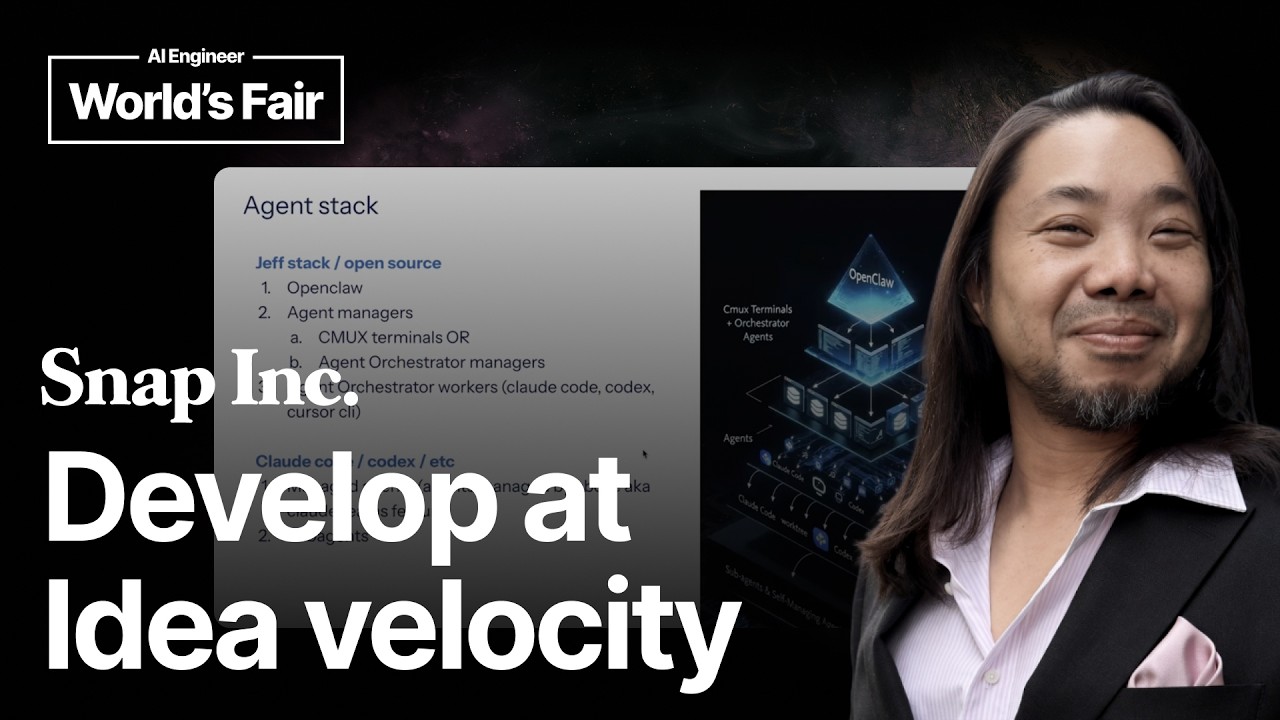
In this workshop, Jeffrey Lee-Chan introduces Open Claw, a tool that enhances developer productivity by enabling seamless communication with AI agents capable of managing context, parallel tasks, and autonomous code reviews. He demonstrates practical setup, advanced AI orchestration techniques, and shares real-world applications while addressing participant questions on environments, token management, and model selection.
In this workshop, Jeffrey Lee-Chan introduces Open Claw, a tool designed to enhance developer productivity by enabling frictionless communication with AI agents. He explains the setup process, catering to both beginners who need help installing Open Claw and advanced users interested in experimenting with staging environments and running multiple instances. Jeffrey emphasizes the importance of managing time effectively during the session, incorporating Q&A and discussions to keep participants engaged and on track.
Jeffrey provides an overview of how Open Claw works, highlighting its ability to maintain context and memory about tasks, which allows users to give brief commands without re-explaining details. He describes using multiple agents with work trees for parallelization and integrating continuous integration (CI) tools. The system can autonomously handle tasks like code reviews, and Jeffrey is working towards making the agents even more autonomous, reducing the need for human intervention.
A key distinction Jeffrey makes is between using Open Claw and directly using Claude, an AI model. Open Claw specializes in managing context related to specifications, goals, and task history rather than just code implementation. This specialization allows for more focused and efficient task management. He also discusses how Open Claw handles browser-based testing and visual elements, which are crucial for certain development tasks, and notes the continuous improvements in agent capabilities over time.
Jeffrey showcases two websites he developed: an AI-driven RPG that uses a Dungeons & Dragons style system with dice rolls for outcomes, and a multi-AI analysis platform that aggregates responses from various models to provide better answers. He also talks about his use of tmux, a terminal multiplexer, to manage multiple parallel tasks efficiently. Austin, one of the creators of tmux, joins the discussion to share recent updates and integrations, highlighting the tool’s benefits for developers working with AI agents.
Throughout the session, Jeffrey addresses questions from participants about sandbox environments, token usage, and model preferences. He explains the difference between local sandbox setups and staging environments, advising on how to manage token consumption effectively. Jeffrey also shares his approach to selecting AI models based on performance and cost, switching between models like Codex 53 and MiniMax depending on the task requirements. The workshop balances practical setup guidance with insights into advanced AI agent orchestration and development workflows.