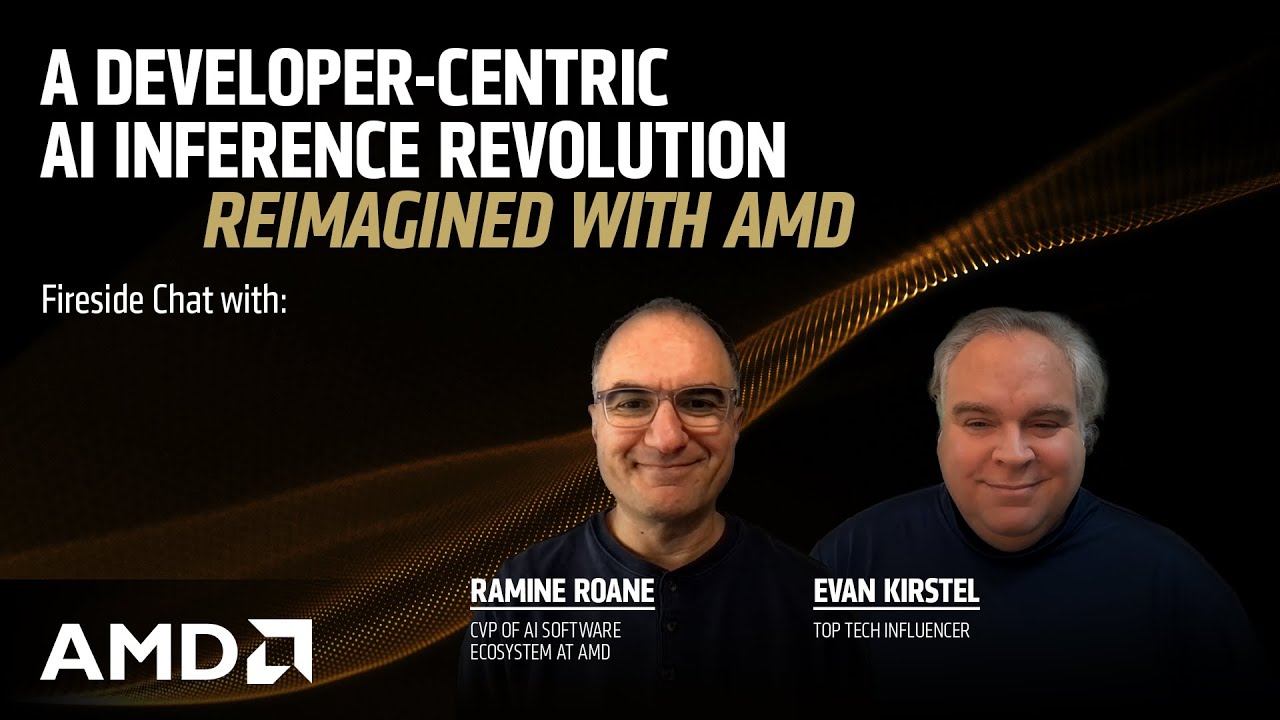
In this insightful fireside chat, Ramine Roane, leader of AMD’s AI group, shares AMD’s comprehensive vision and strategy for AI, highlighting their extensive portfolio that spans from edge devices like self-driving cars and AI-powered PCs to powerful GPUs in data centers. AMD’s approach is deeply rooted in open source, with their entire software stack, including the Rock M platform, being open source. This openness allows them to collaborate closely with the AI community and enterprises, enabling rapid innovation and adoption of their technology in real-world AI applications.
A key differentiator for AMD is the synergy between their hardware and software. Their GPUs stand out not only in compute power but also in memory capacity and bandwidth, thanks to advanced chiplet design and 3D packaging technologies. For example, their first AI GPU launched in 2023 featured 192GB of high-bandwidth memory (HBM), significantly surpassing competitors. This hardware advantage, combined with their open-source software stack, has led to rapid market penetration and adoption by major players like Microsoft and OpenAI, delivering measurable performance and efficiency gains.
AMD’s Rock M7 developer platform exemplifies their commitment to modular, open-source software that supports modern AI workloads. It has evolved to address emerging trends such as distributed and disaggregated inference, which optimize GPU utilization and reduce costs dramatically—by as much as 10 to 30 times per token in some cases. This approach allows enterprises to efficiently deploy AI workloads across clusters of GPUs, improving return on investment and enabling scalable AI inference for applications ranging from language models to video generation and recommendation systems.
Looking ahead, Ramine envisions a future where AI inference increasingly moves to the edge as devices become more powerful, potentially matching today’s data center GPUs within a few years. He also anticipates advances in federated training and more sustainable AI compute practices that reduce energy consumption significantly over time. While optimistic about AI’s trajectory, he remains skeptical about the near-term practical utility of quantum computing due to fundamental stability challenges with qubits.
Finally, Ramine addresses the question of whether the current AI excitement constitutes a bubble. He argues that the shift to deep learning represents a fundamental change in computing, enabling massive parallelization and the creation of entirely new algorithms that were previously impossible. This shift is driving exponential growth rather than a speculative bubble, and while some market segments may experience hype, the overall transformation in compute paradigms is real and sustainable. Looking to 2028, he hopes to see AI achieve groundbreaking scientific discoveries, such as proving unsolved mathematical theorems or unifying physical theories, marking a true milestone in AMD’s AI vision.