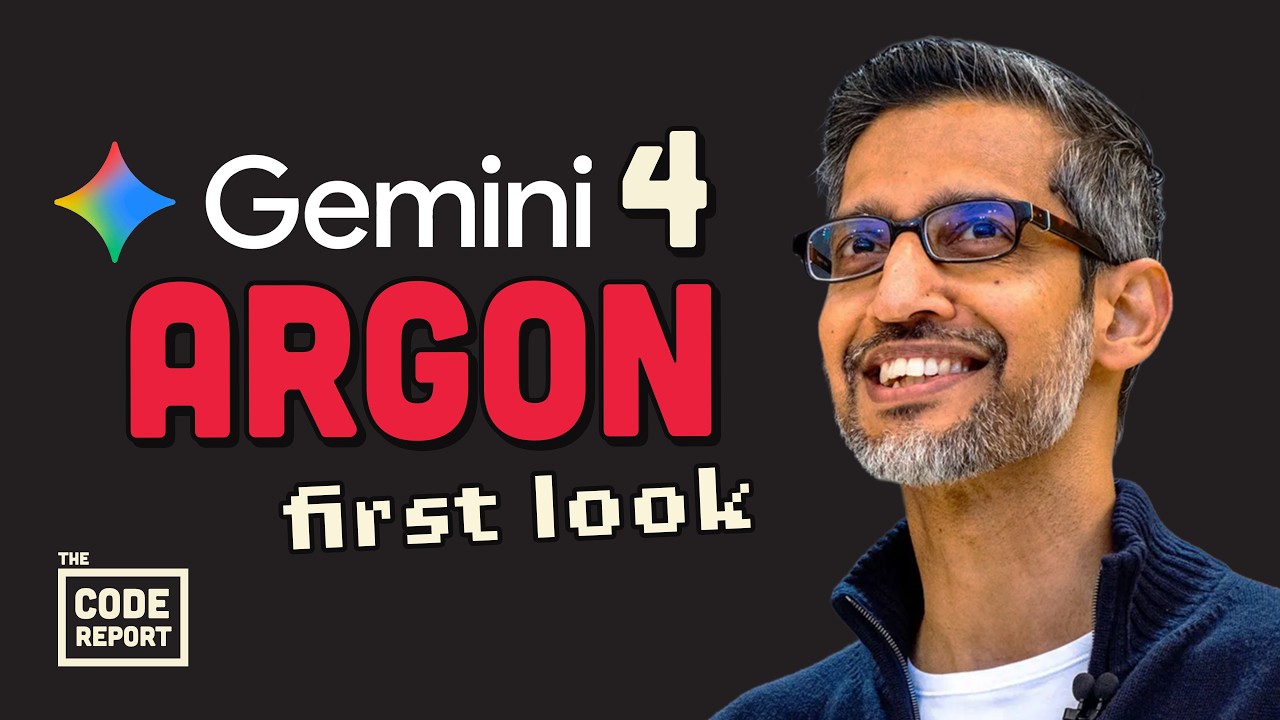
Last week marked a significant moment in AI development with Google’s release of Gemini 4 Argon, a powerful new AI model that has the potential to reshape the competitive landscape dominated by OpenAI and Anthropic. Unlike previous Gemini versions, Argon was trained from scratch over six months using Google’s TPUs and a specialized Python library, resulting in a sparse mixture of experts transformer. Despite the failure of Gemini 3.5 Pro, Argon has emerged as a frontier model that outperforms competitors like GPT6 Astra and Claude Opus 5.5 on several benchmarks, while also being more cost-effective and faster.
Argon’s capabilities are impressive across various domains. It excels in deep software engineering tasks, ranks highest on the Val index—which evaluates performance across finance, legal, and coding sectors—and is considered the best AI lawyer. It also dominates long video understanding benchmarks. However, Argon shows some weaknesses, such as underperforming in web development coding tasks compared to Claude and GPT6 Astra. This mixed performance suggests that while Argon is a strong generalist, it may not yet surpass all competitors in every specialized area.
One of Argon’s standout features is its omni-modal input and output capabilities, allowing it to handle images, videos, and sounds, unlike GPT and Claude, which cannot output raw video. However, in practical tests, Argon’s video generation was underwhelming compared to Claude, which excels by generating motion graphics through code rather than direct video synthesis. When tested on 3D graphics rendering using 3JS, Argon produced a visually appealing user interface but failed in alignment, generating an inappropriate and exaggerated anatomical feature on a 3D horse model, raising concerns about its safety and reliability.
Google’s launch strategy for Argon was somewhat controversial, as initial access was restricted to users with the expensive AI Ultra plan, frustrating many developers who had to wait longer for access with limited quotas. Despite this, the pricing for Argon is competitive, with low costs per million tokens, making it an attractive option for those who can access it. The model’s training cutoff is March 2026, indicating it is up-to-date with recent knowledge, and its performance on subjective human rankings places it at the top for text tasks, though less so for coding.
Overall, while Argon represents a significant leap forward for Google in the AI race, it is not without flaws, particularly in alignment and specialized coding tasks. The model’s broad capabilities and competitive pricing position it as a serious contender against OpenAI and Anthropic, but users should be cautious until Google addresses the alignment issues. Meanwhile, tools like Macroscope are highlighted as essential for managing the increasing complexity of AI-assisted coding workflows, emphasizing the evolving ecosystem around these advanced AI models.
Useful Links