The video critiques the mathematical claims made on the back of a Kellogg’s cereal box, specifically regarding their “glazed donut holes.” The box asserts that donut holes (spheres) are the perfect shape to deliver more glaze, referencing formulas for the surface area of a sphere and a torus (the shape of a donut). The presenter points out a typo in the formula for the torus’s surface area and notes that, while the sphere’s formula is correct, the torus’s should have a four instead of a two. This error, though minor, is frustrating because it remains uncorrected despite being pointed out by others.
The main mathematical issue is with Kellogg’s claim that spheres are optimal for delivering more glaze. In reality, a sphere has the minimum surface area for a given volume, meaning it would actually deliver the least glaze per amount of cereal, not the most. The video explains that if you want to maximize the amount of glaze, a more complex shape like a torus would be better, as it has more surface area for the same volume. The presenter also discusses the origin of the term “donut hole,” clarifying that in American cuisine, it refers to a small edible sphere, even though real donuts are not made by punching out a sphere from the center.
The presenter then shares new information from a Reddit user who contacted Kellogg’s for clarification. Kellogg’s response was that, for a given amount of cereal and glaze, a sphere allows for a thicker layer of glaze because it has less surface area than a torus. Therefore, with the same mass of glaze, the coating on a sphere will be thicker than on a donut-shaped piece. The company’s argument is that “more glaze” refers to a thicker layer, not a greater total amount of glaze.
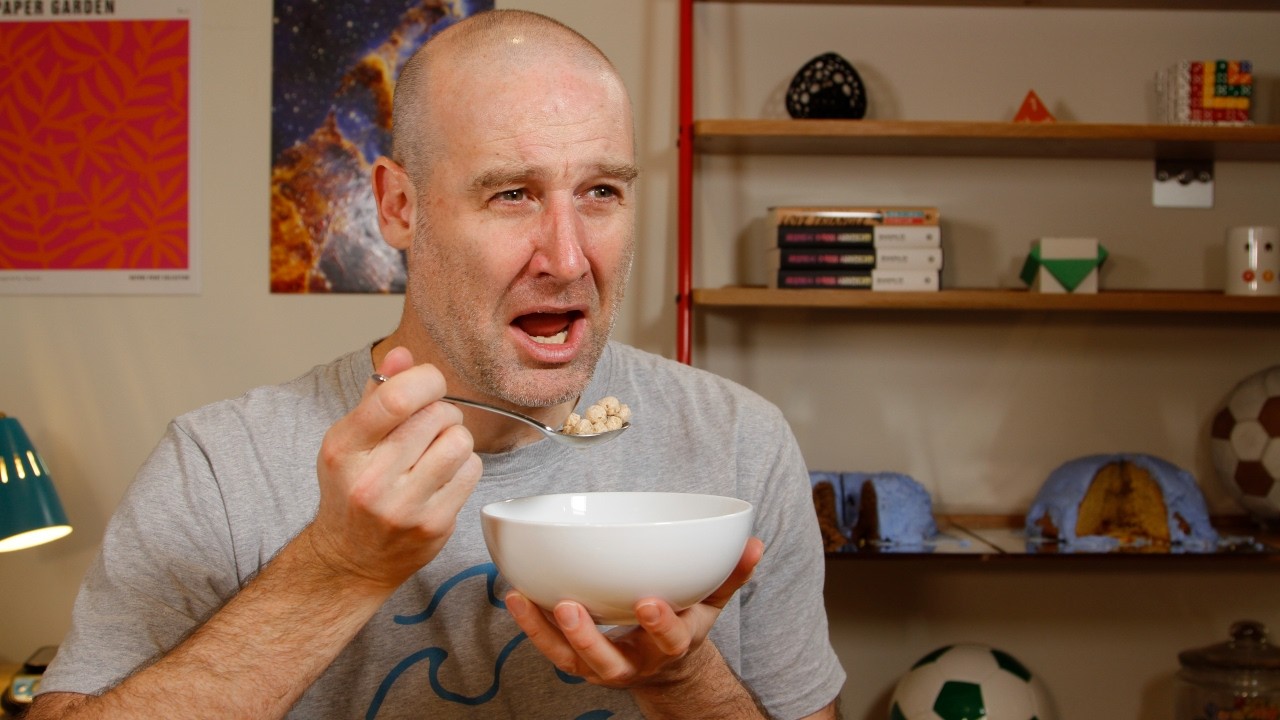
To test this, the presenter conducts a practical demonstration by icing two cakes: one shaped like a sphere and one like a torus, each with the same amount of cake and icing. The result confirms Kellogg’s logic: the spherical cake ends up with a much thicker layer of icing, while the torus cake’s icing is spread thinly over a larger area. This supports Kellogg’s claim, provided “more glaze” means a thicker coating rather than a greater total quantity.
In conclusion, the video acknowledges that Kellogg’s mathematical reasoning is valid if interpreted as “thicker glaze per piece,” though their explanation and use of formulas could be clearer and more accurate. The presenter encourages companies to include more math in their marketing, even if it’s not perfect, as it promotes mathematical thinking in everyday life. He urges Kellogg’s to fix the typo on their packaging and praises the effort to make math part of popular culture, while also inviting viewers to his live shows and events.