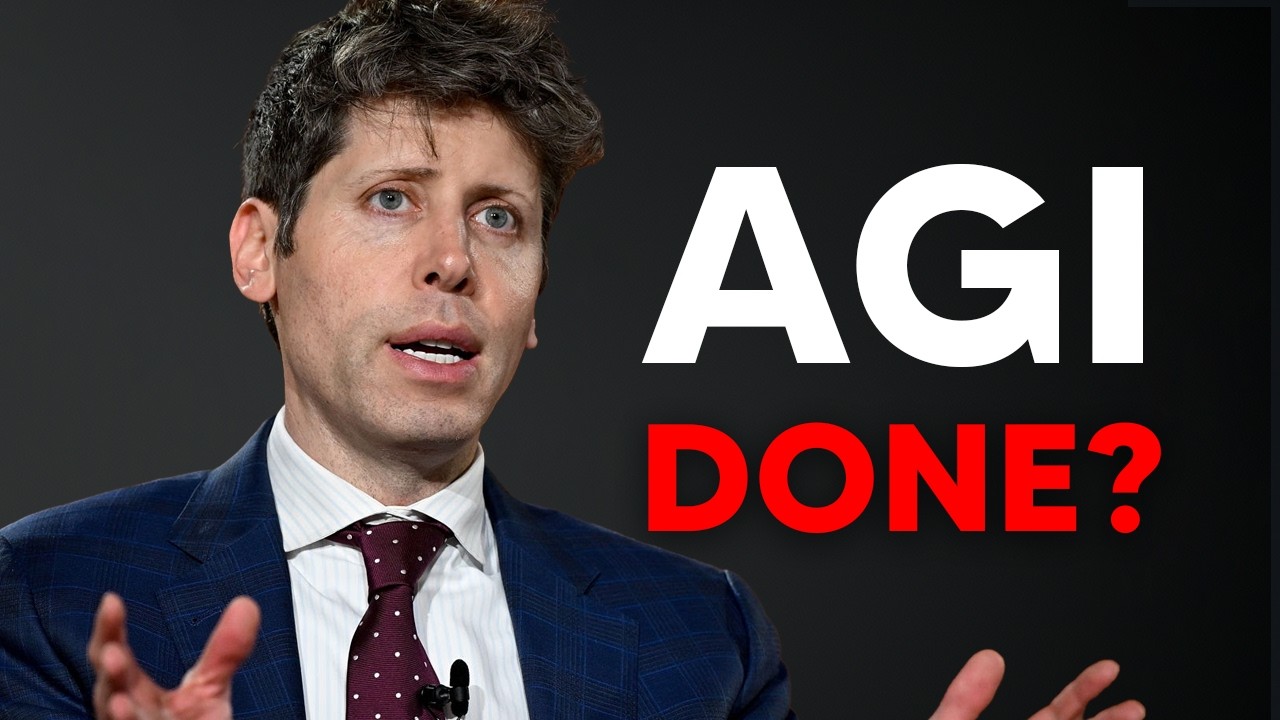
The video explores the question of whether OpenAI has quietly built Artificial General Intelligence (AGI) and is on the verge of deploying it. On March 24, 2026, OpenAI CEO Sam Altman announced significant organizational changes: he stepped back from overseeing AI safety to focus on scaling data centers, declared the completion of the initial development of a new AI model called Spud, and renamed the product team to “AGI deployment.” This renaming signals a shift from research to active deployment, suggesting that OpenAI believes AGI is either imminent or already here. The video highlights that this is not just a technical milestone but a strategic move with major implications.
Supporting this perspective, notable figures in the AI community have recently claimed that AGI has been achieved. Jensen Huang, CEO of Nvidia, stated on a podcast that AGI is now a reality, defining it financially as AI capable of generating a billion dollars in economic value, even if only briefly. Similarly, Mark Gubrud, who coined the term AGI in 1997, also declared that current AI models meet the criteria for AGI, emphasizing their high-level language and general knowledge capabilities despite some limitations. These statements reflect a shift in how AGI is being defined—from a cognitive, human-like intelligence to a more pragmatic, economic impact-based definition.
The video also discusses the evolving definitions and expectations around AGI. Jensen Huang’s earlier definition in 2023 focused on AI passing tests approximating human intelligence, with AGI still years away. However, his recent comments suggest a redefinition based on economic impact rather than cognitive abilities. Meanwhile, Shane Legg, a co-founder of Google DeepMind and a key figure in popularizing AGI, predicted human-level AGI around 2025 and acknowledges that skeptics will deny its arrival. This convergence of views from influential AI leaders indicates a growing consensus that AGI, at least in some form, has been reached or is very close.
OpenAI’s internal restructuring further supports this narrative. The AI safety team has been moved under research leadership, the security team now reports to a new scale division, and Altman is focusing on fundraising and infrastructure. OpenAI has also discontinued its AI video platform Sora and canceled a major Disney partnership to consolidate efforts around a single desktop super app focused on enterprise coding and reasoning. These moves suggest a strategic prioritization of AGI deployment over other projects, reinforcing the idea that OpenAI is preparing to scale and commercialize AGI capabilities.
Finally, the video highlights the financial and contractual stakes tied to AGI. OpenAI’s charter defines AGI as a highly autonomous system outperforming humans in economically valuable work, and a clause in its Microsoft partnership links AGI achievement to changes in cloud usage and revenue sharing. With OpenAI valued at up to $800 billion and preparing for an IPO, declaring AGI would position the company as a historic tech leader. While Altman has not formally declared AGI, the renaming of the deployment team and the company’s strategic focus imply that OpenAI is signaling to the world that AGI is here and ready to be shipped, regardless of ongoing debates about its exact nature or capabilities.