The video begins by addressing the current allocation of computing power by AI companies, noting that much of it is focused on monetizable applications like browsers and video shorts rather than pushing the frontier of AI intelligence and performance. This shift has led to a perceived slowdown in progress, but the speaker suggests that as these commercial avenues saturate, efforts will likely return to advancing frontier AI capabilities. The upcoming release of Google DeepMind’s Gemini 3 model is highlighted as an anticipated milestone, expected within the next two months, signaling renewed focus on cutting-edge AI development.
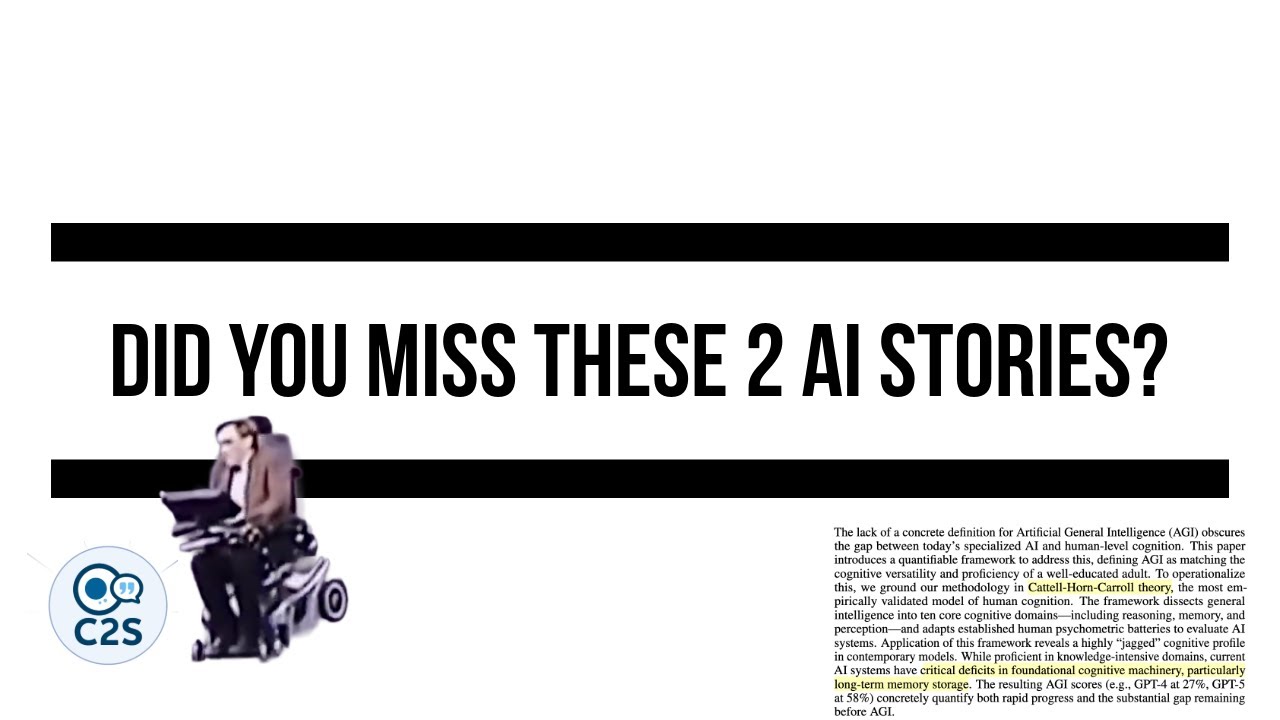
A standout story presented is about a relatively small language model called C2S scale, which, despite its modest size compared to state-of-the-art models, has made a significant scientific breakthrough. This model, based on the older Gemma 2 architecture, was specially trained to understand biological language and predict cellular responses to drugs, particularly focusing on interferon to convert cold cancer tumors into hot ones that the immune system can detect. Impressively, the model generated a novel drug candidate not previously documented in scientific literature, and its predictions were validated in vitro on human cells, marking a rare example of an LLM directly contributing to biological discovery.
The video then shifts to discussing the broader landscape of AI intelligence, referencing a recent paper that proposes a new definition of Artificial General Intelligence (AGI) based on the Cattell-Horn-Carroll theory of human cognition. This model breaks cognition into ten categories, each weighted equally, to assess AI capabilities. Current AI models like GPT-4 and GPT-5 score 27% and 58% respectively on this scale, indicating progress but also highlighting significant gaps, especially in areas like continual learning and memory. The speaker emphasizes that while models excel in knowledge and reasoning, their inability to remember and learn continuously across interactions remains a fundamental limitation.
A key insight comes from an interview with OpenAI’s VP of Research, Jerry Tuar, who discusses the challenges and risks of implementing continual learning in large-scale AI systems. While online reinforcement learning—where models learn in real-time from user interactions—is theoretically possible, it poses significant control and safety concerns. Without robust safeguards, models could inadvertently learn harmful or biased behaviors, making cautious approaches necessary. This highlights why current AI systems do not yet incorporate continual learning despite its potential to vastly improve utility and personalization.
The video concludes by touching on exciting developments in AI video generation, mentioning Sora 2’s ability to answer complex benchmark-level questions through video output, demonstrating the sophisticated real-time physics and calculations these models perform. The speaker also invites viewers to share their experiences with the new ChatGPT browser and expresses intentions to increase content production soon. Overall, the video paints a picture of a rapidly evolving AI landscape, balancing commercial priorities, scientific breakthroughs, and ongoing challenges in achieving true general intelligence.