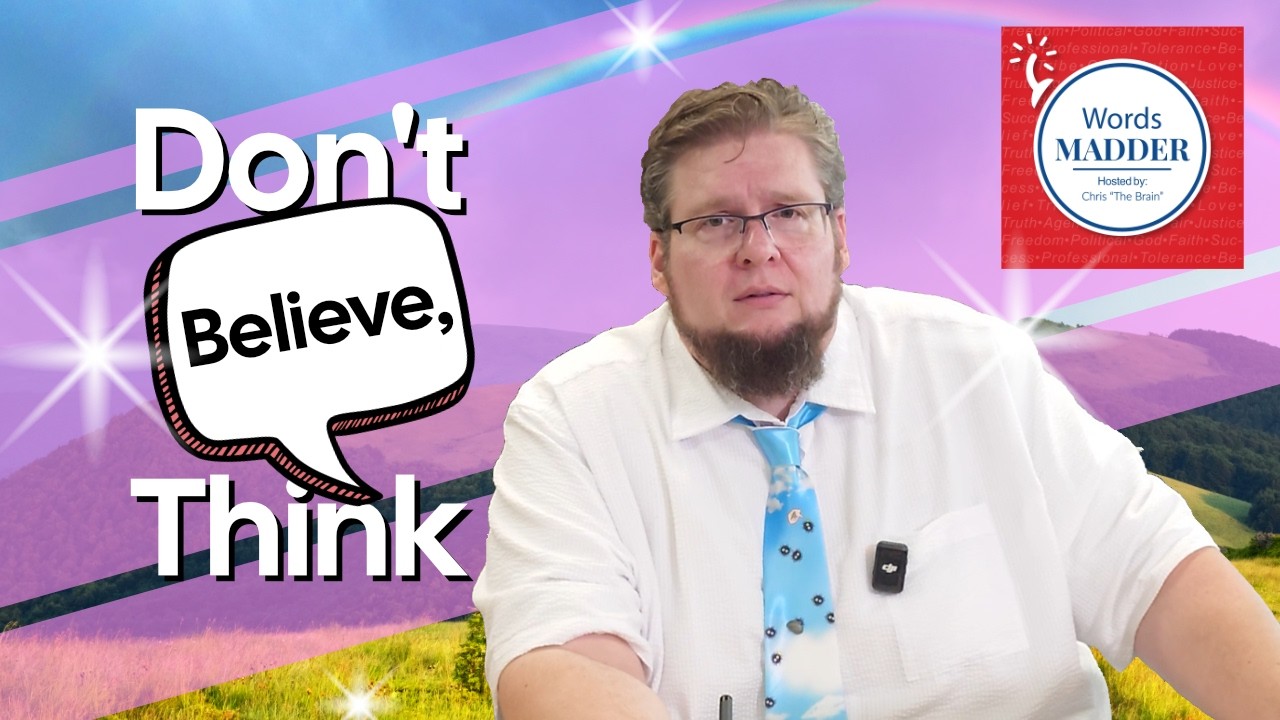
The video “Don’t ‘Believe’ Anything, Think | Words MADDER” critiques the modern misuse of the word “believe,” highlighting how it has been stretched far beyond its original, practical meaning. Traditionally, “believe” implied trust or confidence in someone based on their character or past behavior, often involving a rational judgment about the plausibility of a claim. For example, believing a trusted friend’s intentions or a spouse’s sighting of an unidentified flying object is grounded in reason and trust. However, today, “believe” is frequently used as a cultural escape hatch to avoid accountability, turning opinions into sacred, unquestionable beliefs, which stifles open debate and intellectual honesty.
The speaker emphasizes that in a free society, people should be able to hold differing opinions on matters that lack definitive proof, but calling opinions “beliefs” and demanding they be accepted as virtues is misleading and harmful. True virtue lies not in the beliefs themselves but in the values and actions that stem from them, such as kindness, forgiveness, and generosity. The video references religious texts from Christianity, Judaism, and Buddhism to illustrate that faith without corresponding actions is meaningless, and that many spiritual traditions prioritize deeds over mere belief.
The video also addresses the problematic phrase “I believe in science,” explaining that science is not a belief system but a discipline based on evidence and inquiry. The misuse of this phrase has contributed to a propaganda-like environment where people are encouraged to trust “experts” without understanding the evidence themselves. This dynamic mirrors historical religious gatekeeping, where knowledge was restricted to a select few. The speaker warns that this approach undermines public understanding and fosters tribalism, even though science should be democratized and accessible to all.
The speaker clarifies that their critique is not a denial of scientific facts, such as human-caused climate change, but a call for better science communication and education. They highlight examples of past scientific misconceptions and public health failures to show the dangers of blind trust in authority. The video praises thoughtful, balanced journalism, like a recent Canadian Broadcasting Corporation piece on Tylenol and autism, as a model for how science should be reported—calmly, thoroughly, and without sensationalism.
In conclusion, the video urges viewers to critically examine their own thoughts and distinguish between what they are convinced of and what is objectively true. It encourages open discourse grounded in evidence rather than sanctimonious declarations of belief. The speaker calls on everyone to challenge the misuse of “belief” in social contexts and to recognize that virtues are defined by actions and values, not by simply holding beliefs. Ultimately, the message is to think carefully, use words precisely, and value reasoned conviction over blind faith.