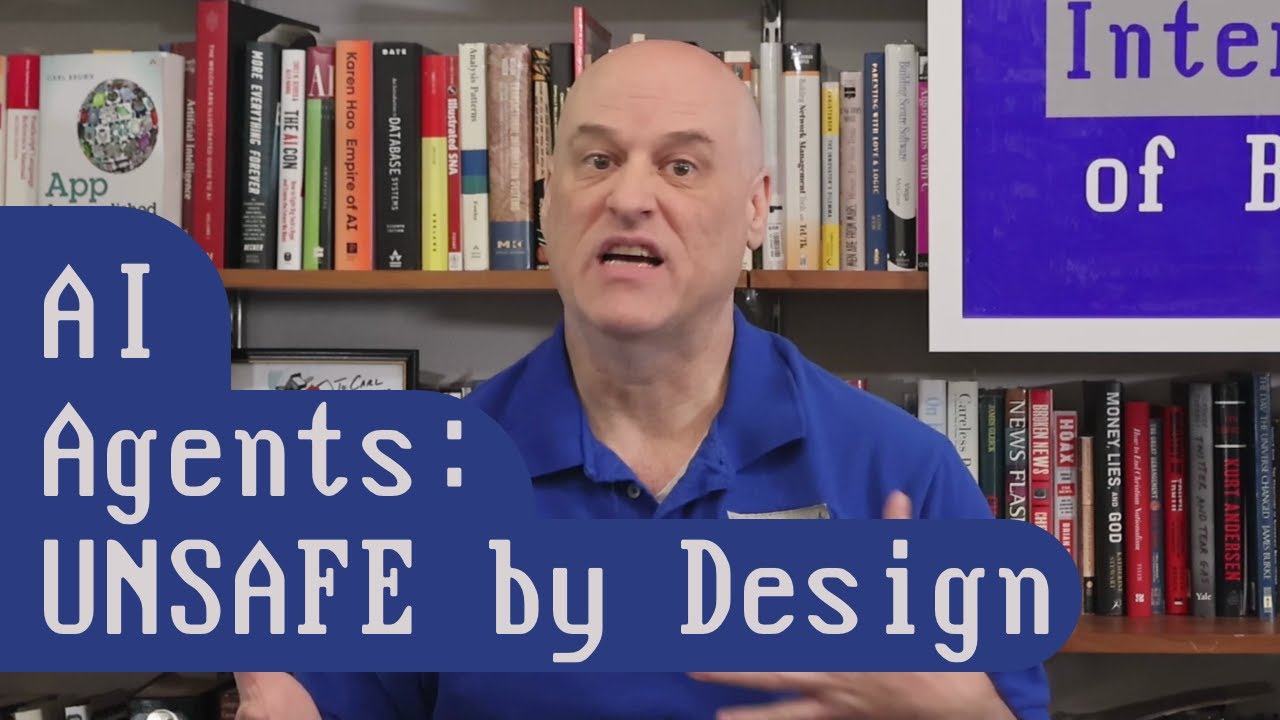
The video warns that AI agents and AI-enabled browsers pose serious security risks due to vulnerabilities like prompt injection, which can allow malicious content to trick AIs into leaking sensitive information or performing unauthorized actions. The creator urges viewers to avoid giving these tools access to anything sensitive and to be extremely cautious until the underlying security issues are properly addressed.
The video discusses the growing excitement around AI agents and browsers, highlighting recent industry developments such as Microsoft declaring 2026 the “year of the agent” and increased attention on tools like Claude Code. Despite the hype, the creator, Carl from Internet of Bugs, warns that these technologies introduce significant security risks that are not being adequately addressed by the companies promoting them. He emphasizes that the video is intentionally non-technical to ensure that a broad audience can understand the dangers involved.
Carl explains a fundamental vulnerability in how modern computers and generative AI systems operate. Both store instructions (actions to perform) and data (like documents or passwords) in similar ways. This design flaw means that if an AI agent is tricked—often by malicious content from the internet—it can confuse harmful instructions for legitimate ones, potentially leading to severe consequences such as leaking passwords or credit card information.
The core issue, known as “prompt injection,” arises when external content (like a webpage or email) is combined with a user’s prompt and treated as a single block of text by the AI. If the external content contains malicious instructions, the AI may unwittingly execute them, exposing sensitive information or performing unauthorized actions. Carl cites real-world examples where researchers have exploited this vulnerability in AI browsers and agents, noting that even after patches, new vulnerabilities continue to emerge.
Despite decades of security advancements that make online transactions relatively safe, Carl points out that AI agents cannot benefit from these protections. Even OpenAI admits that prompt injection is an “open challenge” that will take years to solve. Meanwhile, companies continue to push these technologies to users, often burying warnings deep in technical documentation rather than addressing the risks openly.
To protect themselves, Carl advises viewers to avoid giving AI agents or AI-enabled browsers access to anything they wouldn’t want a hacker to have. This includes not allowing agents to make purchases, access emails, or write files to a computer unless the user is technically skilled enough to isolate the agent in a secure environment. He warns that most online advice about protecting against prompt injection is ineffective and stresses that the only real defense is limiting what agents can access or do. The video concludes with a strong caution: using AI agents comes with serious risks, and users should be extremely careful or avoid them altogether until these security issues are resolved.