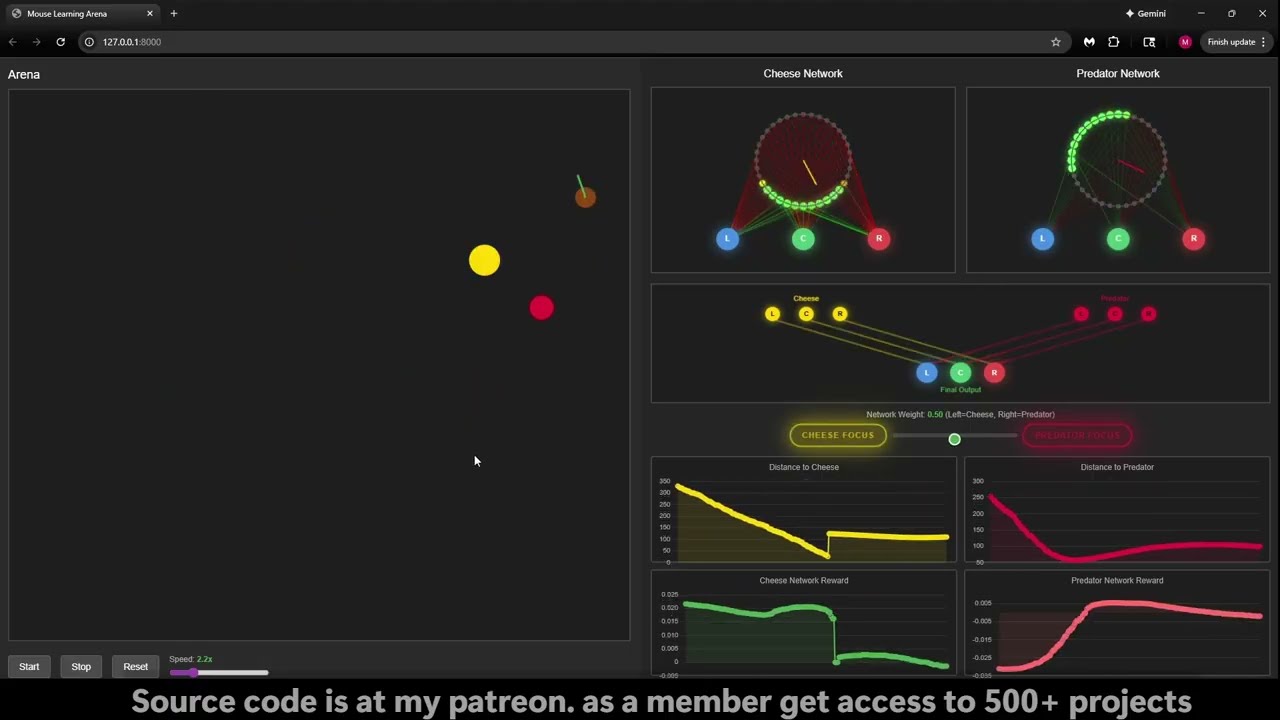
The video presents a neural network model inspired by a mouse brain that uses dual ring attractor networks—one for cheese seeking and one for predator avoidance—combined through a mixture of experts approach with reward-modulated Hebbian learning to navigate effectively. It demonstrates how adjusting the weighting between these networks influences behavior, highlighting the potential for more complex, context-sensitive decision-making with future expansions involving additional networks and dynamic gating.
In this video, the creator presents a neural network model inspired by a mouse brain, designed to navigate towards cheese while avoiding predators. The model consists of two separate networks: one dedicated to finding cheese and the other focused on predator avoidance. These two networks are combined using a mixture of experts approach, where a layer weighs the connection strengths from each network to produce the final motor output. Each network independently connects to three motor neurons and learns separately, with initial equal weighting of 50% for each network’s contribution.
The core of each network is a ring attractor network that encodes directional information—one points towards the cheese, and the other points towards the predator. These ring networks connect to the motor neurons, and the connection weights are updated using reward-modulated Hebbian learning. This learning rule strengthens connections that lead to positive outcomes: moving closer to the cheese yields a reward for the cheese network, while maintaining distance from the predator yields a reward for the predator avoidance network. The model learns quickly, adapting its behavior based on the rewards it receives.
The video demonstrates how adjusting the weighting between the two networks affects the mouse’s behavior. When the slider is set fully towards cheese, the mouse aggressively pursues the cheese without regard for the predator. Conversely, when the slider is moved towards predator avoidance, the mouse learns to stay away from the predator, although this learning is somewhat slower. The creator notes some challenges in situations where the mouse faces the predator head-on, as the ring attractor network’s population coding can make it difficult to differentiate directions precisely in such scenarios.
When the weighting is balanced equally between cheese seeking and predator avoidance, the mouse exhibits more complex behaviors, sometimes circling as it tries to navigate both goals simultaneously. The creator highlights that this mixture of experts approach is a promising framework and suggests that future work could involve more than two networks, potentially with a higher-level gating network that dynamically adjusts the influence of each expert based on the situation. This would allow for more intelligent and context-sensitive decision-making.
Finally, the creator invites viewers to access the source code for this project and many others by becoming patrons on their Patreon page. They also mention that free members can access a variety of open-source projects. The video concludes with thanks to the audience and a promise to explore more advanced mixture of experts models in future videos. Overall, this project showcases an interesting application of Hebbian learning and ring attractor networks in a biologically inspired navigation task.