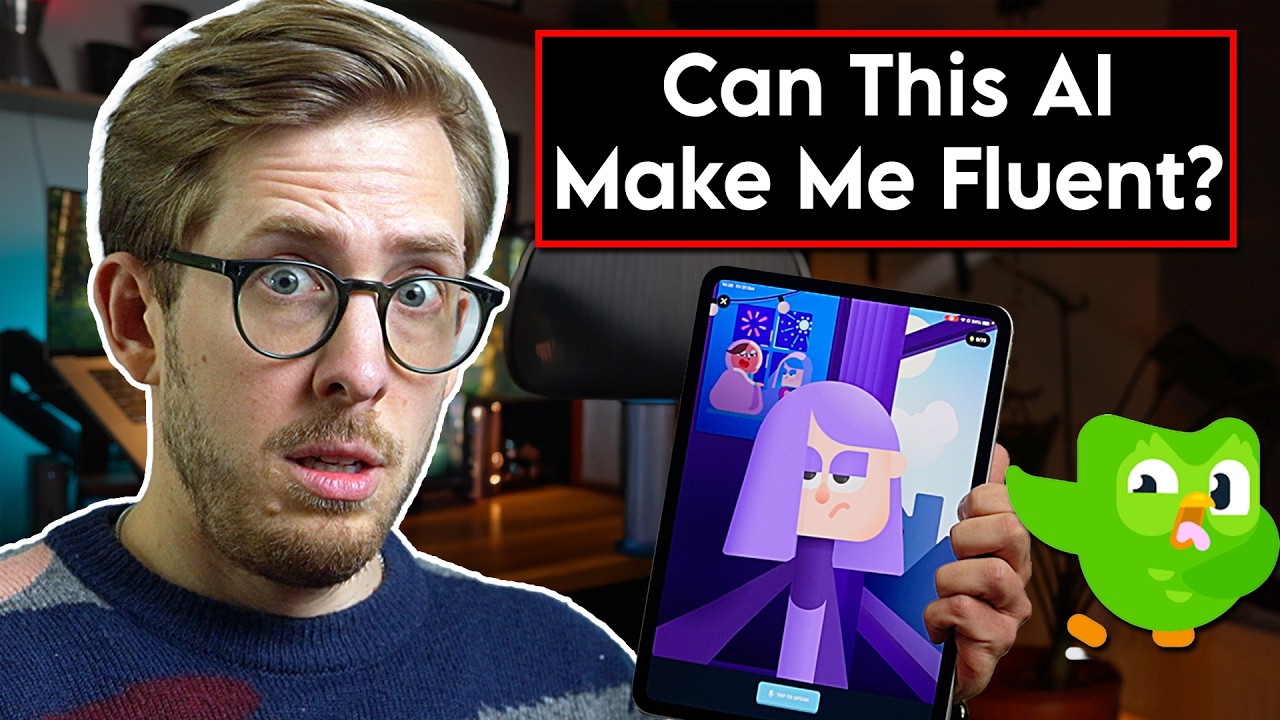
In this video, Evan Edinger explores Duolingo’s new AI chatbot, Lily, and how it has significantly impacted his language learning journey. Initially skeptical about Duolingo’s AI updates, Evan shares that after accidentally gaining access to Duolingo Max—a premium tier with advanced features—he found the app much more effective, especially for practicing spoken Spanish. Despite previous criticisms about the app’s redesign and paywalls, Evan acknowledges that the AI-powered video call feature with Lily has been a game-changer, allowing him to have real-time conversations that boost his fluency and confidence.
Evan explains the three tiers of Duolingo users: free, super, and max. Free users now face an energy-based system that severely limits how much they can learn daily without paying, making it nearly impossible to become fluent without upgrading. The super tier removes ads and offers unlimited energy for £5 a month, but still pushes users to upgrade to Max. The Max tier, costing £20 a month or £120 annually, unlocks key features like AI explanations for exercises, role-play conversations, and the video call feature with Lily, which is central to Evan’s improved fluency.
The video call feature is essentially a reskinned version of ChatGPT, tailored to simulate conversations in the target language with strict guidelines to keep interactions appropriate. This allows users to practice speaking freely on any topic, reinforcing vocabulary and grammar in a natural context. Evan highlights how this feature fills a crucial gap in language learning—active speaking practice—which was previously missing from Duolingo. He shares tips for maximizing this tool, such as asking Lily to correct grammar or focus on specific language concepts, and recommends using it during everyday activities like cooking to integrate learning seamlessly into daily life.
Evan also discusses the overall structure of Duolingo’s language path, which now includes lessons targeting vocabulary, listening, reading, writing, and speaking. While he praises the comprehensive approach, he criticizes the AI-generated stories and audio lessons for being dull and formulaic, suggesting that human-written content would improve engagement. Nonetheless, he believes the app now covers all essential language skills, with the AI conversation feature being the standout addition that has helped him achieve conversational fluency in Spanish solely through Duolingo.
Finally, Evan addresses the common skepticism about achieving fluency using only Duolingo. He argues that while it may not be the most efficient method, it is indeed possible, as demonstrated by his own experience of learning Spanish without other resources. He emphasizes that confidence and consistent practice are key to fluency and that Duolingo’s AI features, especially Lily, have accelerated his progress. Evan plans to continue documenting his journey and share insights on the strengths and weaknesses of relying solely on Duolingo for language learning in future videos.