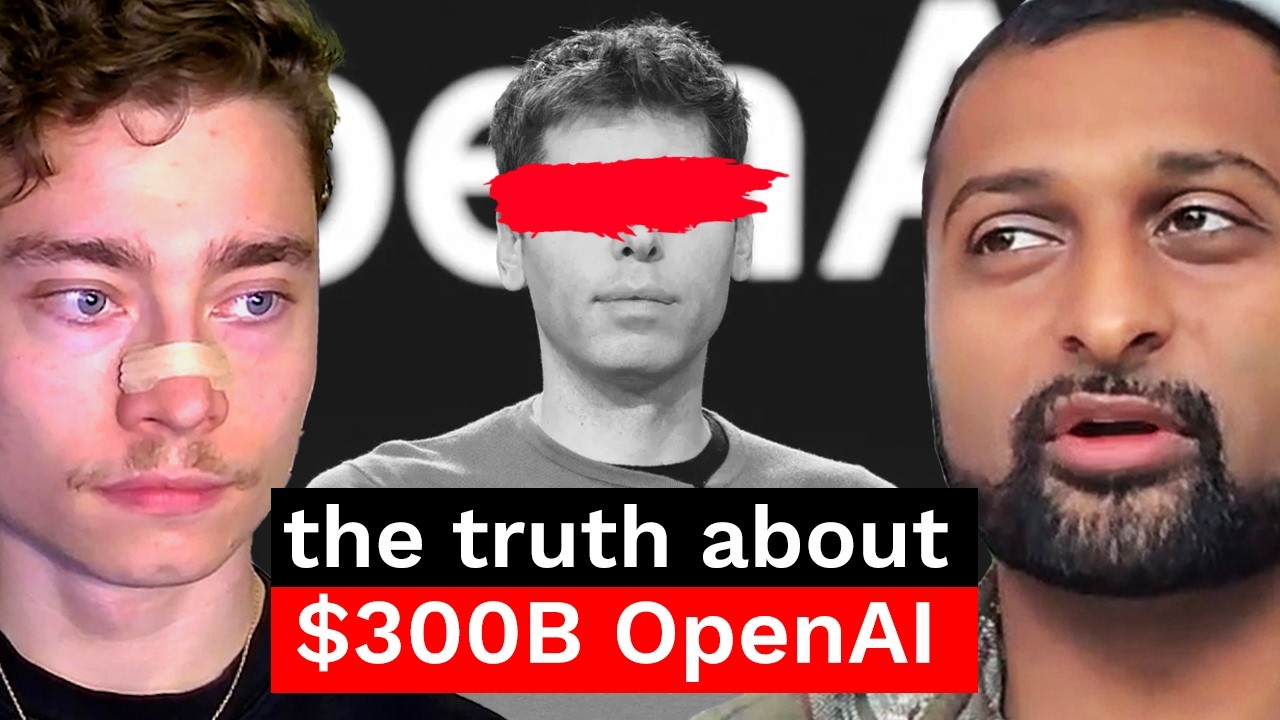
In this insightful podcast, Dylan Patel, founder and CEO of Semi Analysis, discusses the evolving landscape of AI, focusing on the competition between OpenAI and Anthropic, the recent $300 billion OpenAI-Oracle deal, and the future of AI startups. Patel highlights the unprecedented nature of the Oracle deal, emphasizing its scale in compute power and the rare four-year revenue guidance Oracle provided, which significantly boosted Larry Ellison’s net worth. This deal positions OpenAI uniquely, as Oracle is not a competing hyperscaler, unlike Microsoft or Amazon, giving OpenAI a strategic advantage in securing massive compute resources.
Patel delves into the rivalry between OpenAI and Anthropic, noting that Anthropic’s rapid revenue growth suggests it could surpass OpenAI by 2027. He attributes Anthropic’s success to its focused mission and cohesive leadership, describing it as somewhat of a “cult” with a unified vision centered on solving software engineering challenges to accelerate AGI development. In contrast, OpenAI has a broader range of goals and a less unified culture, which Patel believes affects its focus and execution. He also discusses the coding AI market, where Anthropic’s Claude Code currently leads in productivity and user willingness to pay, while OpenAI is aggressively improving its Codex offering to compete.
The conversation further explores the strengths and weaknesses of both companies’ coding AI tools. Patel notes that OpenAI’s Codex, especially with the GPT-5 high reasoning model, has become significantly smarter and more capable than Anthropic’s Opus 4.1, particularly in complex reasoning tasks, though it is slower. Meanwhile, Anthropic’s models provide quicker, more confident responses, making them preferable for instant feedback and simpler tasks. Patel suggests that the future of coding AI may involve using both tools complementarily, leveraging Codex for deep, complex problems and Claude Code for faster, iterative work.
Beyond coding, Patel emphasizes the importance of “computer use” AI—models that can interact with and manipulate software environments directly—as a major frontier for productivity gains. He argues that while AI models have advanced in writing and coding, the real transformative potential lies in AI’s ability to understand and operate within complex software systems like CRM and ERP platforms, which are critical to organizational efficiency. He also discusses the challenges of integrating AI with mobile platforms and the role of multi-cloud personal assistants (MCPs), noting privacy and trust issues that limit their adoption, especially in corporate environments.
Finally, Patel offers advice for AI startup founders, recommending a focus on low-hanging fruit and rapid iteration rather than pursuing massive, highly regulated markets initially. He stresses the importance of founders being directly involved in sales and go-to-market strategies, as these skills are crucial for success. Patel is cautiously optimistic about the future of AI, predicting transformational societal changes without necessarily achieving full AGI by 2030. He also comments on the competitive landscape, including Google’s advancements with Gemini 3.0 and XAI’s progress, highlighting the ongoing race for talent, compute, and data as key factors shaping the industry’s future.