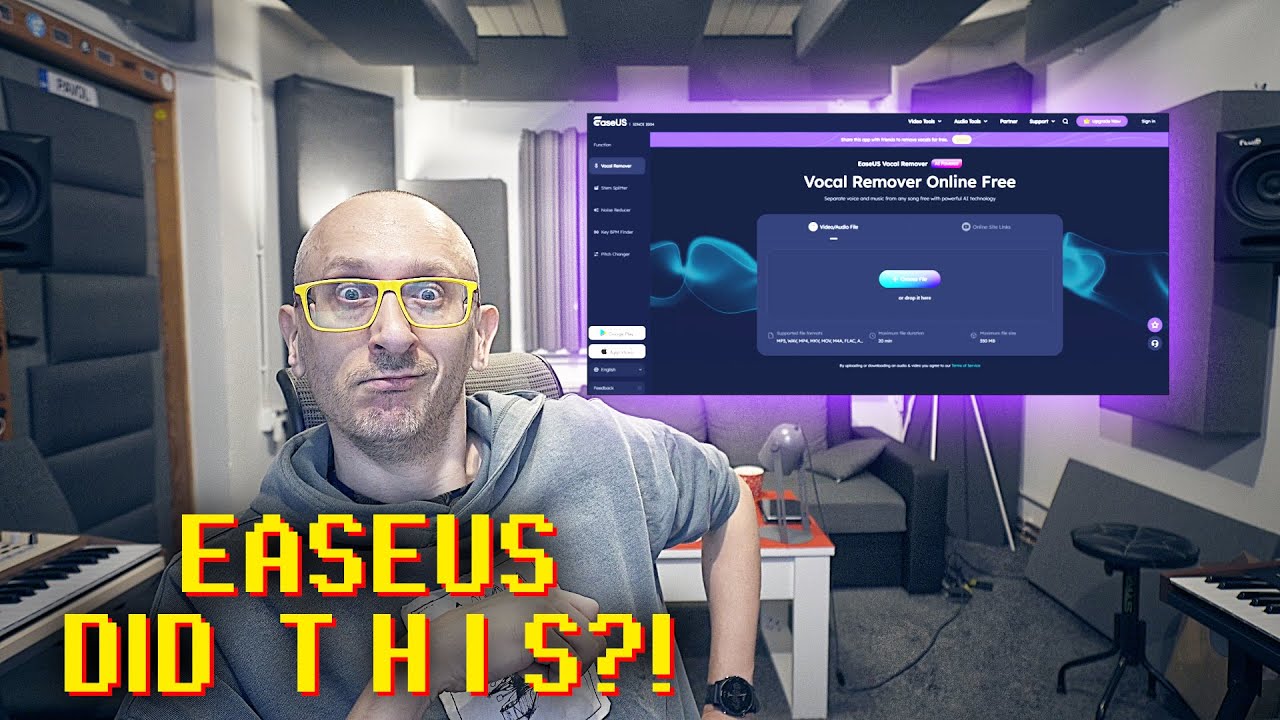
In this video, Paul from his studio in Warsaw, Poland, shares his surprising experience with EaseUS, a company traditionally known for data recovery software, which has recently ventured into the audio software market. He introduces EaseUS’s new audio suite, which includes tools like a vocal remover, stem splitter, AI mastering, and other audio processing features. Paul was initially skeptical about the quality of an audio product from a non-audio company but decided to test it out, intrigued by the potential.
Paul demonstrates the EaseUS vocal remover and stem splitter, highlighting the fast cloud-based AI processing that delivers results quickly compared to other software like Spectral Layers 12. He tests the software on various tracks and is impressed by its ability to detect and separate vocals and instrumentals, even in complex audio with abstract vocal elements. The vocal remover shows minimal leakage and good separation quality, which Paul finds noteworthy for a product from a company outside the traditional audio industry.
To further evaluate EaseUS’s capabilities, Paul purchases the pro version and compares it directly with Spectral Layers 12, a well-known and respected stem separation tool. Through detailed listening tests on two different tracks, he finds that EaseUS often matches or even surpasses Spectral Layers in certain aspects, such as cleaner bass separation and better handling of drums with perfect transients. Although not flawless, EaseUS’s stem separation is highly effective and practical for professional use.
Paul also notes the user-friendly features of the EaseUS suite, including key and BPM detection, options to enhance vocals or instrumentals, and the ability to download stems in MP3 or WAV formats. He appreciates the affordability and speed of the web-based service, emphasizing that it offers a solid solution for both casual users and professionals. Paul expresses hope that EaseUS will develop their tools into VST or AU plugins for integration into digital audio workstations, which would expand their appeal to professional audio engineers and producers.
In conclusion, Paul redefines his perception of EaseUS, now considering them a serious player in the audio software market. He praises their professional approach, quality of stem separation, and the potential their technology holds for the future. He encourages viewers to try EaseUS’s audio suite and compare it with their current tools, recommending it as a valuable addition to the audio production toolkit. Paul ends by inviting comments and feedback from his audience, eager to hear their thoughts on this unexpected but impressive product.