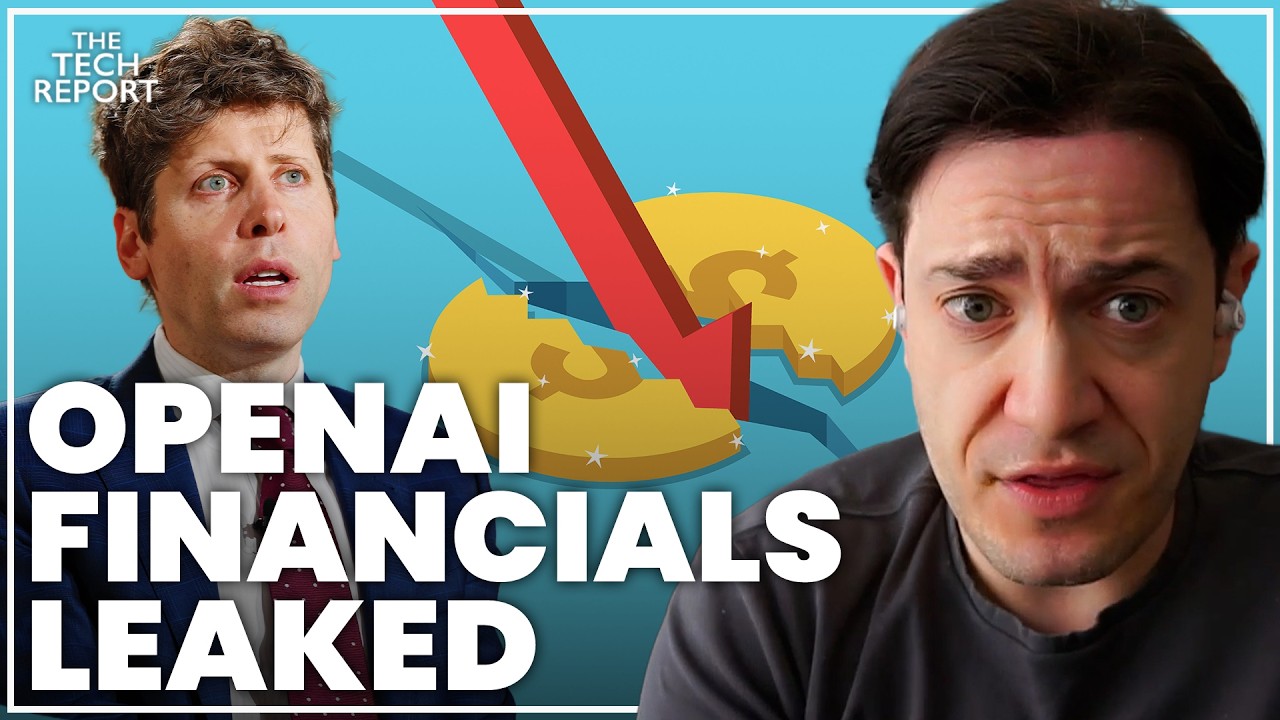
Ed Zitron provides a critical analysis of OpenAI’s recently leaked financials, revealing troubling signs about the company’s profitability and accounting practices. Despite generating $13.07 billion in revenue, OpenAI is projected to lose $38.5 billion in 2025, with a significant portion of these losses stemming from complex accounting maneuvers involving non-controlling interests. Zitron highlights that even excluding research and development costs, OpenAI continues to operate at a substantial loss, debunking the myth that removing R&D expenses would render the company profitable. He suggests that OpenAI’s costs increase linearly with revenue, a pattern common across AI labs, indicating a fundamental issue with the business model.
The discussion delves into the opaque nature of OpenAI’s accounting, particularly the large losses attributed to non-controlling interests and the conversion from nonprofit to for-profit status. Zitron points out that these accounting practices obscure the true financial health of the company, with some costs seemingly shifted to external entities to mask the scale of losses. This lack of transparency raises concerns about the credibility of OpenAI’s financial reporting, especially as the company prepares for an IPO. Zitron predicts that the IPO filings may reveal even more complex financial arrangements, but the underlying losses will be difficult to hide.
Zitron also critiques OpenAI’s sales and marketing expenses, which are unusually high—surpassing those of major corporations like Coca-Cola—despite the company’s limited traditional advertising efforts. He theorizes that OpenAI may be categorizing inference costs and free credits given to startups as sales and marketing expenses to manipulate financial appearances. This strategy, combined with token-based billing that customers find prohibitively expensive, has led to customer pushback and forced OpenAI to consider price cuts, despite already operating at a loss. Zitron argues that these price cuts may not be sustainable given the high operational costs.
The conversation shifts to the broader AI market, where OpenAI’s market share has dropped below 50% for the first time, challenged by competitors like Anthropic and open-source models. Zitron notes that the AI industry is becoming commoditized, with little differentiation between products, leading to a race to the bottom in pricing and profitability. He expresses skepticism about the long-term viability of current AI business models, emphasizing that after four years and over a trillion dollars spent, the industry still struggles to demonstrate clear return on investment. This uncertainty is compounded by the lack of compelling use cases outside software development and the difficulty in measuring AI’s ROI.
Finally, Zitron discusses the potential impact of open-source AI models and the financial pressures facing AI companies. He suggests that if major players like Microsoft fully embrace open-source models, it could disrupt the market by offering cheaper alternatives, further challenging companies like OpenAI and Anthropic. Zitron warns that the AI industry is in a precarious position, reliant on continued investor confidence and escalating compute commitments that may be unrealistic. Without a clear path to profitability or a breakthrough product that justifies high costs, the future of leading AI companies appears uncertain and fraught with financial risk.