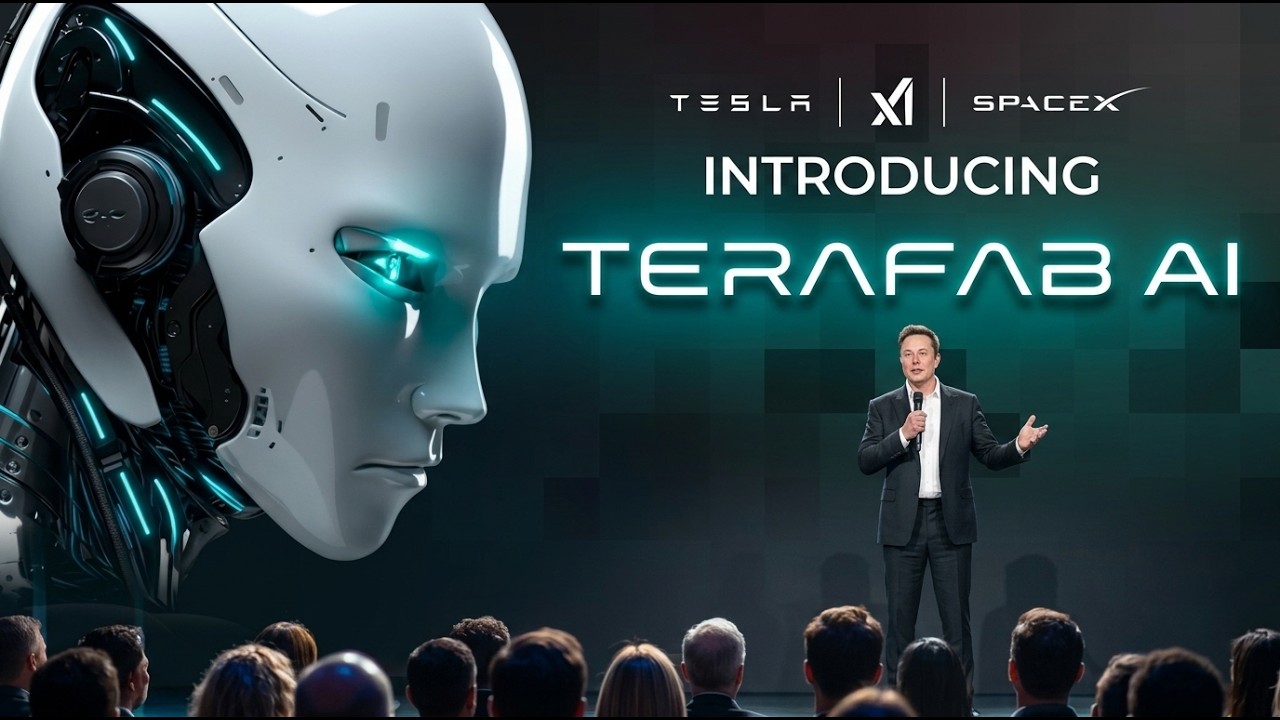
In this visionary talk, Elon Musk outlines an ambitious future where humanity evolves into a galactic civilization, expanding beyond Earth to colonize the solar system and eventually other star systems. He emphasizes the importance of harnessing vast amounts of energy, particularly solar power, to scale civilization’s capabilities. Musk references the Kardashev scale, noting that humanity is still far from becoming a Type 1 civilization, which fully utilizes the energy of its home planet. To achieve this, he stresses the need to capture and use the immense energy of the sun, which dwarfs all other energy sources in the solar system.
Central to this vision is the development of the “Terafab” project, a massive semiconductor fabrication facility designed to produce a terawatt of compute power per year. Musk explains that current global AI compute capacity is only about 20 gigawatts per year, far short of what is needed for future AI and robotics applications. The Terafab will integrate advanced chip manufacturing, including logic, memory, packaging, and lithography mask production, all within a single facility to enable rapid iterative improvements. This approach aims to push the boundaries of computing physics and create chips optimized for both terrestrial and space environments.
Musk highlights the synergy between SpaceX, Tesla, and XAI in realizing this future. SpaceX’s Starship rocket is critical for transporting massive payloads to orbit, enabling the deployment of large-scale solar power and compute infrastructure in space. Tesla’s advancements in electric vehicles, robotics (Optimus), and global charging networks demonstrate the potential for mass production of humanoid robots, which Musk predicts will outnumber cars by a significant margin. XAI’s rapid development of gigawatt-scale compute clusters further supports the scaling of AI capabilities.
A key insight Musk shares is the advantage of deploying AI compute infrastructure in space rather than on Earth. Space offers continuous, abundant solar energy without atmospheric attenuation or weather-related issues, making it more cost-effective and scalable over time. He envisions future satellites with megawatt-scale power and discusses the potential for lunar mass drivers to launch payloads cheaply into deep space, enabling compute power to reach petawatt levels. This expansion beyond Earth’s constraints is essential for achieving the grand scale of energy and computation required for a galactic civilization.
Ultimately, Musk envisions a future of incredible abundance enabled by AI, robotics, and sustainable space-based energy. He imagines a society where material needs are effortlessly met, money becomes obsolete, and experiences like trips to Saturn are accessible to all. Drawing inspiration from science fiction authors like Iain Banks, Musk sees this as the best possible future—one where humanity thrives as a multiplanetary species with limitless opportunities for exploration, innovation, and prosperity.