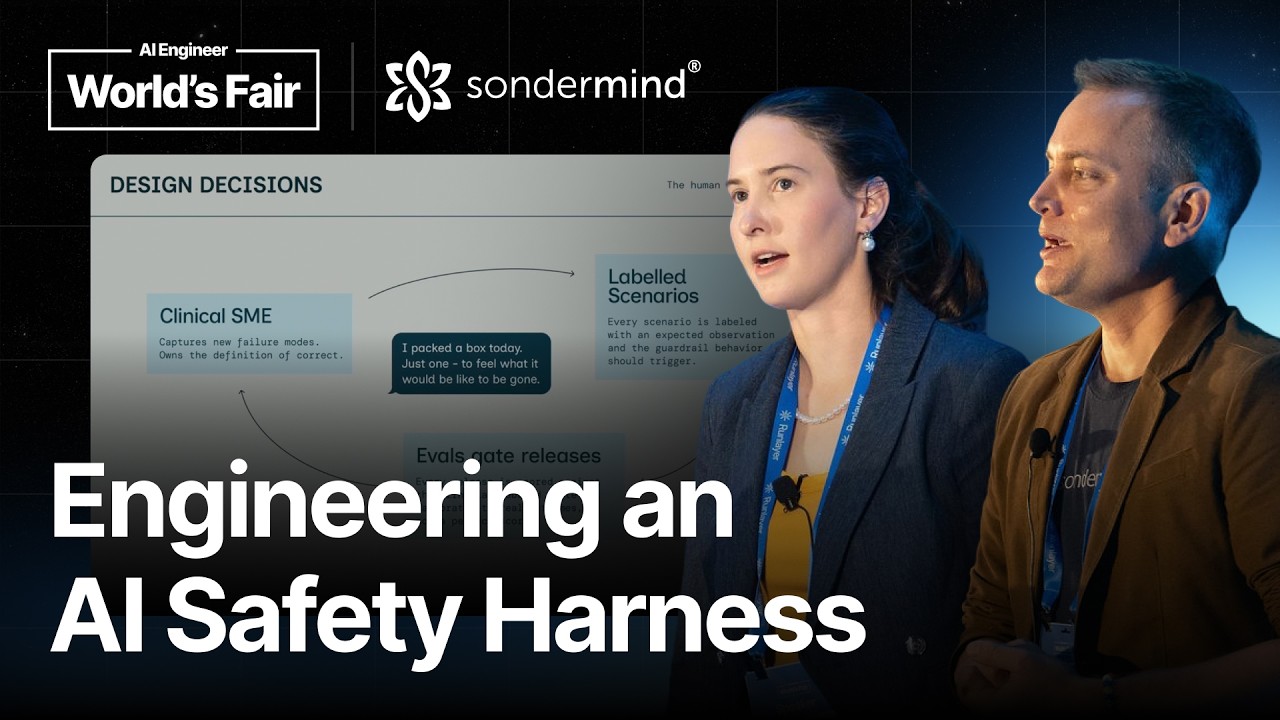
Akele Reed and Dave Revere from SonderMind presented Sonder, a mental health AI coach designed with modular safety guardrails and a human-in-the-loop system involving licensed clinicians to ensure ethical, clinically informed support and crisis intervention. They emphasized balancing sensitivity to protect users without alienation, shared open-source guardrail datasets, and highlighted the importance of specialized, clinically grounded AI safety mechanisms tailored for mental health applications.
Akele Reed and Dave Revere from SonderMind presented on engineering a mental health AI coach named Sonder, designed to provide ethical and safe mental health support. SonderMind is a mental health care company that connects individuals with therapists and psychiatrists nationwide, aiming to improve access and outcomes in mental health care. Sonder is a conversational AI with voice capabilities, built specifically for mental health support, intended to assist users who may not yet be ready for therapy or need support between sessions. It also serves as a gateway to human providers when necessary, addressing a significant gap as many people already use AI for mental health support but general-purpose large language models (LLMs) are not designed for this sensitive domain.
The technical foundation of Sonder includes a modular system of input and output guardrails that monitor user messages and AI responses to ensure clinical safety. These guardrails act as safety nets, intervening when conversations risk user safety, such as in crisis situations. The modularity allows for iterative improvements without compromising safety, and separating the guardrails into distinct LLMs makes them more robust against attempts to bypass them. The architecture also includes analytics and alerting systems to monitor performance and safety continuously, reflecting the team’s prioritization of user safety in every design decision.
A key challenge discussed was the nuanced nature of mental health communication, where users may express distress indirectly or ambiguously. Dave emphasized that simple keyword detection or broad moderation tools are insufficient to capture the clinical subtleties needed to identify risk accurately. Instead, SonderMind employs a learning loop where licensed clinicians review flagged conversations, annotate them with detailed rubrics, and provide expert judgments that inform ongoing system calibration. This human-in-the-loop approach ensures that the AI’s safety mechanisms evolve based on real clinical expertise and real-world data, rather than relying solely on automated or heuristic methods.
The team highlighted the importance of balancing false positives and false negatives in the guardrails to avoid alienating users or missing critical safety issues. Overly sensitive systems can discourage vulnerable users by prematurely shutting down conversations, while under-sensitive systems risk failing to intervene when necessary. SonderMind’s approach centers on clinical judgment to define what constitutes appropriate intervention, using labeled scenarios and rigorous evaluation to gate system updates. Their goal is not perfection but practical benchmarks that protect users effectively while maintaining engagement and trust.
Finally, SonderMind has open-sourced their guardrail datasets, including 200 input and 100 output scenarios, all clinically reviewed to support others building safe mental health AI systems. They encourage the community to use these resources to create their own clinically grounded learning loops, emphasizing that safety must be a shared priority in this rapidly evolving field. The presentation concluded with a Q&A addressing technical questions about model calibration and the challenges of working with general-purpose LLMs, underscoring the need to disable default guardrails and build specialized ones tailored to mental health contexts.