Sam Bhagwat, co-founder and CEO of Mastra, delivered a forward-looking talk titled “Every Harness Will Become a Claw,” focusing on the evolution of AI agents and frameworks. He began by introducing the concept of the “harness era,” describing harnesses as frameworks or systems that manage AI agents. These harnesses exist in various forms today: local harnesses used daily by developers, cloud harnesses that operate in distributed environments, and open-source frameworks that provide tools for building custom agents. Sam positioned Mastra within this landscape as a TypeScript agent framework designed to empower developers.
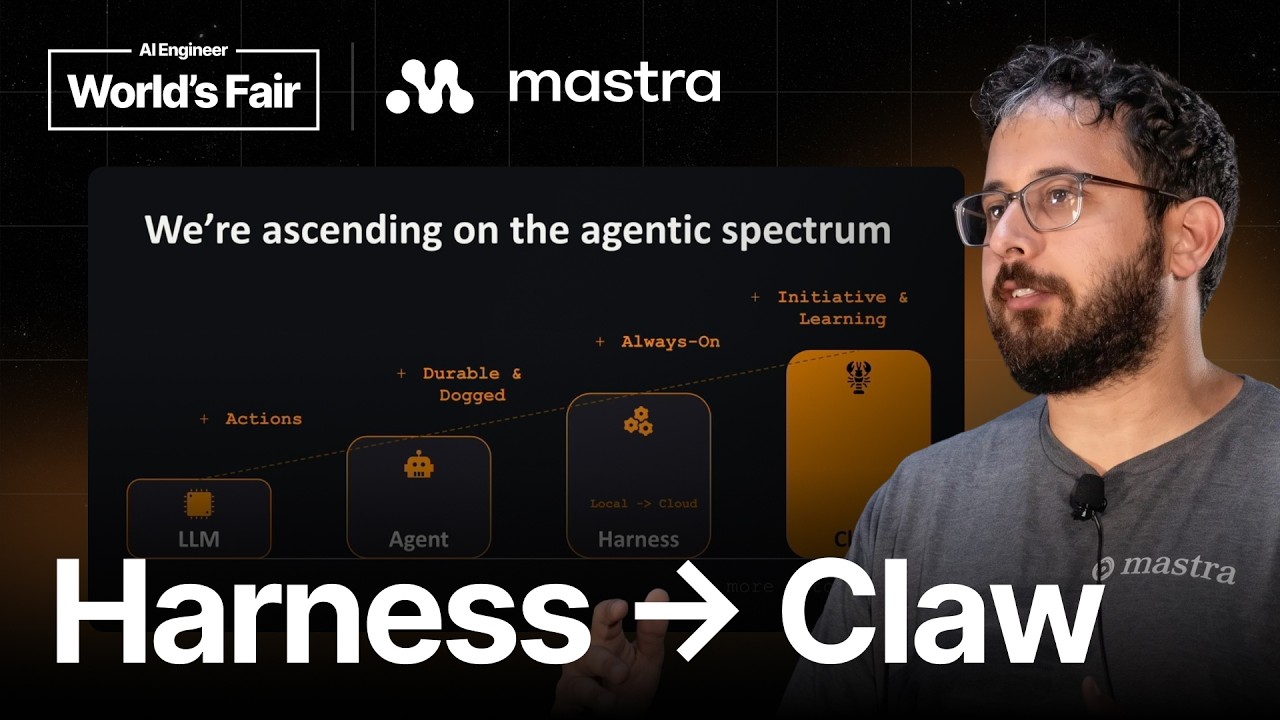
He then explored the progression of AI agents over the past 18 months, emphasizing the agentic spectrum—a continuum from simple language models (LLMs) to more complex agents, harnesses, and ultimately claws. Agents differ from LLMs by incorporating features like tool calls, memory, retry mechanisms, and context engineering. Harnesses add durability and persistence, enabling agents to run continuously, manage parallel tasks, and maintain session states. Cloud harnesses, which are always on and can handle multiple users and tasks simultaneously, represent a significant step forward, offering scalability and integration with platforms like Slack and mobile apps.
The next phase, according to Sam, is the transition from harnesses to claws. Claws are agents imbued with initiative and learning capabilities—they proactively monitor external inputs, wake up periodically to perform tasks, and continuously improve through learning and skill generation. This evolution involves more sophisticated memory management, persistent state, and the ability to modify their own code. While the industry is still exploring the best approaches to implement these features, Sam sees claws as the future of AI agents, combining power with control.
Sam introduced “Steinberger’s law,” his observation that every harness will inevitably expand until it becomes a claw. This expansion is driven by user demand for more interactive, persistent, and capable agents that can operate across multiple channels and contexts. However, he also predicted an upcoming market shakeout similar to the mobile app ecosystem of the 2010s, where only a few dominant players survive due to limited user attention and economic value. He highlighted that users only have mental bandwidth for a small number of highly valuable or frequently used agents, implying that many harnesses will consolidate or disappear over time.
In conclusion, Sam advised developers and organizations to stay informed about rapid changes in AI agent technology and to build agents with the capabilities users truly need. He cautioned that even if one achieves early success, the landscape will continue to evolve, requiring ongoing adaptation. Sam wrapped up by inviting attendees to engage with Mastra and his book, “Principles of Building AI Agents,” emphasizing the importance of community and continuous learning in this fast-moving field.