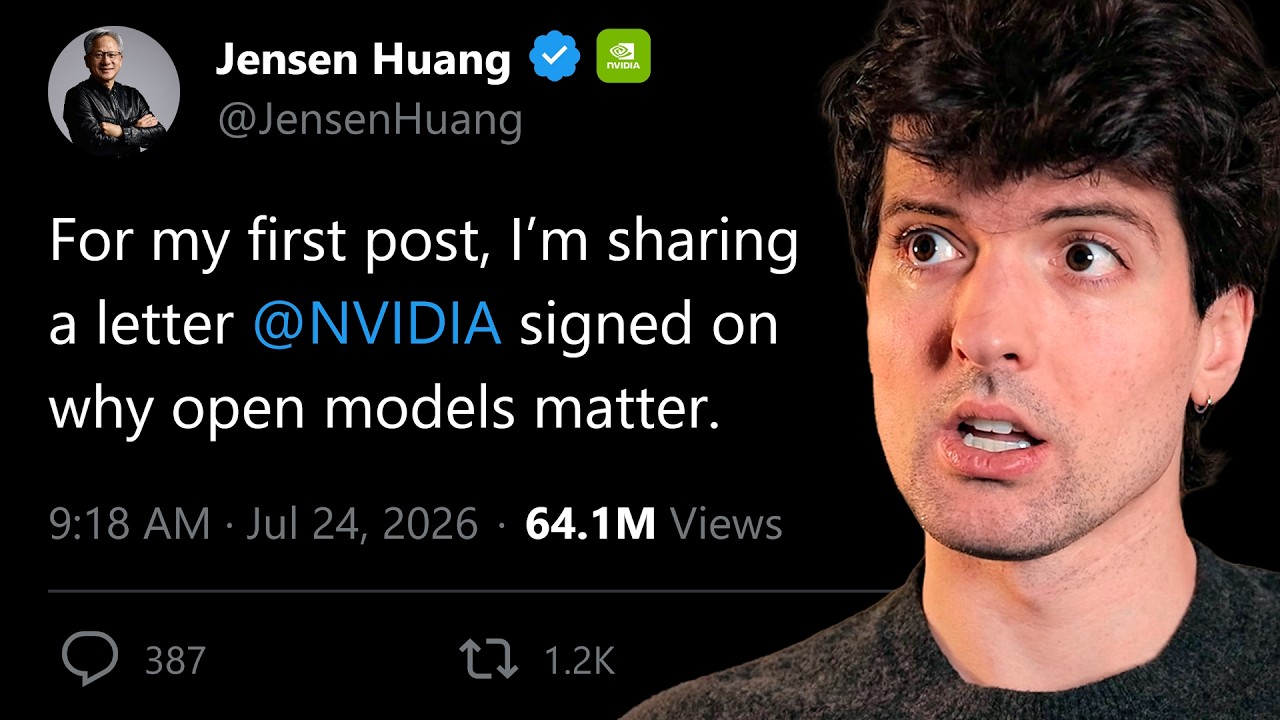
The video highlights a recent controversy in the AI industry where many major players signed a letter advocating for open access to AI models, but Anthropic notably abstained, prompting criticism from Nvidia CEO Jensen Huang. This situation underscores the ongoing tension between promoting openness to foster innovation and exercising caution due to security and geopolitical concerns, reflecting broader debates about the future governance of AI.
The video discusses a recent development in the AI industry where a significant letter advocating for open access to AI models was signed by many major players, but notably, Anthropic was absent from the list. This absence has sparked controversy, particularly drawing the ire of Jensen Huang, the CEO of Nvidia. Jensen made his first-ever Twitter post specifically to call out Anthropic for not joining the collective stance on open AI models.
OpenAI, a key player in the AI field, is among those who signed the letter, emphasizing the importance of maintaining open weights and expanded access to the AI economy. The letter advocates for keeping AI development pluralistic by avoiding premature restrictions on open models, which could otherwise stifle competition or push innovation overseas. This collective effort highlights a shared concern about the future direction of AI development and the need for collaboration and openness.
Anthropic’s decision not to sign the letter is particularly striking given the industry’s current emphasis on openness. However, it is noted that Anthropic has never explicitly advocated for a ban on open-weight models. Their stance appears more nuanced, possibly influenced by secondary concerns, including geopolitical issues such as the role of the Chinese Communist Party in AI development and security.
The tension between Anthropic and other AI leaders like Jensen Huang underscores the complex dynamics within the AI community. While many companies push for open access to AI technologies to foster innovation and competition, others are more cautious, weighing the risks associated with unrestricted AI proliferation. This divergence in approach reflects broader debates about balancing innovation, security, and ethical considerations in AI development.
Overall, the video highlights a significant moment in the AI industry where differing philosophies about openness and control are coming to the forefront. The absence of Anthropic from the letter signals potential rifts and challenges in achieving a unified approach to AI governance. As the AI landscape continues to evolve rapidly, these discussions will likely shape the future trajectory of AI technology and its global impact.