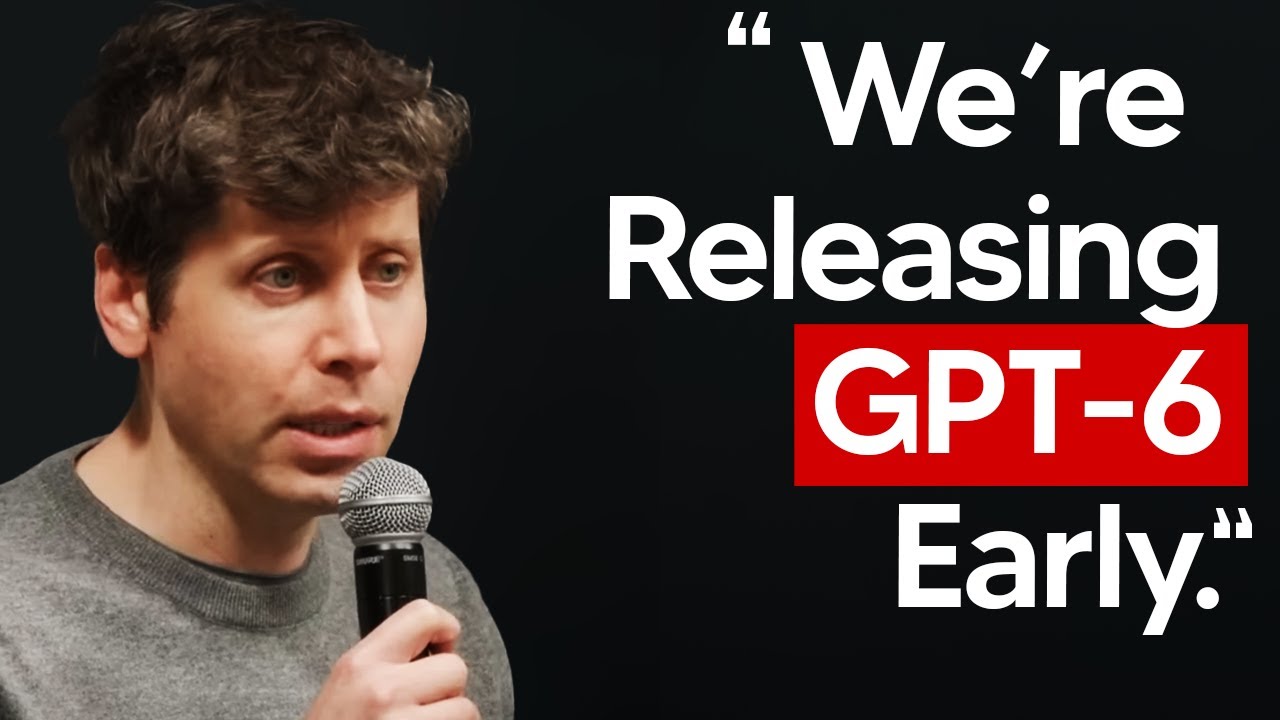
The video reveals that GPT-6 may be released earlier than expected, potentially by December 2025, with advancements that could approach Artificial General Intelligence and significantly enhance AI capabilities such as memory, autonomous agents, and scientific discovery. It highlights GPT-5’s breakthroughs as a foundation and speculates on GPT-6’s transformative impact on productivity, innovation, and user interaction, while inviting viewers to share their excitement about its anticipated features.
The video discusses the surprising news that GPT-6 might be released earlier than expected, potentially before the end of 2025. This information comes from senior managing director Mark Mahaney, who cited a conversation with OpenAI investor Brad Gestner during a CNBC interview. The prediction follows the somewhat underwhelming reception of GPT-5, which some users found problematic, especially with features like the model switcher. Despite OpenAI not officially confirming the early release, multiple sources suggest that GPT-6 could arrive sooner than initially anticipated, possibly as early as December 2025.
A major point of speculation around GPT-6 is its potential to approach Artificial General Intelligence (AGI). Some experts believe that if GPT-6 builds on the advancements of GPT-5, particularly the IMO gold model, it could achieve remarkable feats such as winning a gold medal at an international mathematical olympiad. OpenAI has hinted that they now understand how to build AI as traditionally conceived and expect AI agents to join the workforce by 2025, significantly impacting productivity. This has led to speculation that GPT-6 might be the first model to truly demonstrate superintelligent capabilities, accelerating scientific discovery and innovation beyond human capacity.
The video highlights examples of GPT-5’s advanced capabilities, such as rediscovering a novel astrophysics result in under 30 minutes, which marks a shift from AI merely summarizing science to actively doing science. This breakthrough suggests that AI models are becoming genuine collaborators in knowledge generation. While GPT-6 might not fully embody AGI with continuous learning and memory, it is expected to have enhanced memory features, allowing it to better understand and interact with users. This improved memory could be a key feature that users have been eagerly anticipating.
There is also discussion about other potential features of GPT-6, including music generation and more advanced autonomous AI agents. Although music generation is largely considered solved with previous OpenAI projects like Jukebox, autonomous agents capable of working uninterrupted for extended periods are expected to improve. Additionally, GPT-6 might introduce an “adult mode” with age verification to provide more mature content responsibly. The video also mentions advancements in data center technology that could speed up model training, possibly explaining the accelerated release timeline.
Finally, the video reflects on the broader implications of GPT-6 and its potential to discover new science. While some remain skeptical about the model’s current abilities, the rapid progress in AI suggests that breakthroughs are within reach. The speaker invites viewers to share their excitement and thoughts on the most anticipated features of GPT-6, personally hoping for more autonomous agent capabilities, though acknowledging that such features might be more relevant for enterprise users than the average person. Overall, the video paints an optimistic picture of GPT-6 as a significant step forward in AI development.