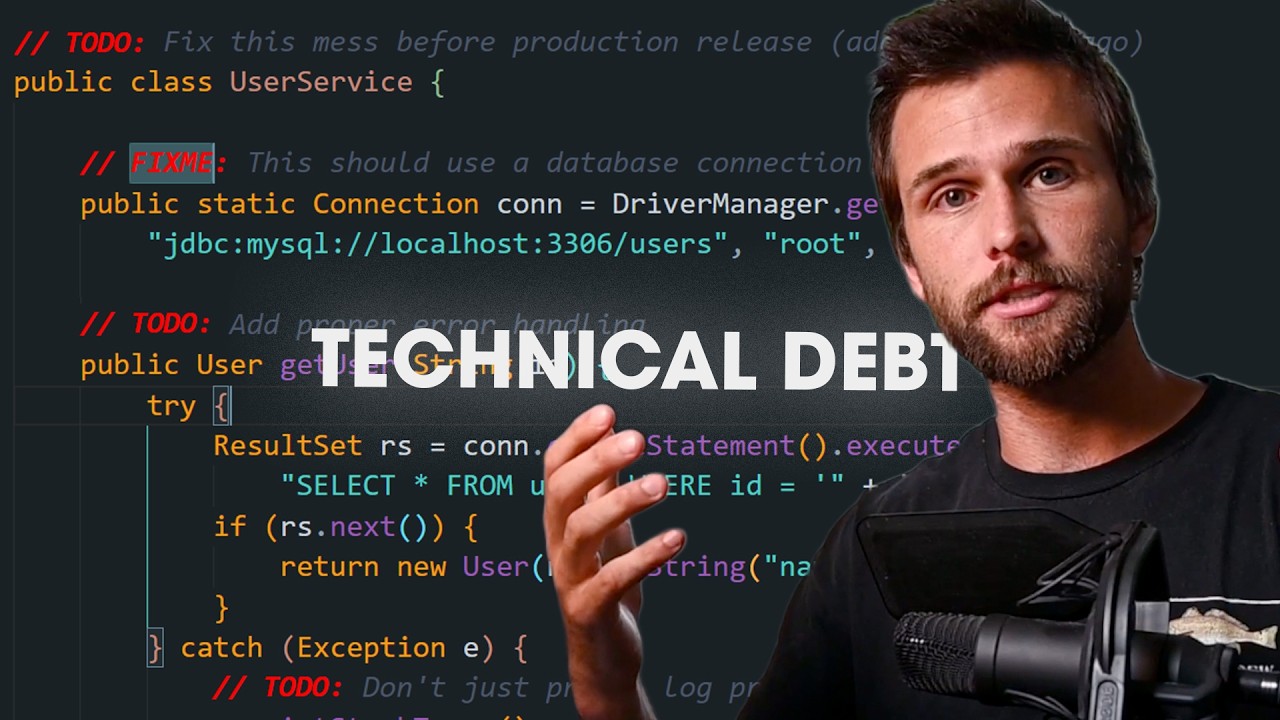
The video provides a comprehensive overview of technical debt, explaining that it arises when developers take shortcuts to speed up delivery, knowing it will slow them down later. Technical debt is categorized into four types based on Martin Fowler’s framework: deliberate and prudent (strategic decisions to ship now), deliberate and reckless (rushed, poor design choices), inadvertent and prudent (learning and improving after the fact), and inadvertent and reckless (lack of skill or awareness). The analogy of technical debt to financial debt is used to illustrate how it accumulates interest, meaning the extra time spent dealing with problematic code slows down development over time.
Statistics reveal that teams spend between 23% and 42% of their time managing technical debt, which similarly reduces development velocity. To handle this, many teams adopt the 80/20 rule, dedicating 20% of their sprint time to addressing technical debt while spending 80% on new features. Some companies, like Shopify, allocate even more time, breaking it down into daily, weekly, and monthly efforts to integrate debt management into their culture. Other approaches include dedicating entire sprints to technical debt cleanup every 6-8 weeks, balancing feature development with maintenance.
Preventing technical debt is emphasized through practices like test-driven development (TDD), pair programming, and automated quality checks via CI/CD pipelines. These methods help ensure cleaner code enters the system, reducing future debt. The video also highlights the importance of design patterns and the Boy Scout rule—leaving code cleaner than you found it—to maintain code quality incrementally. The red-green-refactor cycle in TDD is presented as a disciplined approach to writing and improving code continuously.
Measuring technical debt is crucial, with tools like SonarQube providing metrics such as the technical debt ratio, cyclomatic complexity, test coverage, lead time, and code churn. These metrics help teams identify hotspots and prioritize debt reduction efforts based on impact, fix cost, and spread. The video introduces models like the PAID framework (Performance, Architectural importance, Integration complexity, Dependency) to guide prioritization. It stresses that not all debt should be eliminated; instead, teams should focus on the most impactful areas to maintain development velocity.
Finally, the video outlines a phased roadmap for managing technical debt: first, measure and establish baseline metrics; second, tackle low-hanging fruit while implementing prevention practices; and third, adopt a consistent allocation framework for ongoing debt management. Communication with stakeholders using clear data and impact statements is encouraged to secure support. The key takeaway is that technical debt is inevitable, but disciplined, conscious management allows teams to balance speed and quality, preventing debt from sabotaging progress while enabling sustainable development.