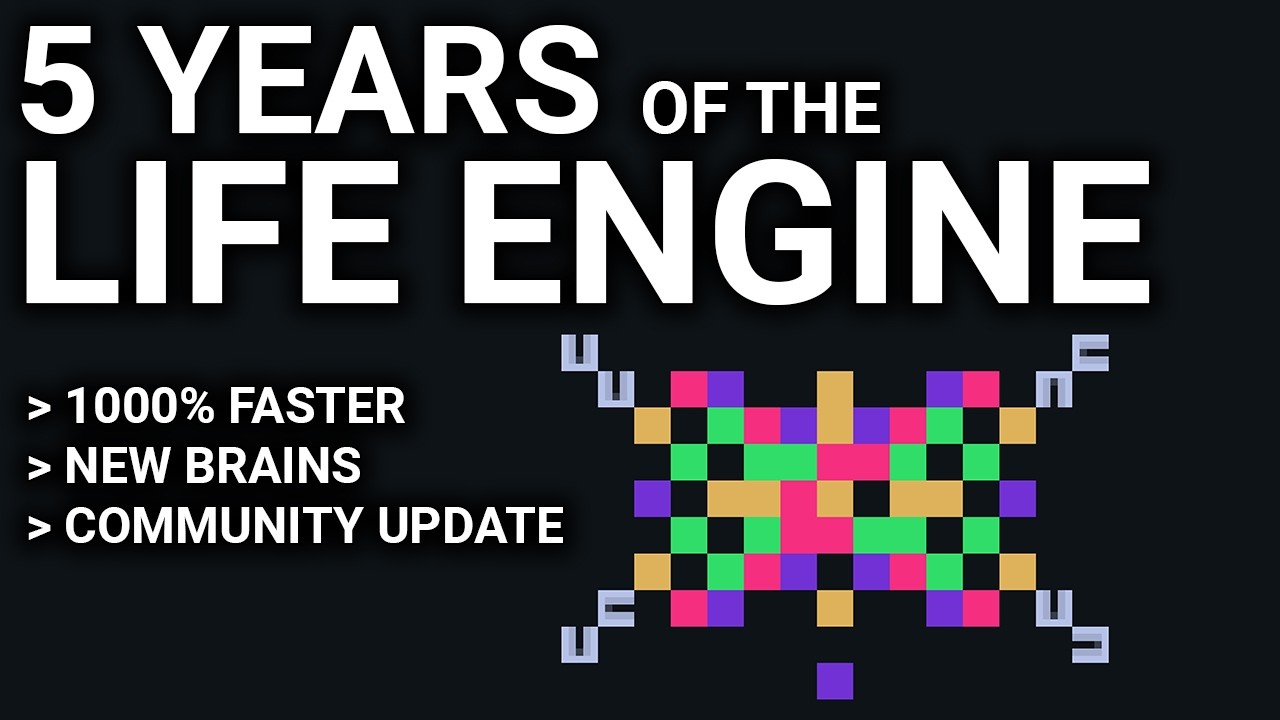
The video celebrates the 5-year anniversary of the Life Engine, a free-to-play evolution simulator created by the presenter. The Life Engine simulates organisms living on a grid, composed of various colored cells with different functions such as food production, movement, attack, defense, and vision. Organisms eat, reproduce, and mutate, with natural selection favoring those better adapted to survive. The presenter introduces a major update featuring significantly faster simulation speeds, more complex brain systems for organisms, new evolution controls, and additional color schemes, including a nostalgic return to the original palette.
The presenter shares the backstory of the Life Engine, tracing its origins back to a high school inspiration sparked by observing shrimp at an aquarium. This moment led to the realization that evolution is an algorithmic process that can be simulated. The initial prototype dates back to 2015, five years before the first YouTube video introducing the Life Engine in 2020. The project began as a college summer project during the COVID lockdowns and helped the creator secure jobs, highlighting the importance of coding skills in bringing such simulations to life.
A significant technical improvement in the update is the implementation of “update packing,” a JavaScript-specific optimization that allows the simulation to run many steps during downtime between rendering frames. This results in a speed increase of up to 10 times under certain conditions, making the simulation much more efficient without sacrificing accuracy. The presenter explains the challenges of JavaScript timing and how this hack maximizes performance while avoiding browser crashes.
The new brain system for organisms is inspired by state machines, allowing for multiple brain states and more complex behaviors such as diagonal movement and mode switching between hunting and fleeing. Unlike neural networks, this system is computationally cheap, backwards compatible, and easier to understand and program. Although neural networks could offer more complexity, the presenter chose not to implement them due to their computational cost and complexity. The update also introduces new evolutionary features like symmetrical mutations and species-specific immunity to killer cells, encouraging more diverse and cooperative behaviors.
Finally, the presenter reflects on the future of the Life Engine, indicating that it will be put on hold for now as other projects, especially Minecraft-related content, take priority. Despite some burnout and lower performance of recent Minecraft videos, there are plans to return with new developments and multiplayer servers. The presenter also shares community art and expresses enthusiasm for continuing to engage with fans. Overall, the update marks a milestone in the Life Engine’s development and celebrates the ongoing journey of creating unique and evolving simulations.