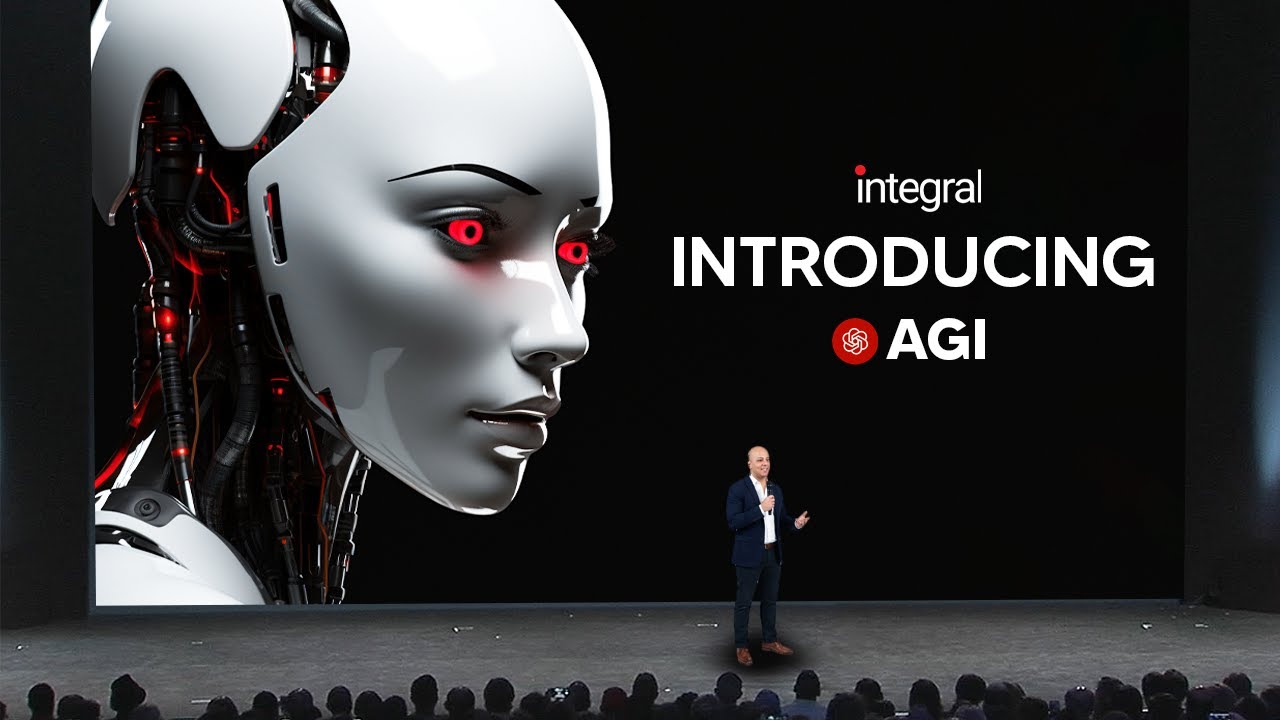
The video discusses a bold claim made by Jad Tafari, an ex-Google AI expert and CEO of Integral AI, who asserts that his company has developed the world’s first AGI-capable system. Tafari, who previously worked on Google’s early generative AI teams, now focuses on building artificial general intelligence (AGI) through a new approach emphasizing freedom-based AI and efficient world modeling. Despite the significance of this claim, the announcement has surprisingly low visibility on social media, raising questions about its reception and credibility within the AI community.
Integral AI defines AGI with three core criteria: autonomous skill learning without relying on pre-existing datasets or human intervention, safe and reliable mastery without catastrophic failures, and energy efficiency comparable to human learning. These criteria highlight the importance of a system that can independently learn new skills, operate safely in real-world scenarios, and do so with energy efficiency similar to the human brain. The company criticizes current AI models for functioning as black boxes that rely heavily on memorization and brute-force optimization, leading to inefficiency and brittleness in novel situations.
Integral AI’s approach involves a paradigm shift through what they call “universal simulators,” which create explicit hierarchical abstractions mirroring the human neocortex. Their system integrates multimodal data (vision, language, audio, physical sensors) to build unified world models, compresses sensory data into layered representations for high-level reasoning, and supports scalable growth through lifelong learning without catastrophic forgetting. Demonstrations include a 3D agent navigating environments, an AI mimicking human eye movements to focus on relevant visual patches, and a puzzle-solving experiment showcasing efficient planning and learning over time.
However, the video’s narrator expresses skepticism about the AGI claim due to the lack of peer-reviewed publications, open-source code, or independent verification. Unlike DeepMind’s 2017 work on imaginative agents, which was peer-reviewed and publicly documented, Integral AI’s demonstrations remain unverified and rely on self-defined success metrics. The demos appear low quality relative to the magnitude of the claim, and the company has not engaged with established benchmarks or external validation, which are typically expected for such groundbreaking announcements.
In an interview clip, Tafari elaborates on the architectural, learning method, and alignment breakthroughs underpinning their model. He emphasizes moving beyond prediction-only models to those combining abstraction and prediction, introducing interactive learning that enables efficient planning and continual self-improvement, and ensuring safe operation through alignment techniques. While the architecture and approach seem promising and align with broader scientific efforts, the absence of concrete, independently verified results leaves the claim open to doubt. The video concludes by inviting viewers to consider the information and share their thoughts on this potentially transformative but still unproven development in AGI research.