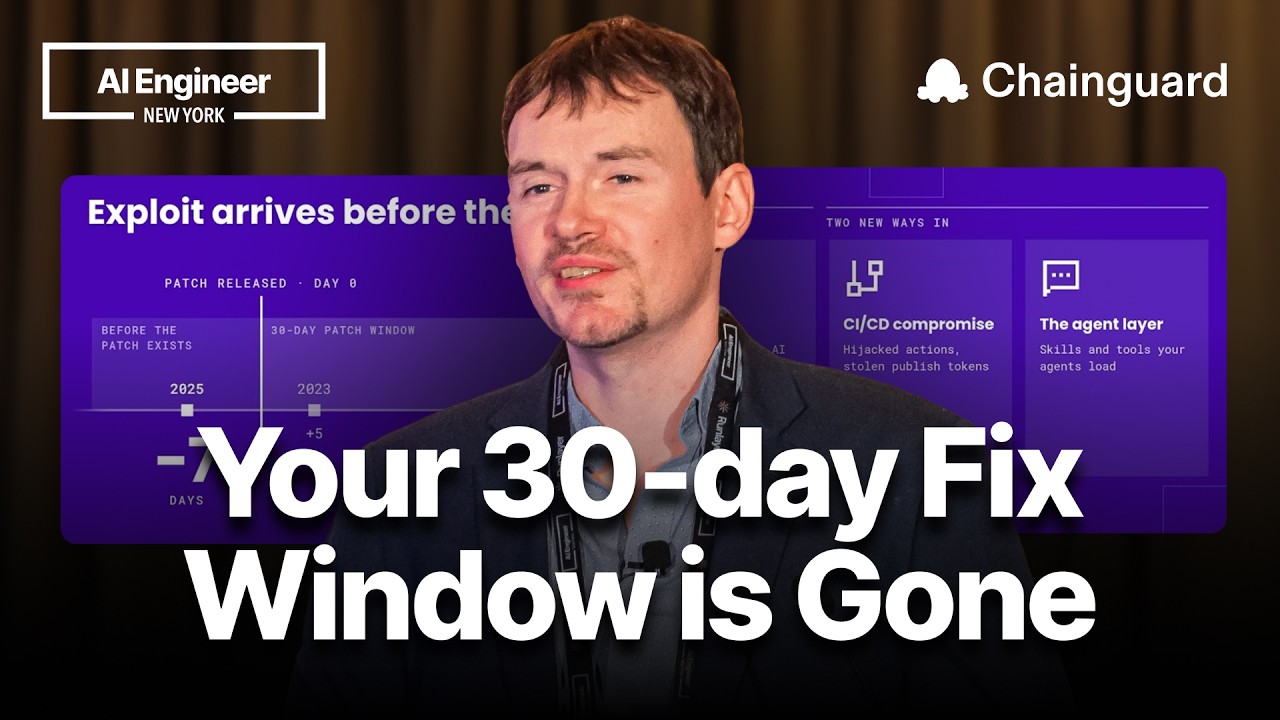
Patrick Smyth from Chainguard discusses how the advent of Frontier AI has drastically shifted the risk landscape for open source software security. He highlights recent alarming incidents, such as a teenager using ChatGPT to orchestrate a large-scale data theft and attackers leveraging cloud technologies to automate and escalate their attacks. Smyth emphasizes that threat actors are becoming increasingly sophisticated, turning what used to be individual efforts into coordinated teams, thereby raising the complexity and frequency of attacks. He points out a critical shift where exploits now often precede patches, with attackers exploiting vulnerabilities before fixes are released, a reversal from previous years.
The presentation delves into the challenges posed by the rapid pace and scale of modern cyberattacks, including malware waves and supply chain attacks that occur almost daily. Smyth references the “Shai Hulud” worm from the JavaScript ecosystem as an example of how attackers are innovating with self-propagating malware. He also discusses the erosion of trust within software communities, likening it to the concept of “eternal September,” where an influx of new, less knowledgeable participants disrupts established norms, leading to a more hostile and less secure environment. This cultural shift exacerbates the difficulties in maintaining secure software supply chains.
Smyth outlines the multifaceted nature of software supply chain security threats, categorizing them into malware, known vulnerabilities, zero-day exploits, and new attack vectors targeting CI/CD pipelines and developer workstations. He stresses the importance of addressing each vector with tailored strategies, such as implementing cooling-off periods for package updates, signing artifacts using tools like Sigstore and Salsa, and enhancing operational security on developer devices. The rise of AI-powered tools capable of discovering and combining vulnerabilities further complicates the zero-day threat landscape, necessitating more proactive and sophisticated defenses.
Chainguard’s approach to these challenges involves building minimal, secure container images with virtually no known vulnerabilities, compiling software from source to avoid compromised repositories, and collaborating with industry consortia to share zero-day intelligence. Smyth introduces their new Linux distribution, Wolfi, designed from the ground up for supply chain security with rapid update cycles and minimal upstream dependencies. He also highlights Chainguard’s efforts to secure CI/CD pipelines through hardened GitHub Actions and refined agent skills, aiming to reduce the attack surface in modern development workflows.
In closing, Smyth urges organizations to take software supply chain security seriously in 2024, emphasizing that the threat environment is more severe than ever. He encourages completing modernization efforts like containerization and CI/CD adoption, adopting zero-trust principles through artifact signing, and investing in operational security. Smyth also promotes upcoming community initiatives, such as the open source finance forum and Chainguard’s presence at industry events, inviting collaboration and knowledge sharing to collectively improve security in the AI era.
Useful Links