The video begins with an introduction to Silicon Dojo, a tech education initiative started in 2009 by the speaker, Eli. The goal of Silicon Dojo is to provide free, hands-on technology education accessible to everyone, removing financial and other barriers. Eli emphasizes the importance of making education authorityless and gatekeeperless, highlighting challenges such as attendance tracking and the difficulty some people face in even paying a small fee due to lack of access to credit cards or bank accounts. The platform is crowdfunded, and while free to users, donations are welcomed to support the initiative. Eli also discusses the global reach of his educational content and the aspiration to create a replicable system that can be used worldwide.
The core of the class focuses on REST APIs and how they extend AI capabilities. Eli explains REST APIs as a standardized way for software to communicate with external services using HTTP requests, typically GET requests with parameters embedded in URLs. He introduces JSON as the common format for API responses, which consists of key-value pairs that software can easily parse. The class covers practical examples such as weather, news, location, and country information APIs, demonstrating how to make requests, handle nested JSON responses, and extract relevant data. Eli stresses the importance of understanding API rate limits, costs, and terms of service, as these factors affect real-world application development.
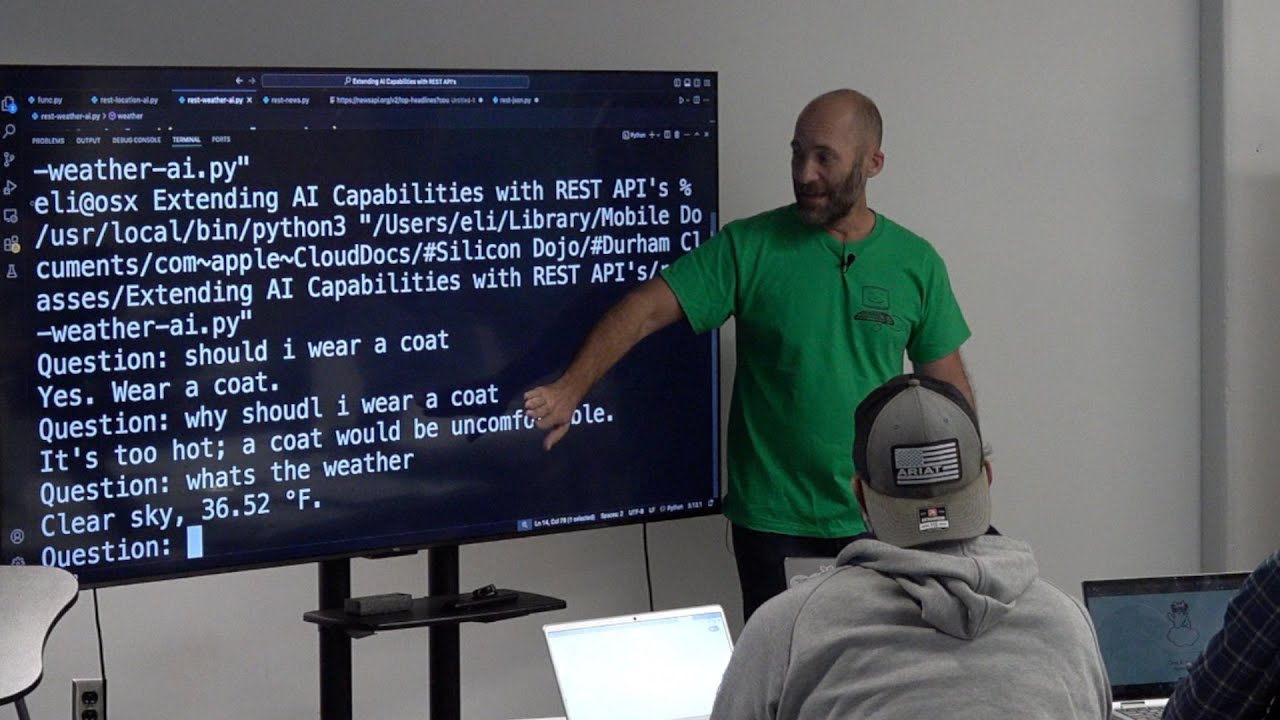
Eli then transitions into integrating AI models with REST APIs, using the Olama framework to run local AI models and OpenAI’s API for cloud-based AI. He demonstrates how to dynamically incorporate user location data obtained from a REST API into AI prompts, enabling personalized responses such as identifying the user’s president or national bird based on their country. The class also explores combining weather data with AI to answer natural language questions like “Should I wear a coat?” Eli highlights the challenges of AI models, including quirks in smaller models like Pi3, the importance of prompt engineering, and the limitations of AI memory, explaining that AI models do not inherently retain context between queries without additional architecture.
Further, Eli discusses advanced AI concepts such as retrieval augmented generation (RAG) and function routing. He explains RAG as a method where AI systems query a vector database of chunked documents to provide more accurate and contextually relevant answers, contrasting it with simpler cache-augmented generation. Function routing is introduced as a technique where an AI model determines which predefined function to call based on user input, allowing for modular and extensible AI applications. Eli demonstrates a system where multiple AI models are stacked to handle different tasks, such as selecting functions and generating human-readable responses, emphasizing that AI is a stack of components rather than a single intelligence.
Towards the end, Eli shares insights on coding with AI, particularly the concept of “vibe coding,” where AI assists in writing code. He cautions that while AI can speed up development, developers must understand and audit the generated code to avoid errors and security risks. Eli reflects on his long experience in technology, stressing that AI tools are force multipliers that make coding easier but do not replace the need for human expertise. The session concludes with practical advice on setting up development environments, choosing AI models, and the importance of continuous learning and practice in technology. Eli also touches on his YouTube content strategy, emphasizing consistent output and authenticity as keys to building an audience.